• Skip to primary navigation
  • Skip to main content

Trail Option

A personal geography of landscape and place, art and geo-science.

  • Home
  • TrailOption Blog
  • About
  • Contact TrailOption
  • Subscribe!
  • Lost Journals
  • Show Search
Hide Search

Mojave Desert

Nevada High Points #119 – Resting Spring Range

D. Craig Young · April 7, 2024 · Leave a Comment


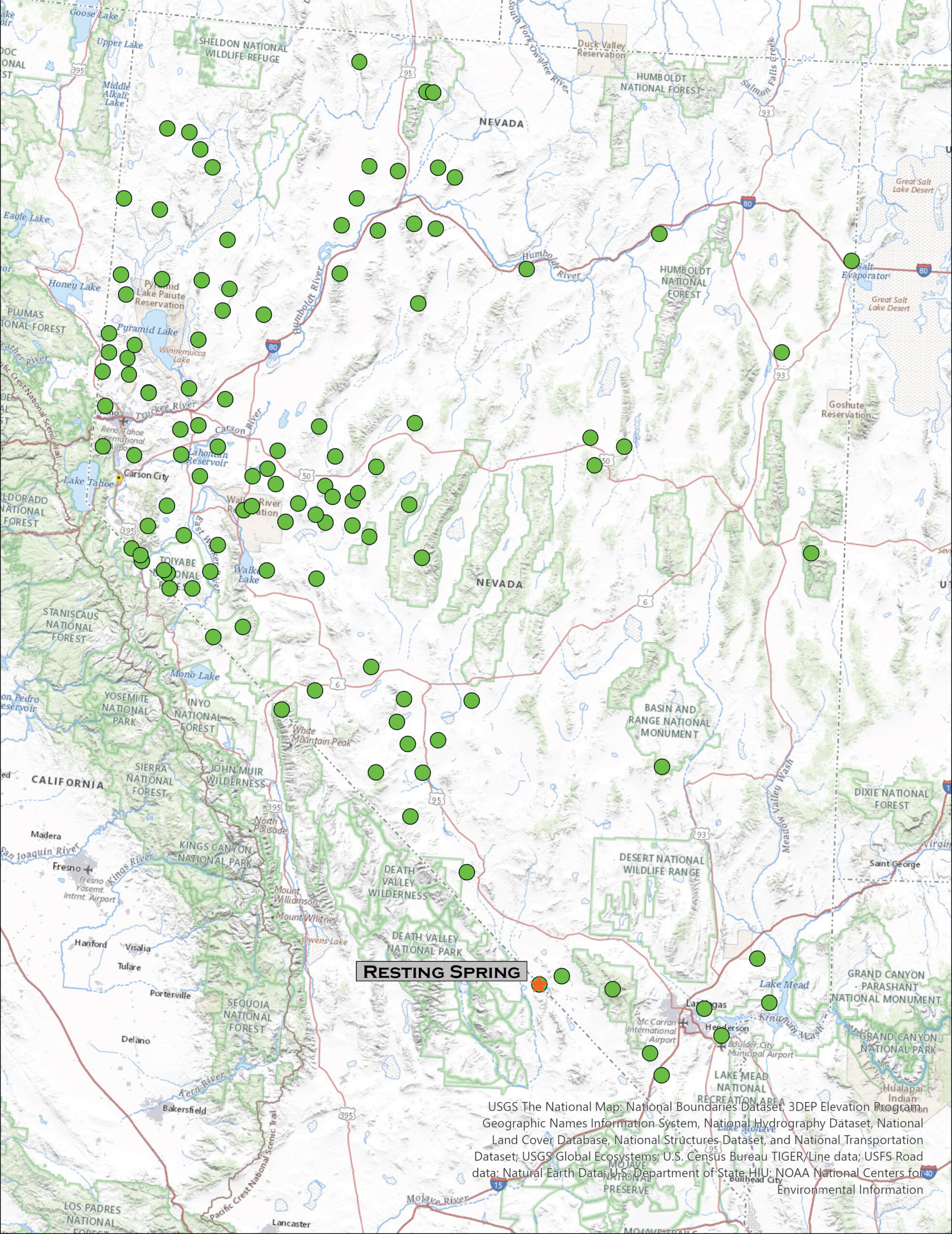
Map showing climbed high points with Resting Spring Range labeled as #119

Unnamed – Border Monument 105

3960 ft (1207 m) – 1530 ft gain

2024.03.10

Resting Spring Collection


I am back in the Mojave. In northern Nevada – in the sagebrush steppe of the Great Basin Desert – the transition to spring has brought a series of atmospheric rivers that vary from warm rains to several inches of new snow. Our water budget appreciates it, and the ski resorts are happy, but it lowers the potential for backcountry travel across the northern tier of the state. But late winter in the Mojave has a very different effect. The precipitation nourishes an ephemeral but amazing green, punctuated by blooms of wildflowers; the typically sharp and prickly landscape softens. Drawn by this ephemeral setting, like last month, I am once again in the Mojave.
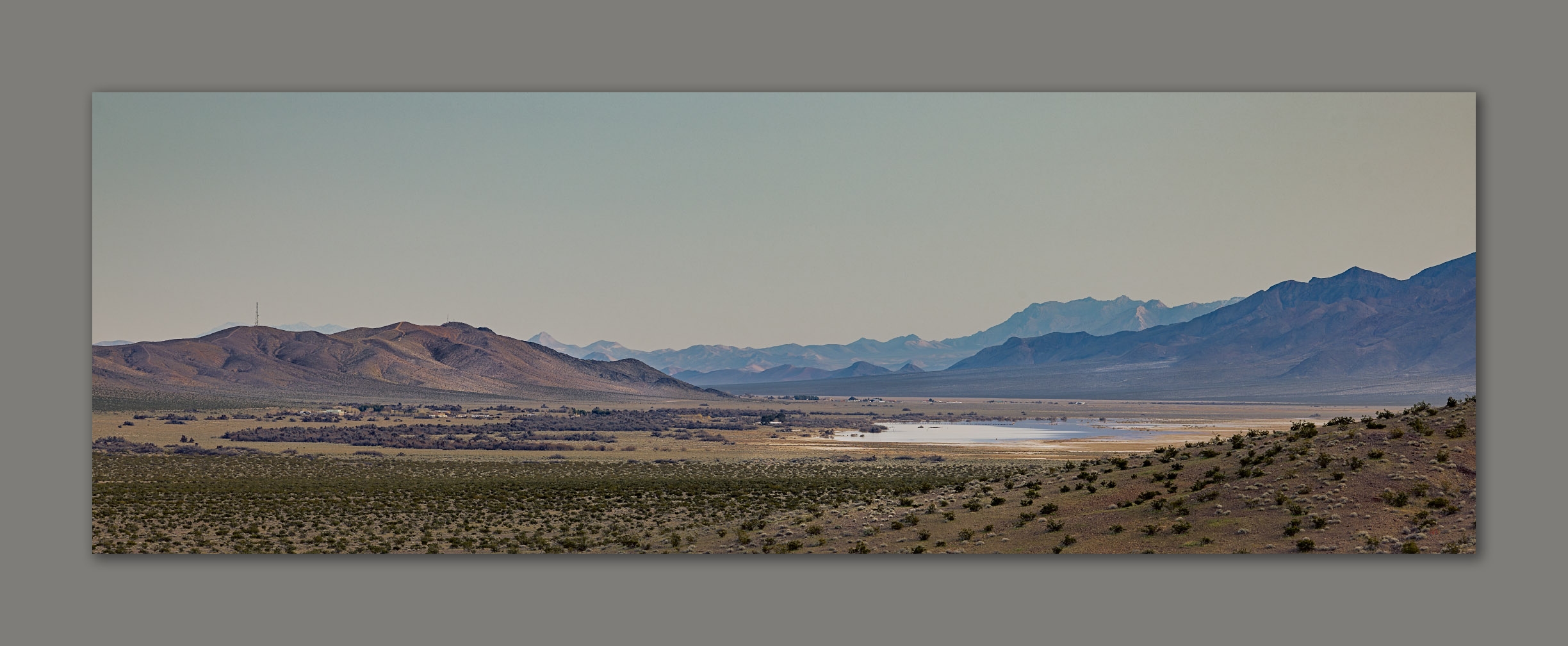
Desert evening. Stewart Valley at the close of winter, Resting Spring Range, Mojave Desert, NV, USA (Map Point #1)

After exploring a few roads on the north side of the Resting Spring Range – most went nowhere or were badly washed out, I set camp on some desert pavement formed on small fans in low, hummocky foothills. The narrow mountain range rises above the Amargosa River with most of its mass in California and only a northern spur and expansive alluvial fans extending into Nevada. My target is the Nevada high point, marked by a small, ridge-line outcrop well below the prominence of Shadow Mountain, the range’s actual summit. I will head up there too.
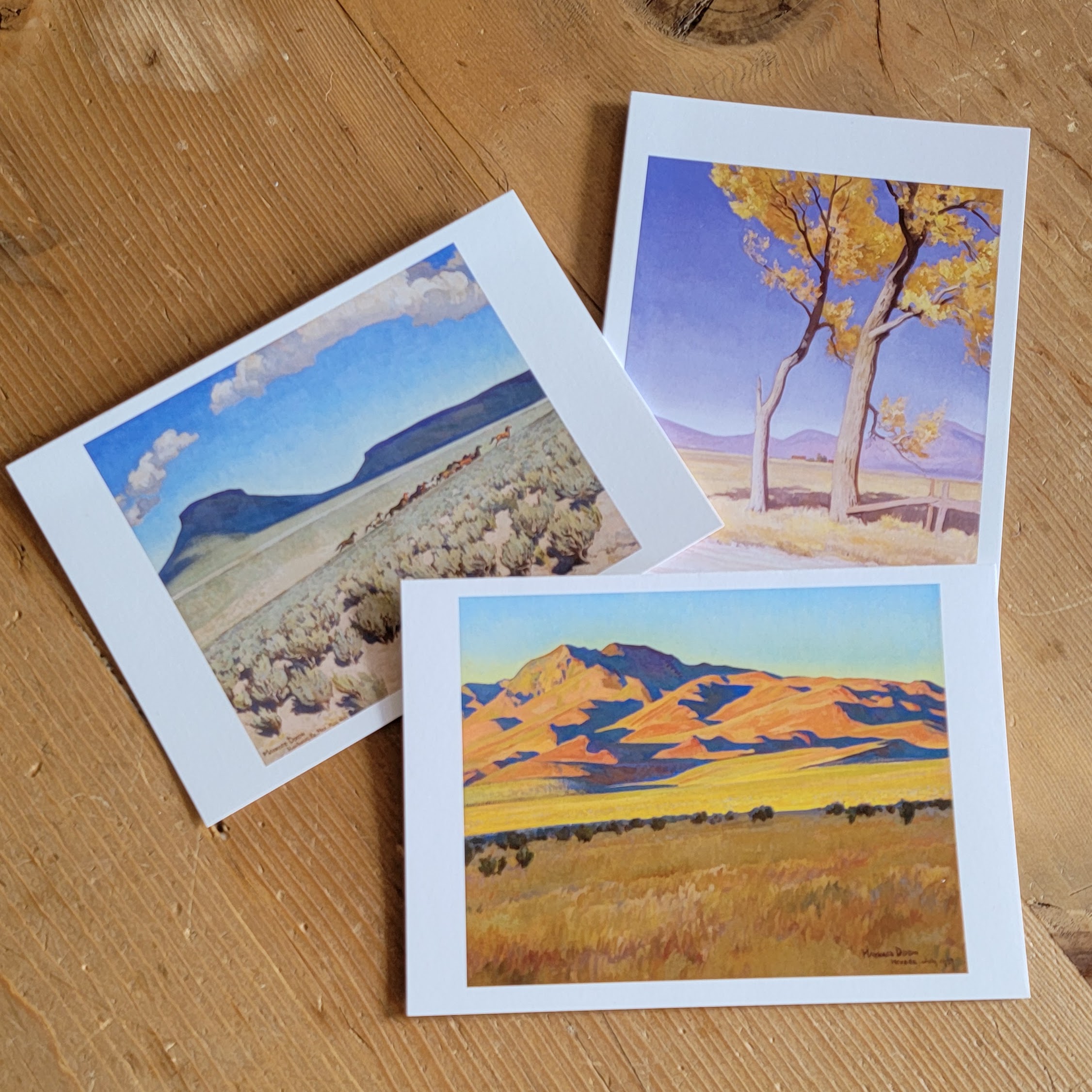
But, first, I will turn the calendar back to yesterday. Desna and I visited the Nevada Museum of Art where there is a wonderful exhibit of Maynard Dixon paintings, poetry, and photographs created during his excursions to northern Nevada and eastern California (open until 7/28/2024). I mention this because first, I really enjoy so much of his work and, second, I think it important to look at art, especially landscape art, and to consider what I like about it. This might provide direction for my landscape photography. Dixon’s use of saturation and contrast, in color and in light, evokes my emotional connection to desert landscapes. His composition is typically minimal, and he has little hesitation in expressing the open sky, dotted with bright clouds, over stark shadows streaking across desert landforms.

Photographers, especially landscape photographers, often cringe at mid-day or high-contrast conditions, preferring the raking, red hues of sunrise and sunset, adding in dark, glowing clouds for dramatic impact. I love these too. I can, however, find challenge and growth in applying a touch of Dixon’s eye, maybe, to my photographic work – both in seeking and exposing compositions and in creative processing, as a painter might. Who knows? I may never be successful, but it got me thinking about its application. Oh, and third, I spent a lovely afternoon with Des.
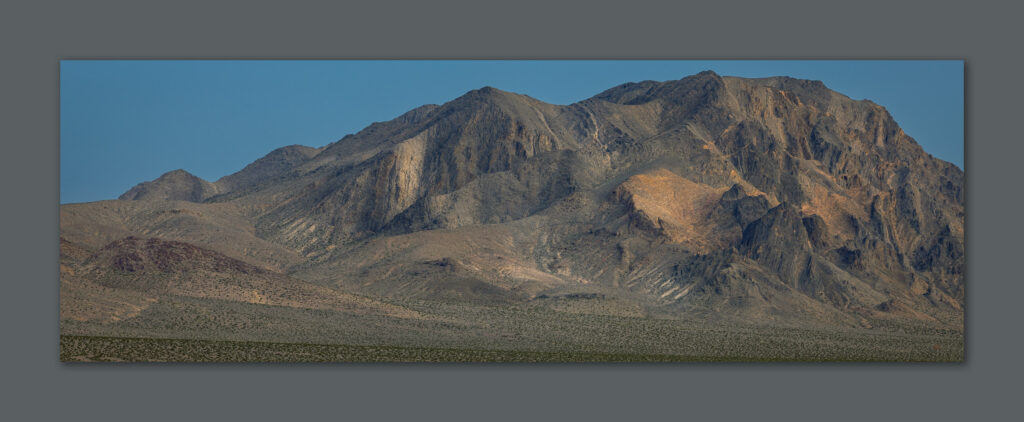
Upheaval. Folds and fans in the hills of Stewart Valley, Resting Spring Range, Mojave Desert, NV, USA (Map Point #1)
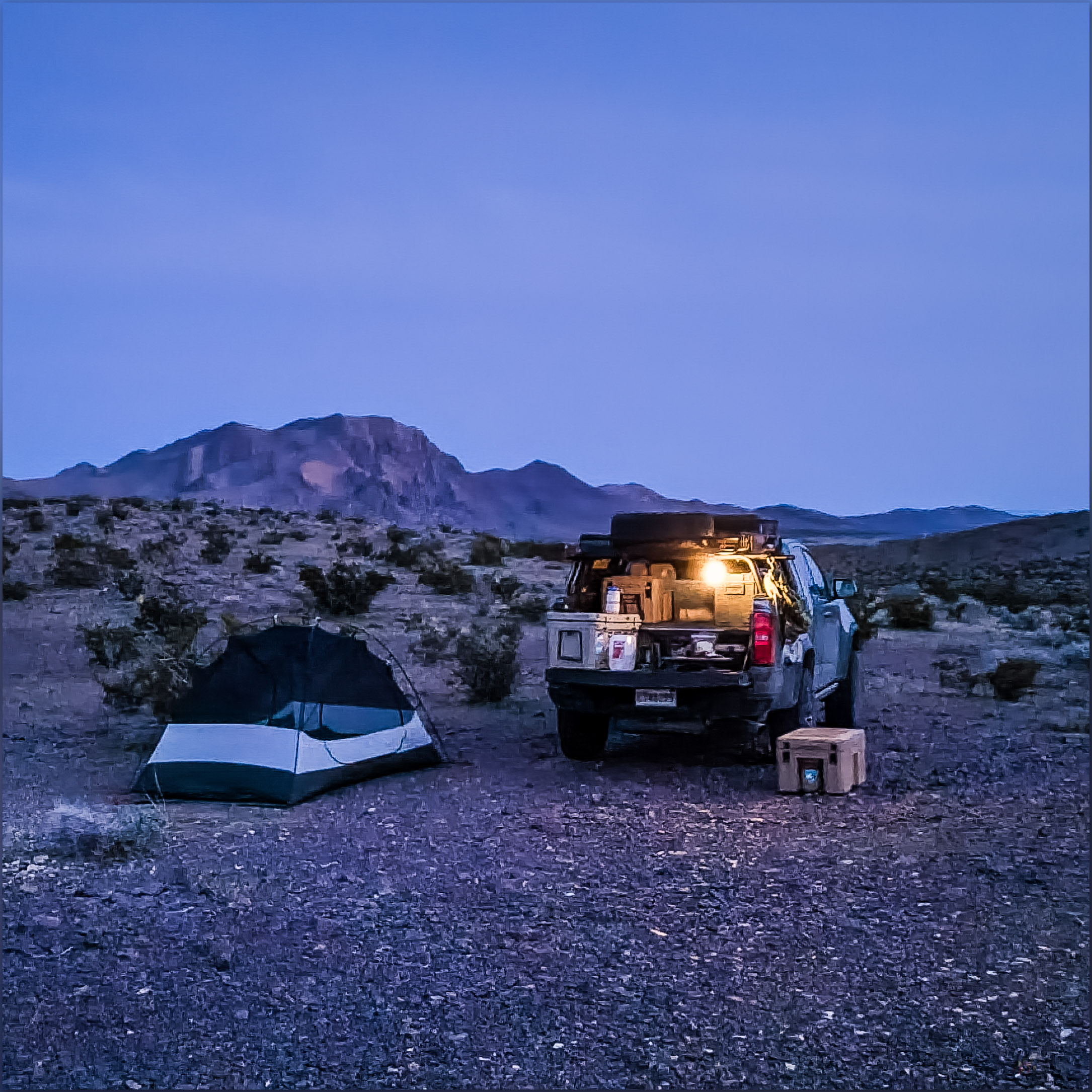
Camp at dark. Foothills and pavements on the eastern margin of the Resting Spring Range, Mojave Desert, NV, USA

Back in the Resting Spring Range, after an evening exploring the pavements and hummocks around camp, I am up before first light, making coffee and collecting a few calories before setting out. I need to walk about three miles of alluvial fans before hitting a punchy slope to the Nevada high point. I go by headlamp, cresting a low hill where an almost complete darkness extends in front of me; the yawning space of the vast alluvial fans soaking all light, from the faint light of my headlamp to blackness to a very distant starry horizon. The night still feels close around me. It is a calm silence, until a Burrowing Owl calls from somewhere far ahead and below; her call a lonely reminder of the few critters that call this desert home. Again and then again, a quiet hoot-hoot is the only sound. I walk into the dark.
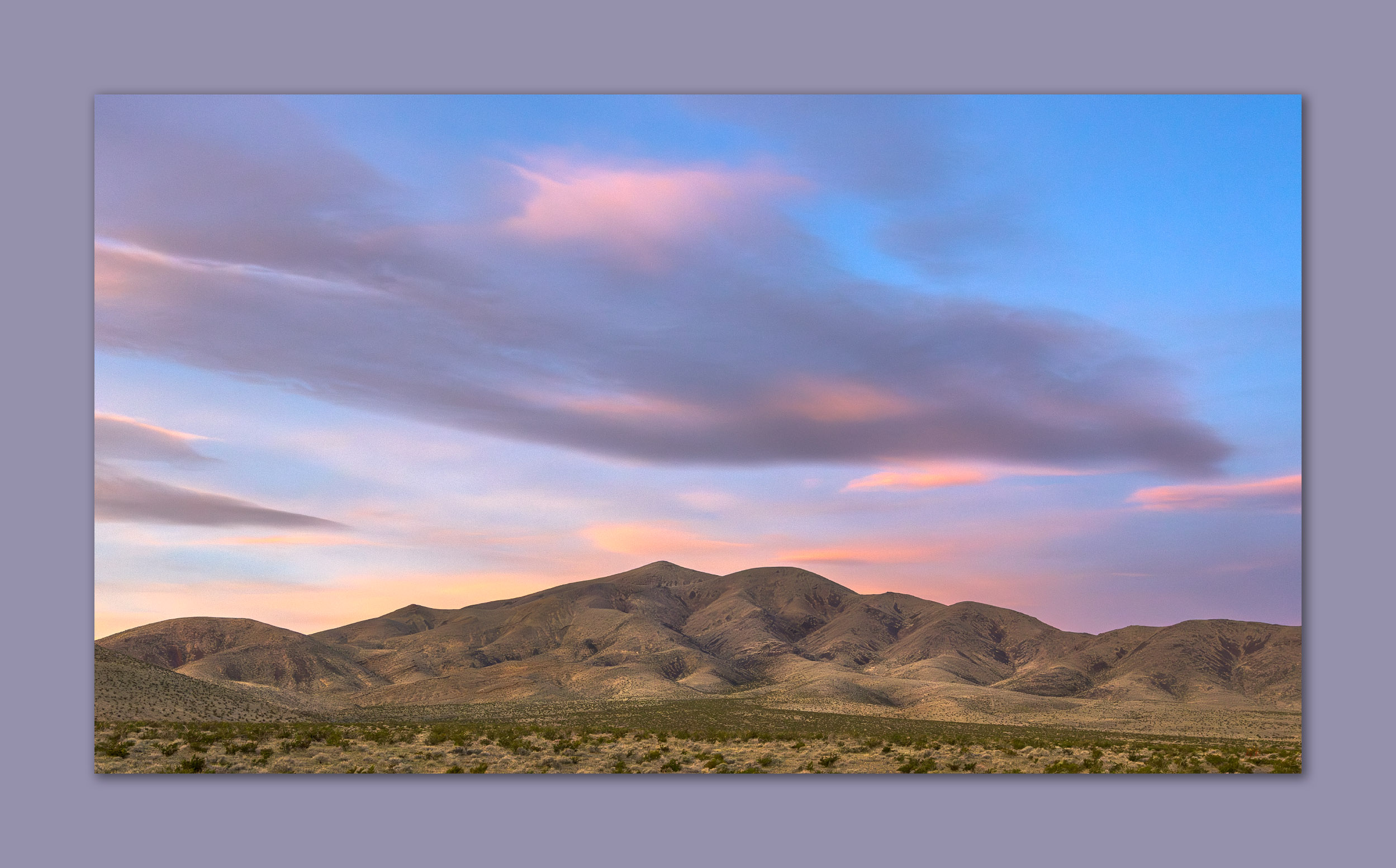
Shadow morning. Shadow Mountain at first light, Resting Spring Range, Mojave Desert, NV, USA
(Map Point #2)

As the light grows, I am in the openness of the fans, moving between desert pavements with dark patination – old, stable fan surfaces – and incised, bouldery washes exposing light-colored alluvium disturbed only recently. The variegated surfaces alternate to reflect the temporal structure of the piedmont or bajada below the steep slopes of Shadow Mountain. A Black-throated Sparrow flits and sings among the creosote and saltbush. The beautiful, sing-song call of a Rock Wren echoes from boulders along rock levees and debris flows that choke the fan’s incised gullies. The morning is perfect. There is a pink in the sky that off-sets the dark fan surface, and newly green blooms of the desert compliment the yellow-brown of the mountain backdrop. Bright yellow highlights reach out from the growing wildflower bloom – Yellow Suncups here; I am early for the ‘super-bloom,’ but it is definitely building.

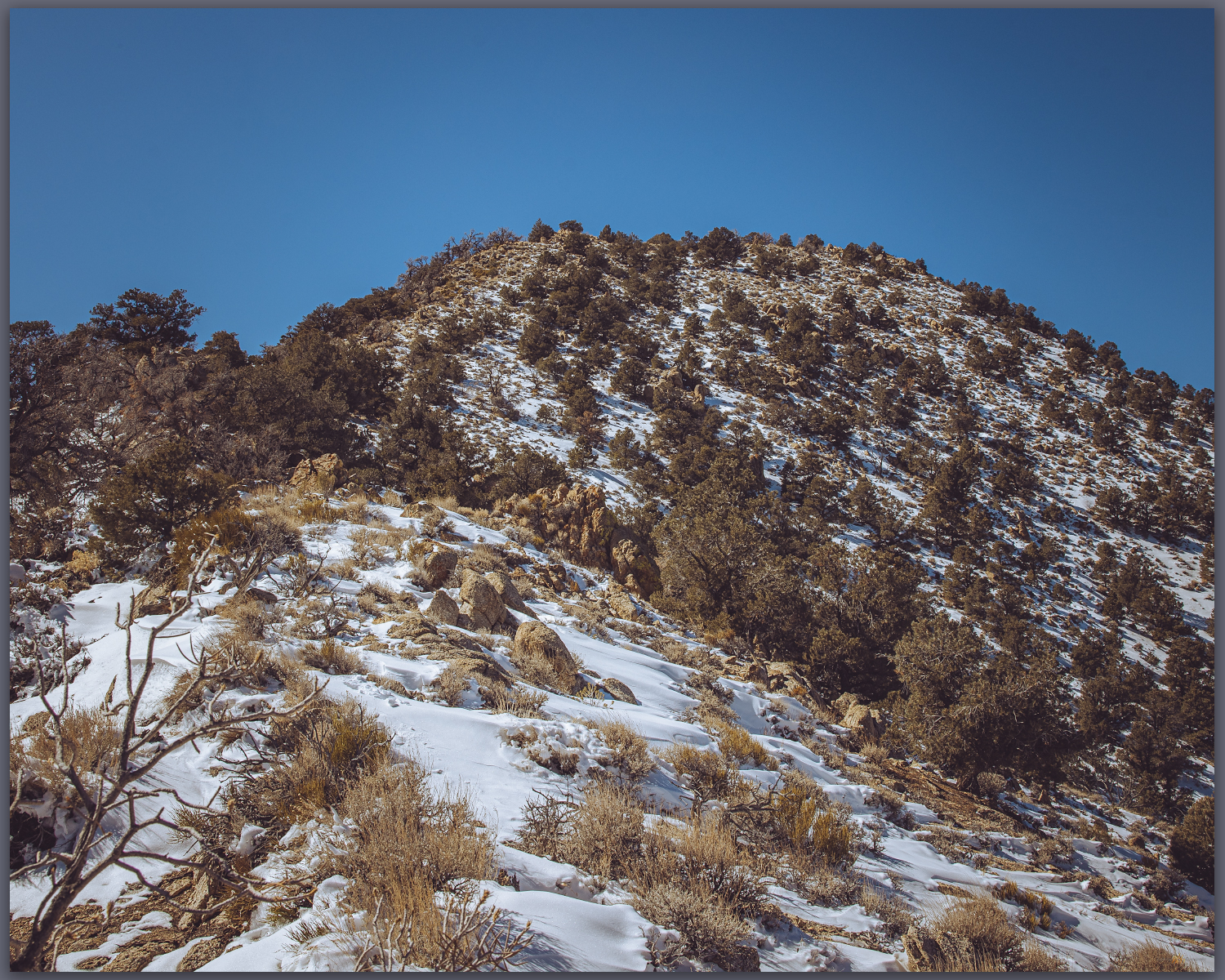
Rocky, talus-screed slopes lead to the Nevada high point at 3960’ above sea-level; I have climbed just over 1500 feet above my camp. Marked by a cairn on an otherwise non-descript ridge, the highpoint is a great viewpoint, nonetheless. Shadow Mountain looms to the south and Amargosa Valley drops precipitously to the west. The sun has risen behind me, and the wind is picking up. I cross the state border in a crease where the ridge drops from the Nevada side, I then begin a good ridge-walk toward the summit, 1000 feet or so above me.
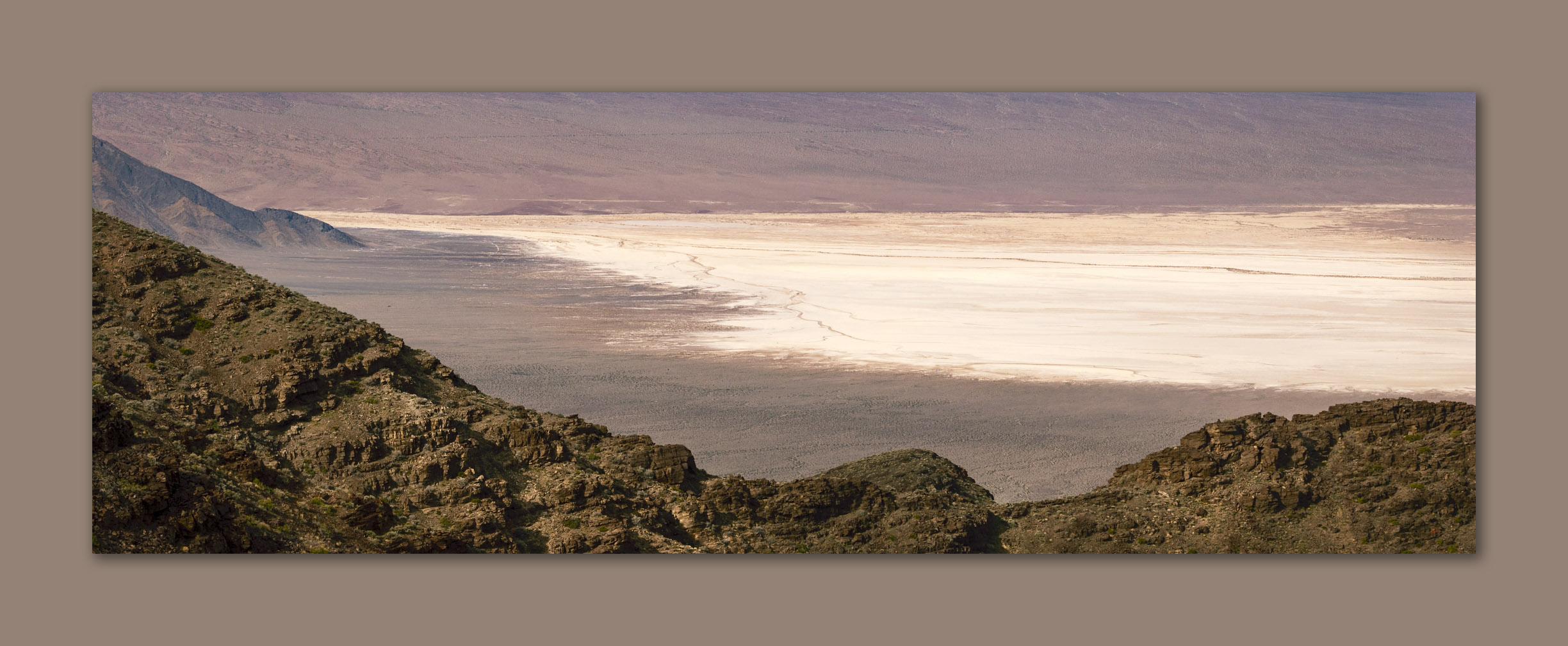
Amargosa distance. Playa and fine-grained alluvium at a constriction of the Amargosa River from the Resting Spring Range, Mojave Desert, NV, USA (Map Point #3)

It is a nice climb with great views in every direction. While the summit of Shadow Mountain does not reach above 5000 feet, the Resting Spring Range remains a prominent landmark visible in all directions. I am happy to be on the summit and realizing I have been looking at this peak for many years, and can now enjoy it from a different perspective – it is always satisfying to be driving or flying, and while looking up (or down) at a lonely spot, knowing that I have visited and experienced it for a short time.
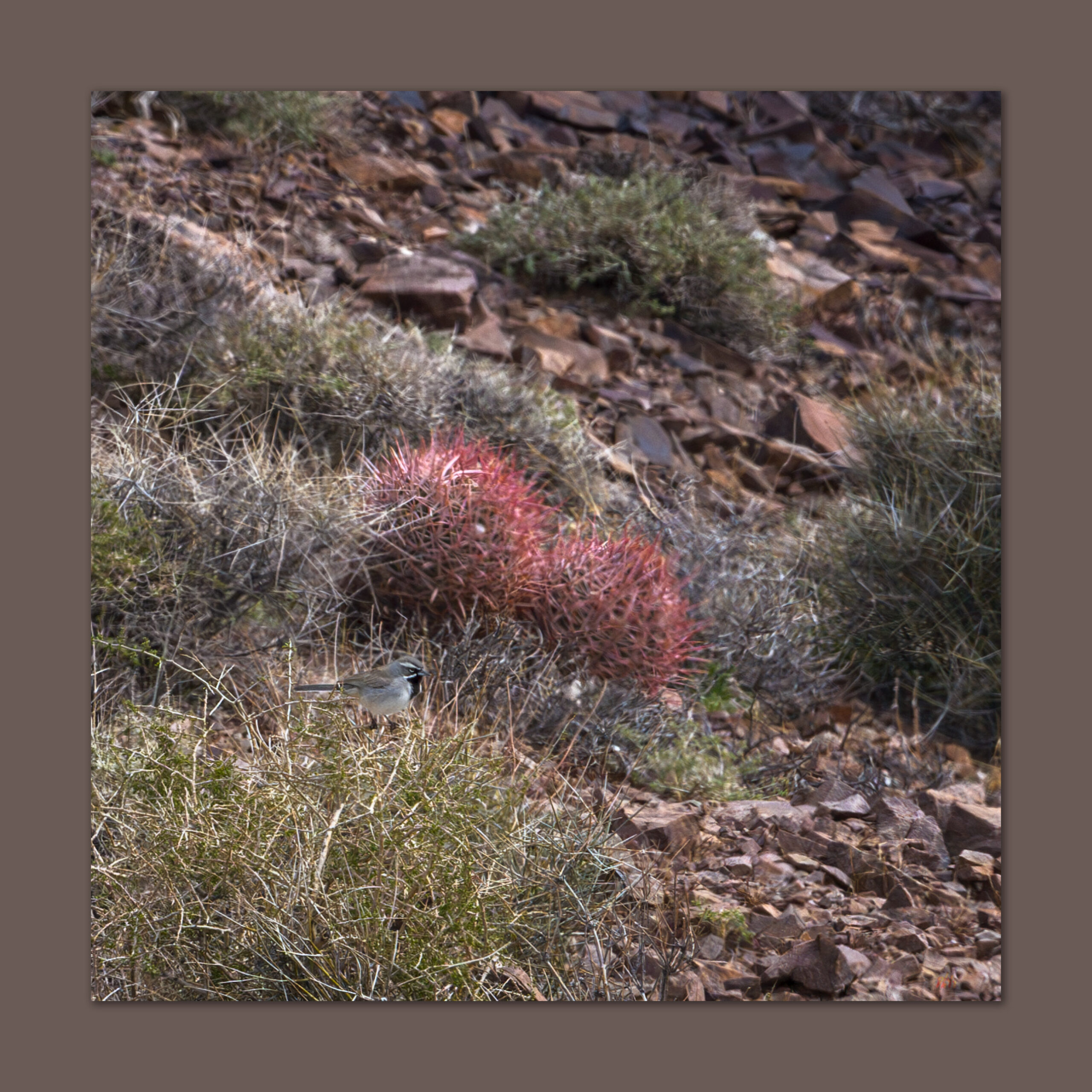
Black-throated Sparrow. Resting Spring Range, Mojave Desert, NV, USA

I work my way down, visually mapping the variegated alluvial fans with their shaded pavements of various ages. I can easily identify four surface ages based on the maturity of desert pavement. Dark surfaces with seemingly uniform pattern of rocks, some that fit together like gravelly puzzle pieces, are generally old. Very old; it takes hundreds of thousands of years for the weathering to create the distinct, intricate patterning. Younger surfaces will be lighter colored, with rougher surfaces, seemingly random rock patterning, and even evidence of recent flooding. And several intervening surfaces along a continuum of very old to, well, practically yesterday. From a distance, the patterns can be clear, and I often map landform age based on aerial imagery that resolves the temporal relationships nicely.
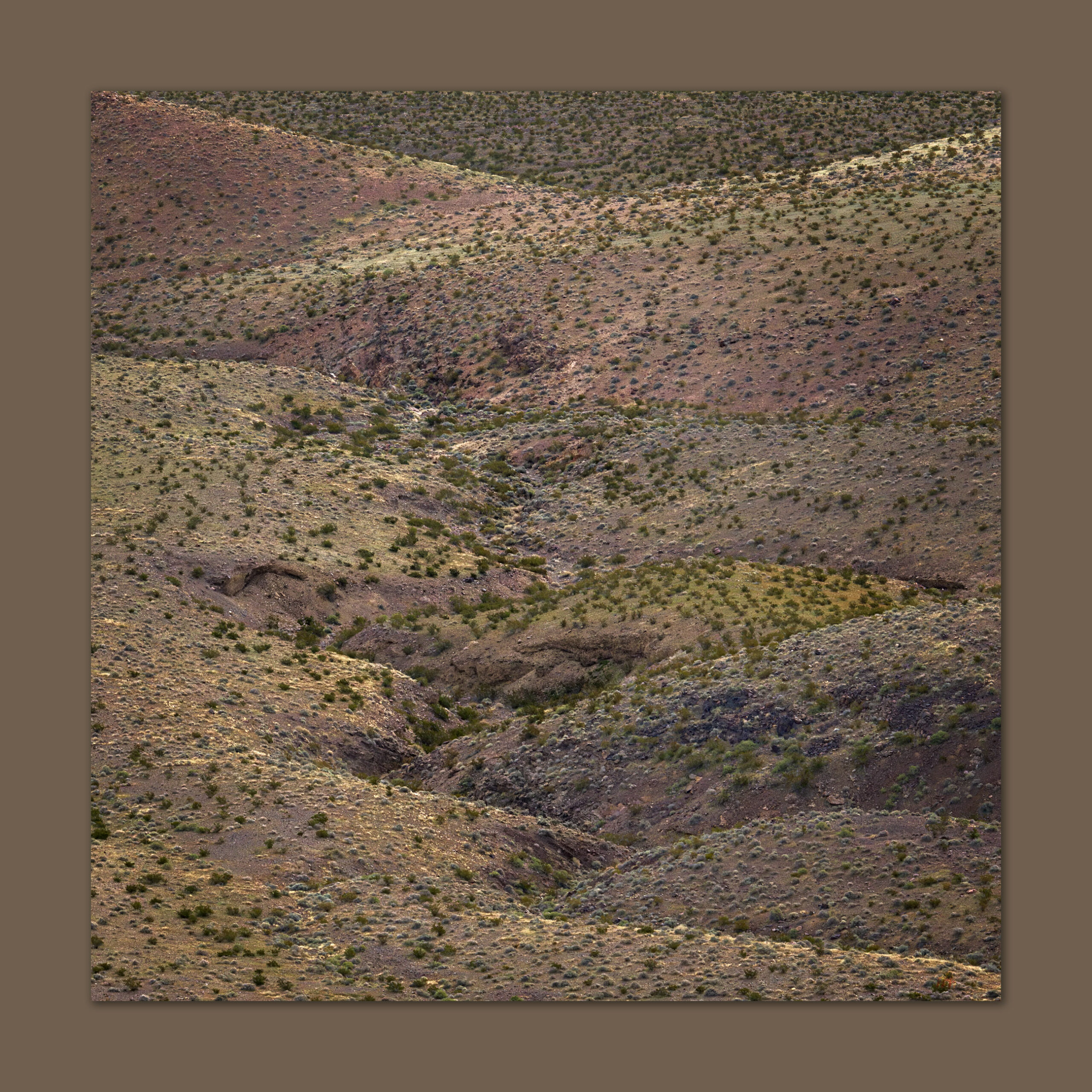
Creosote crunch. An early glow on the sparse vegetation of relic fans of the Resting Spring Range, Mojave Desert, NV, USA (Map Point #3)

This is important because archaeological sites, their age and preservation, may be patterned in close relationship that age of a landform or its surface. Sites of any age may occupy the oldest pavements – let us assume there is some clustering of plant, animal, or water resources that might have led people to this location. Because that armored surface is as stable as it is old, it is very unlikely to hold buried archaeology. So, the information you get from the distribution of artifacts on the surface is the only information you are going to get.

As we move to surfaces that have formed and stabilized in the Holocene (say, the last 12,000 years or so), we may start to see some patterning among the surfaces, with some interesting changes over time; the relative age of fan surfaces may provide the first clues in looking for such patterning. Very young fans (with evident debris flows and tumbled cobbles and boulders) suggest that most sites may have been wiped out, and while you may find some displaced artifacts, there is little detailed information in such a disturbed setting. The patterns can shift rapidly as one moves across such an ancient and complex fan.
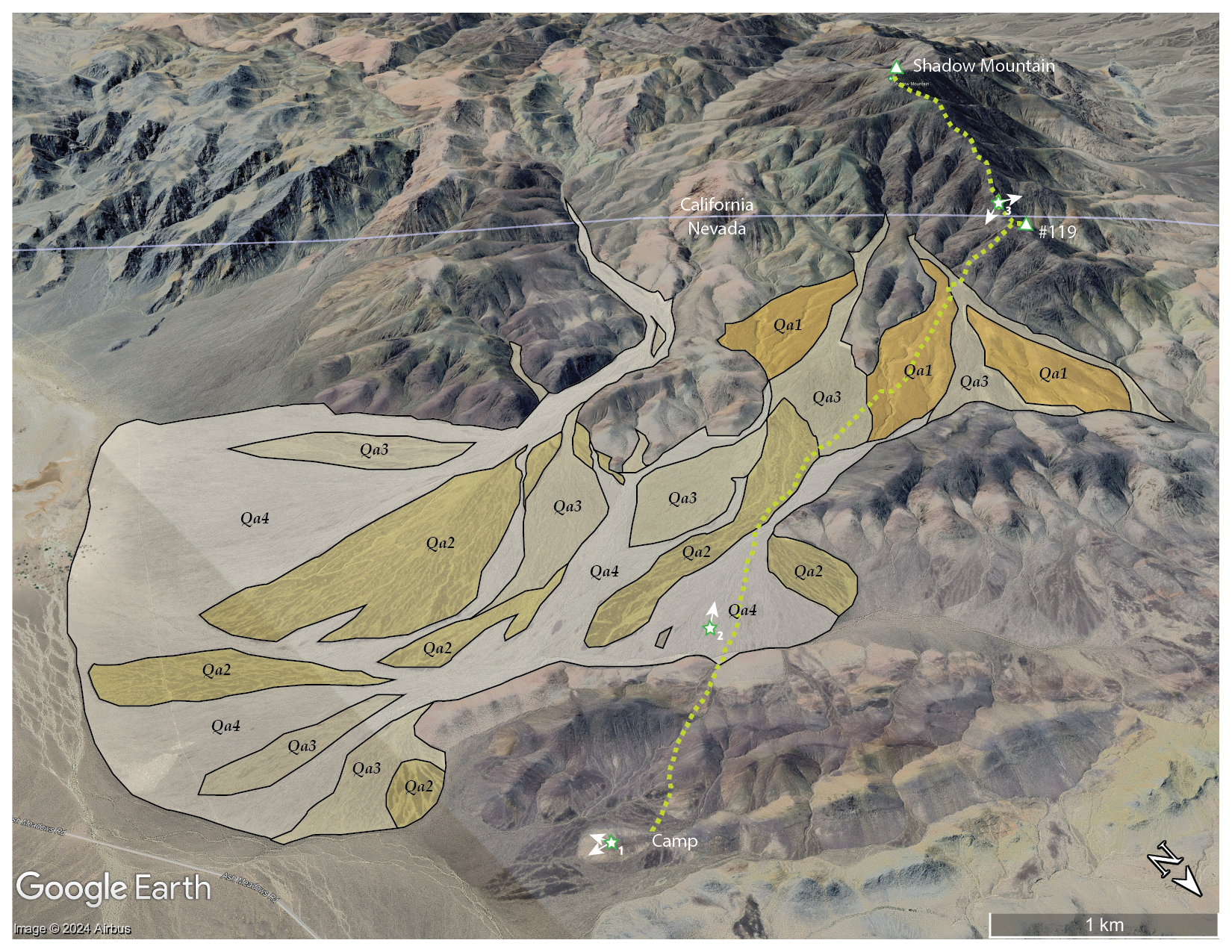
Quaternary landforms of northern section of Resting Spring Range, Mojave Desert, NV, USA

I recognized four temporal surfaces on the bajada (i.e., coalesced fans) expanding from the canyons on the northeastern side of the Resting Spring Range. On the map, Qa1 highlights the oldest surface, marked by darkly patinated and strongly developed pavement. Younger fans cut through the Qa1, leaving its ancient surface abandoned to continued slow, constant weathering. The gradient of surfaces from Qa2 to Qa4 reflects younger landforms and a general increase in recent erosion and/or deposition. The Qa4 is where the occasional floods happen or have happened relatively recently; one can hardly predict the next flooding disturbance to spread across the fans as the flashy flows find their paths basinward. A spot may be stable for centuries, until it is not.

As usual, I focus on the younger landforms (not rocks) and the processes that build the environments and habitats of today – that is why my maps only highlight the young, active landforms. The older rocks, their structure, composition, etc., play a role, but I want to document and understand the work that wind and water can do now that the mountains and hills are in their place, at the scale of the Holocene, at least. That is geomorphology, in a nutshell.

Resting Spring Collection

I reach camp happily after seven or so hours of walking out and back. It was a special and relaxing day. Unlike last month in the Last Change Range, I was well-provisioned, and my gear worked flawlessly (I did film more than I anticipated, and I should have brought my better audio set-up – the wind noise in my YouTube post embarrasses me). Although it is often better to focus on one activity during an excursion – Am I here to climb, do photography, map landforms, or make geomorphology videos? – I took the time, this time, to do a bit of everything during my walk. It is good to get a complete outing like this occasionally. This was a great one.
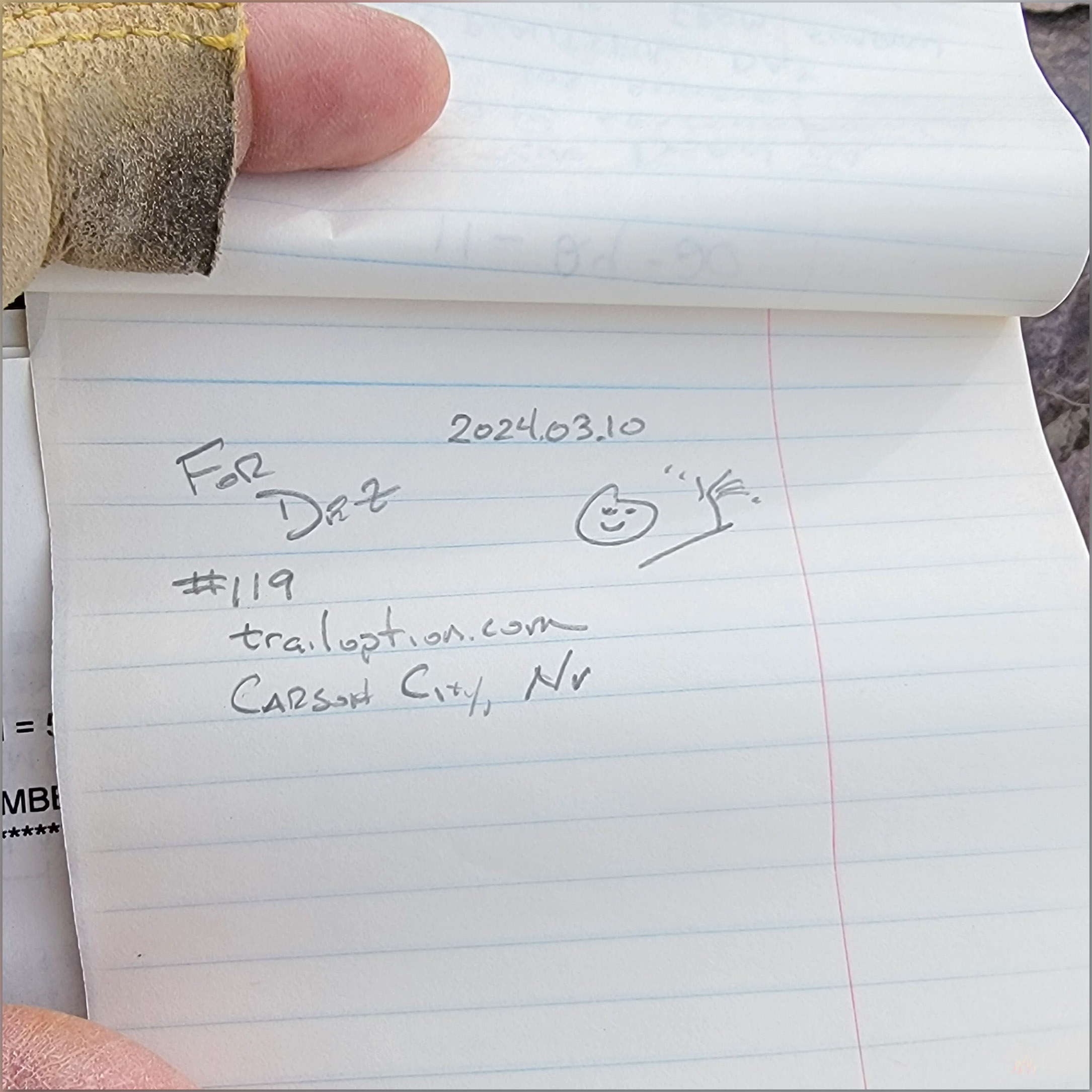
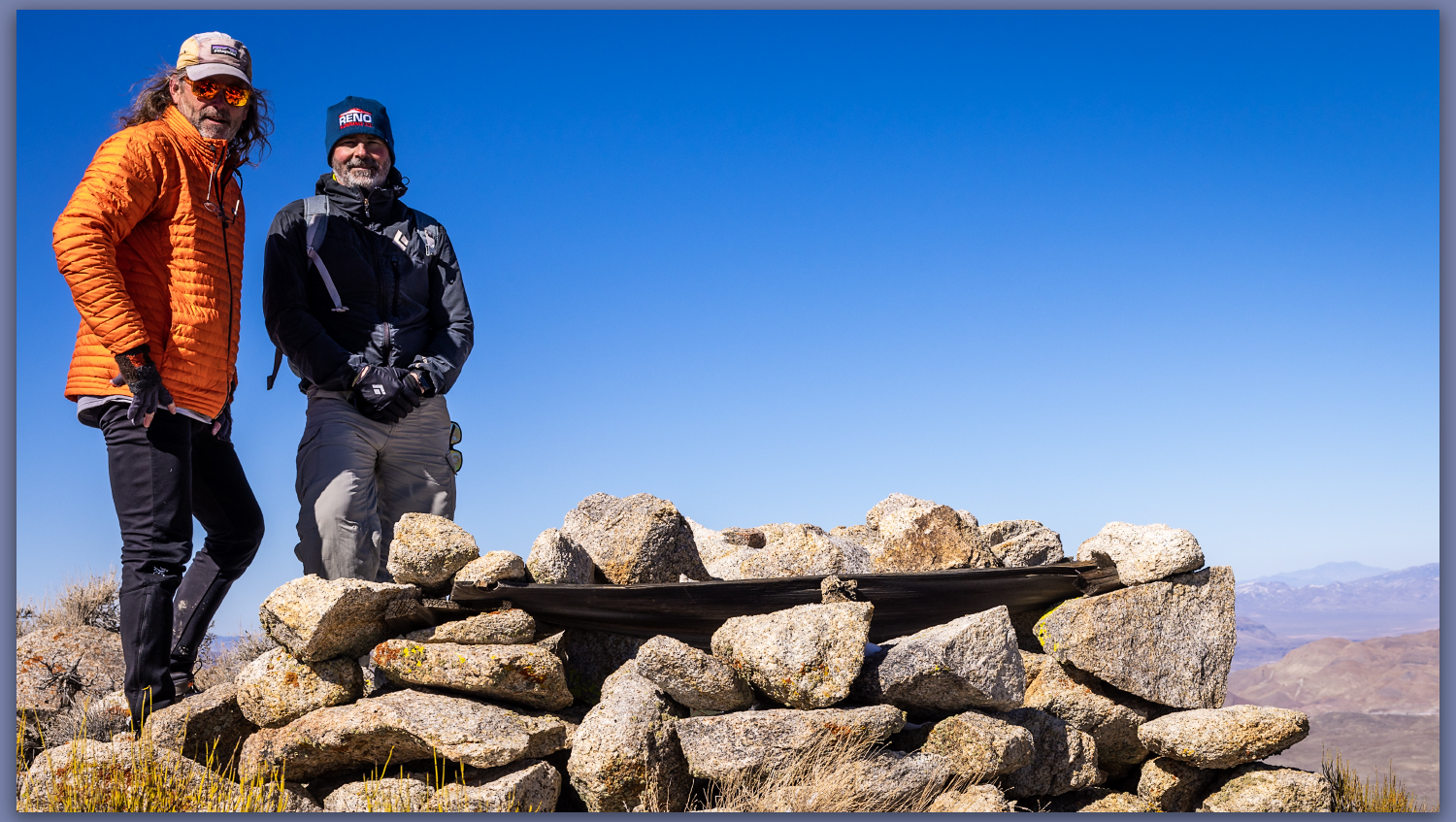
Register #119. Resting Spring Range, Mojave Desert, NV, USA

I continue this journey, after packing up my little camp, with a photographic excursion into Death Valley, and then on to more focused fieldwork in the landforms of the ancient Mojave River further south. It has begun well.

Keep going.

Please respect the natural and cultural resources of our public lands.
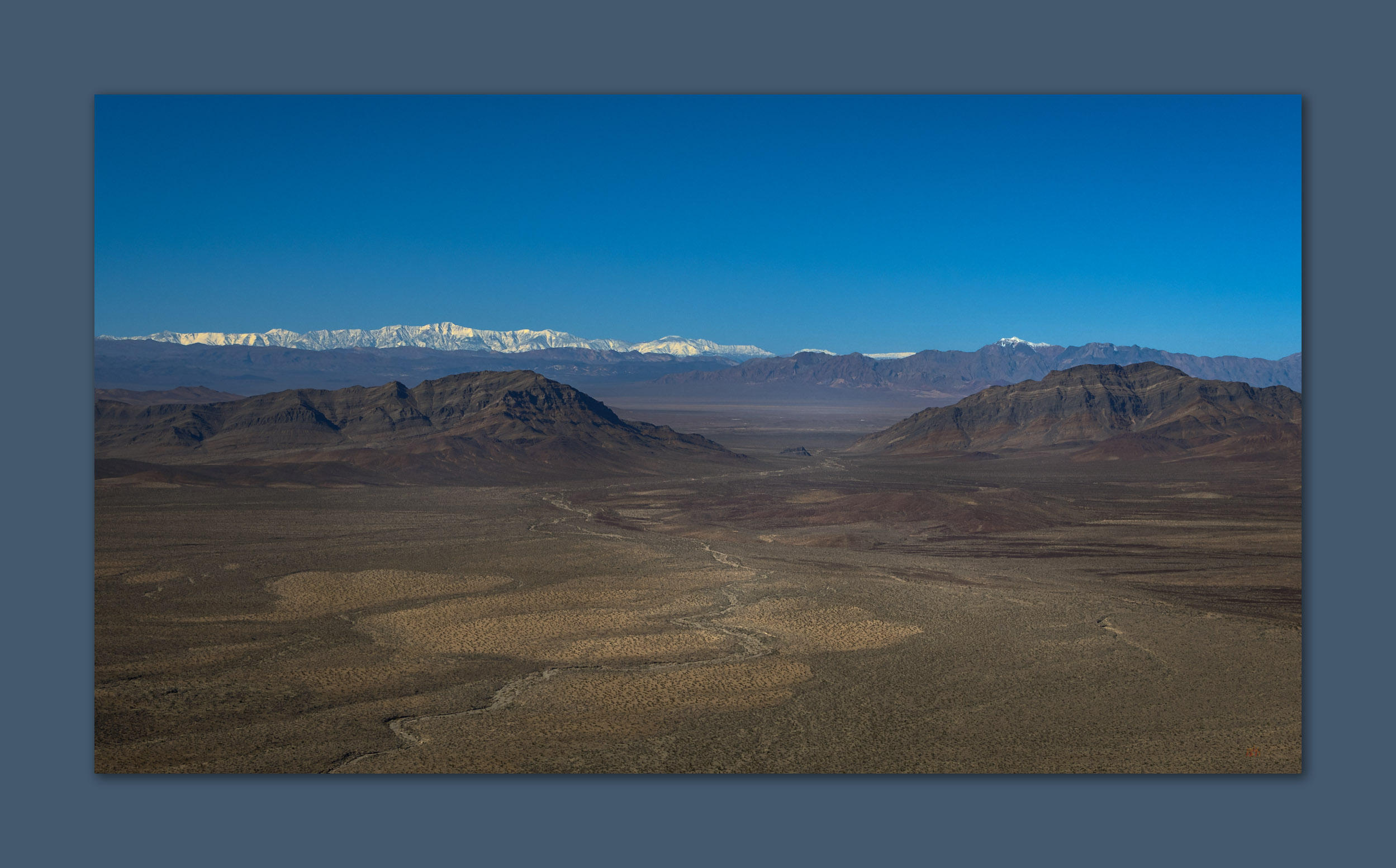
#naturefirst #keepgoing

Nevada High Points #118 – Last Chance Range

D. Craig Young · March 23, 2024 · 2 Comments

Coalescent wash. Variegated landscape of Devils Hole Wash from the Last Chance Range, Mojave Desert, NV, USA

Unnamed Peak

4985 ft – 1519 m (2257 ft gain)

2024.02.11

Last Chance Image Collection


Keeping a disciplined calendar is important to me. It truly does keep things from happening all at once, and it provides motivation for keeping to goals and practices that I set for myself. It also acts as a form of communication and agreement between home, work, projects, and travel – these are so intertwined in my personality and pursuits that I can think of no other way of living. I am not a slave to the calendar, and I commonly make changes – and it is by no means a daily list, only a practical target with emphasis on keeping to high point and geography pursuits. Setting aside Second Friday gives momentum to the aspirations of finishing the list, even in its general impossibility. Yet sometimes the calendar gets pushed around – in February the push came in the form of a series of atmospheric rivers that derail my projects in southern California.

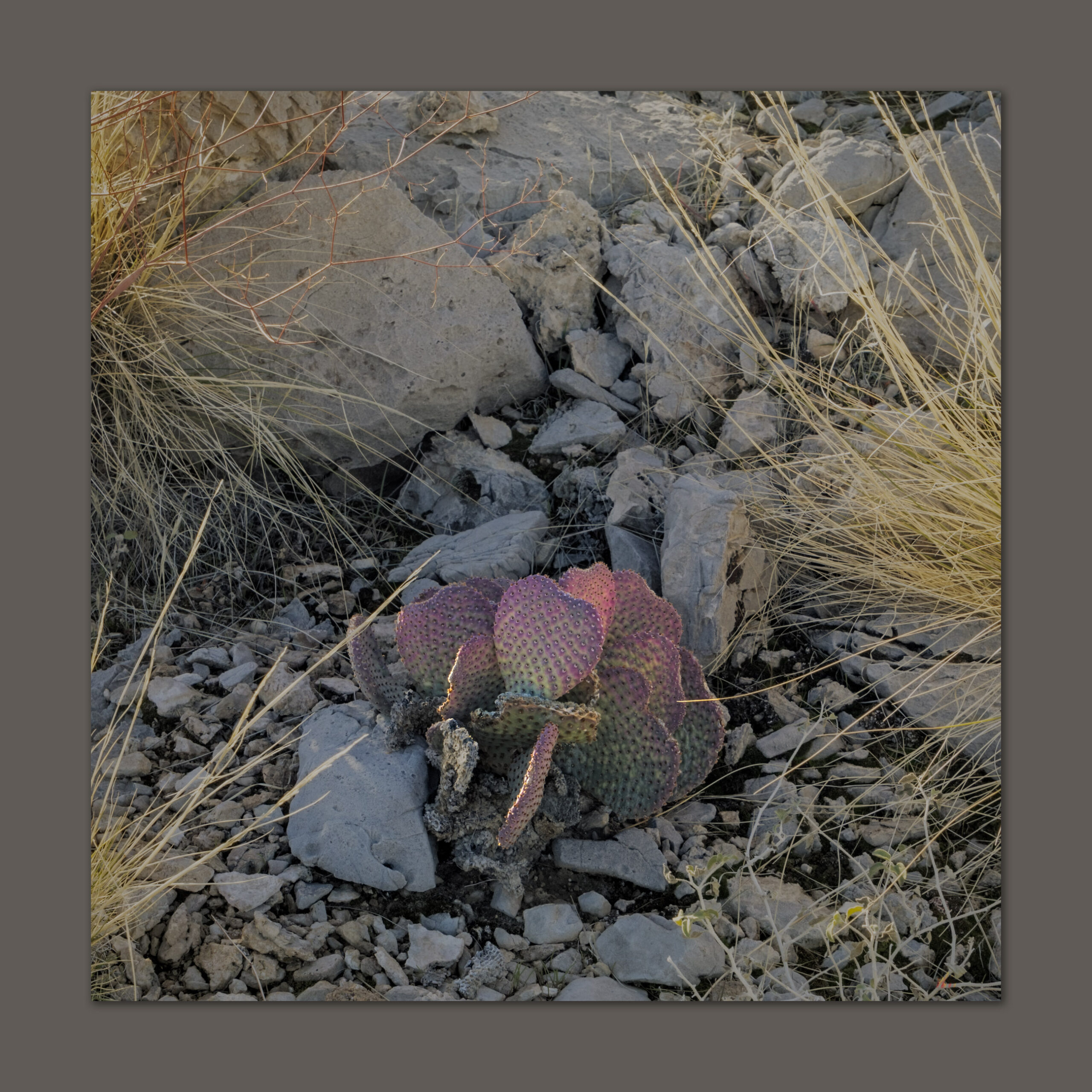
Hearts of cactus. Color on the limestone slope of the Last Chance Range, Mojave Desert, NV, USA

I have been trying to schedule an exploratory excavation project – contracted by Caltrans – in the southern Sierra, near Lake Isabella, for the past month, but the rain and snow kept coming. Finally, the forecast hinted we would get a break, so we pack up and head south. If everything goes well, I will be back into southern Nevada on Second Friday, so I keep in mind several ranges around the Amargosa Desert and Ash Meadows (northwest of Pahrump, NV).

Things do not go well. The storm sent a last-gasp arm of heavy precipitation into southern California, sending landslides over highways and bringing snow to the hills of the southern Sierra. I am stuck in a hotel room. We eventually get our work done over a couple extra days, and I drive into the desert, traversing through Death Valley and into the Amargosa Desert on Saturday night. The Amargosa River is in flood mode inundating a long stretch of the Ash Meadows Road east of Death Valley Junction; I ford it slowly only to find ‘road closed’ signs at the Nevada line. But they suggest the road closure is now behind me, that is, at the river crossing I just experienced. The signs face toward the west-bound traffic, but I am going east on a road that is high and dry ahead of me. I find my Ash camp in a gravel quarry at the foot of the Devils Hole Mountains east of the river – I have camped here a few times when gouging around the Amargosa River. The ground is wet but holds firm, so I set camp in a stiff breeze, finally making dinner in the cool and quiet dark – so much nicer than the hotel of the past few nights.

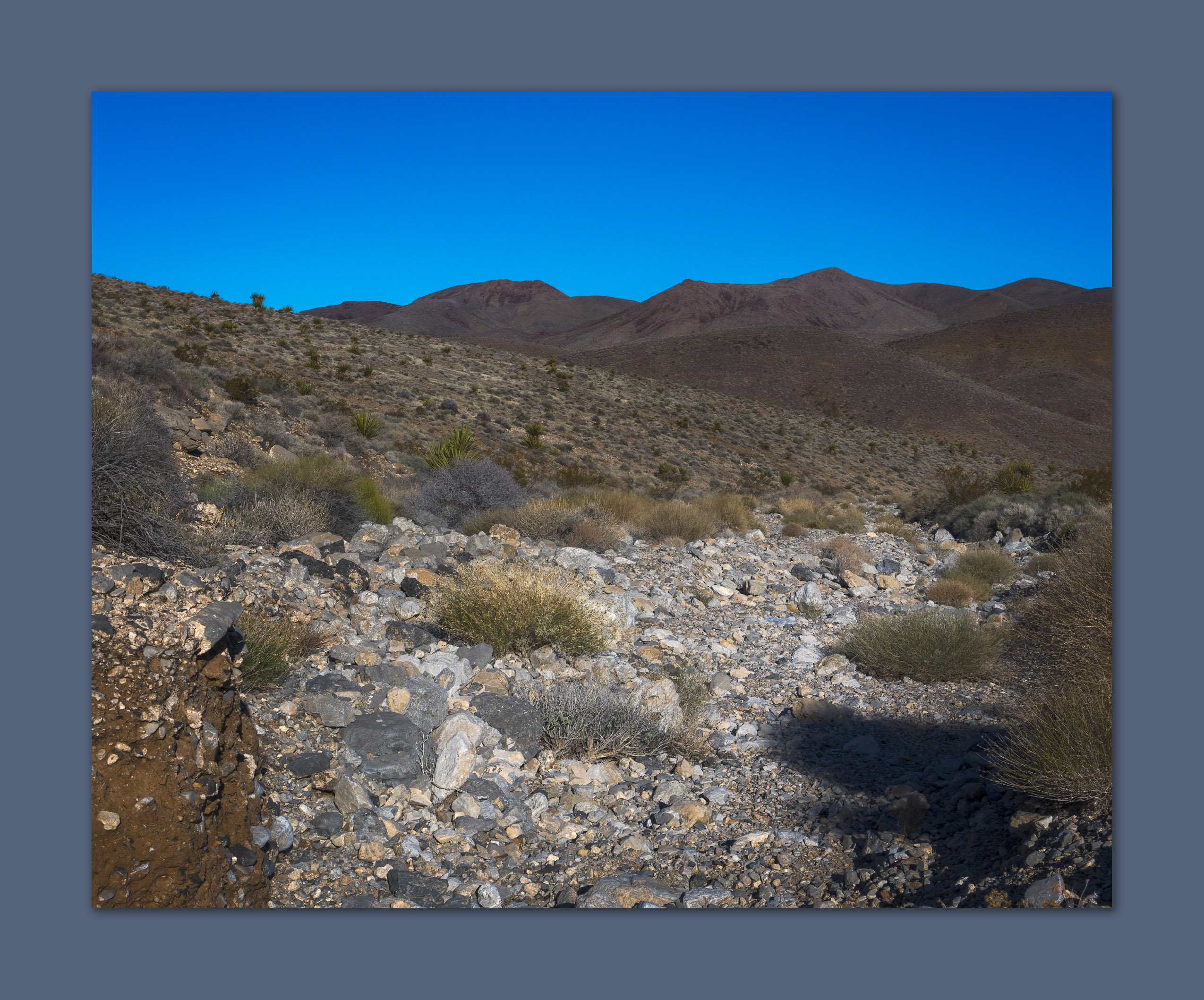
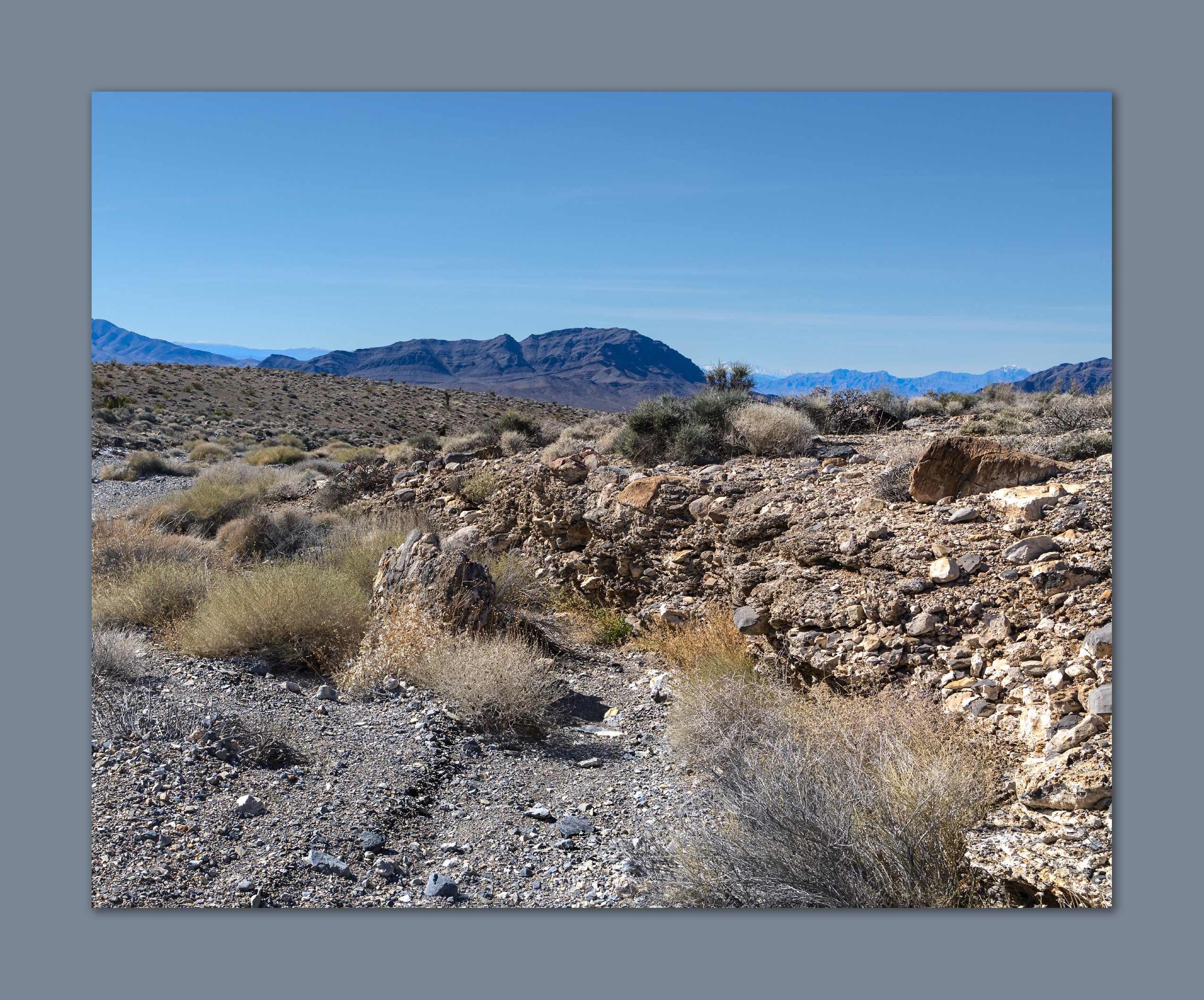
Rock wash. Proximal fan segment, northern Last Chance Range, Mojave Desert, NV, USA (Map Point #1)

Sunday morning opens bright with frost and cold with a north wind behind the recent storm. Coffee in hand, I decide to head into the Last Chance Range above Pahrump. I can make this a quick excursion into the limestone hills and then hit the long drive home. I park at the base of a ridge that seems to lead toward rocky shelves below the prominent summit, maybe 1,700 feet above me. I am not expecting compelling photographs under the bright, blue-sky conditions, so I  focus on simply enjoying the walk.

I soon realize that I am not at all prepared for the terrain of the Last Chance Range. First, I made the mistake of thinking this would be quick. I have a liter of water and virtually no extra gear; the battery is dead in my Garmin beacon. Second, I am not experienced in the stepped limestone crags of southern Nevada, with sometimes puzzling route-finding where small talus-filled chutes provide access to higher ledges, and ledges end suddenly at steep drops and rocky falls. I consider turning back; maybe I can just get to the next saddle, check the view, and try another time. But no, I am here today, and it looks interesting ahead; I should be fine. It was not a smart decision, but I put it in my pocket for now and turn onto a game trail traversing a ledge that seems to lead toward the final boulder-filled ravines below the summit.

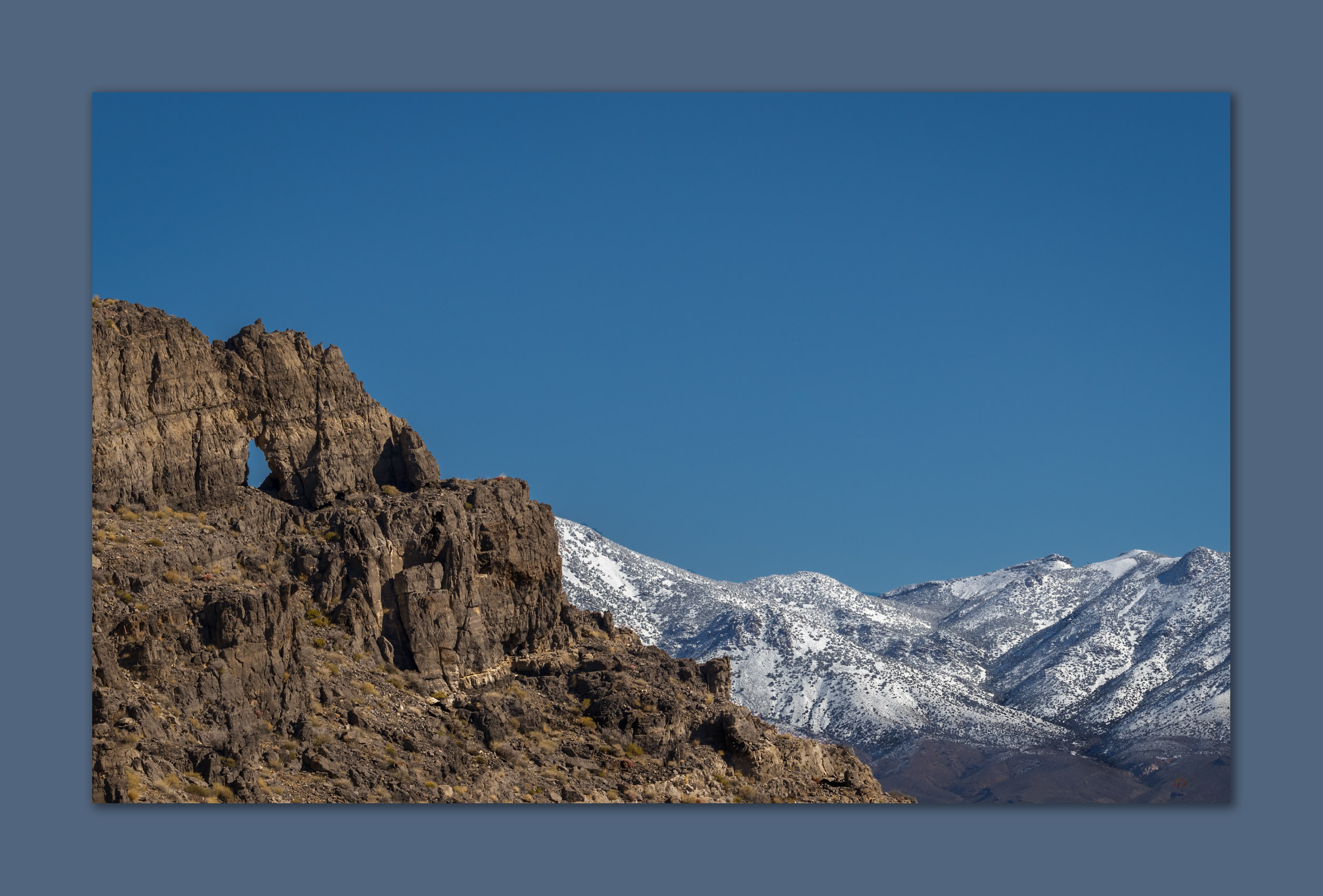
Eagle’s window. Last Chance Range, Mojave Desert, NV, USA (Map Point #2)

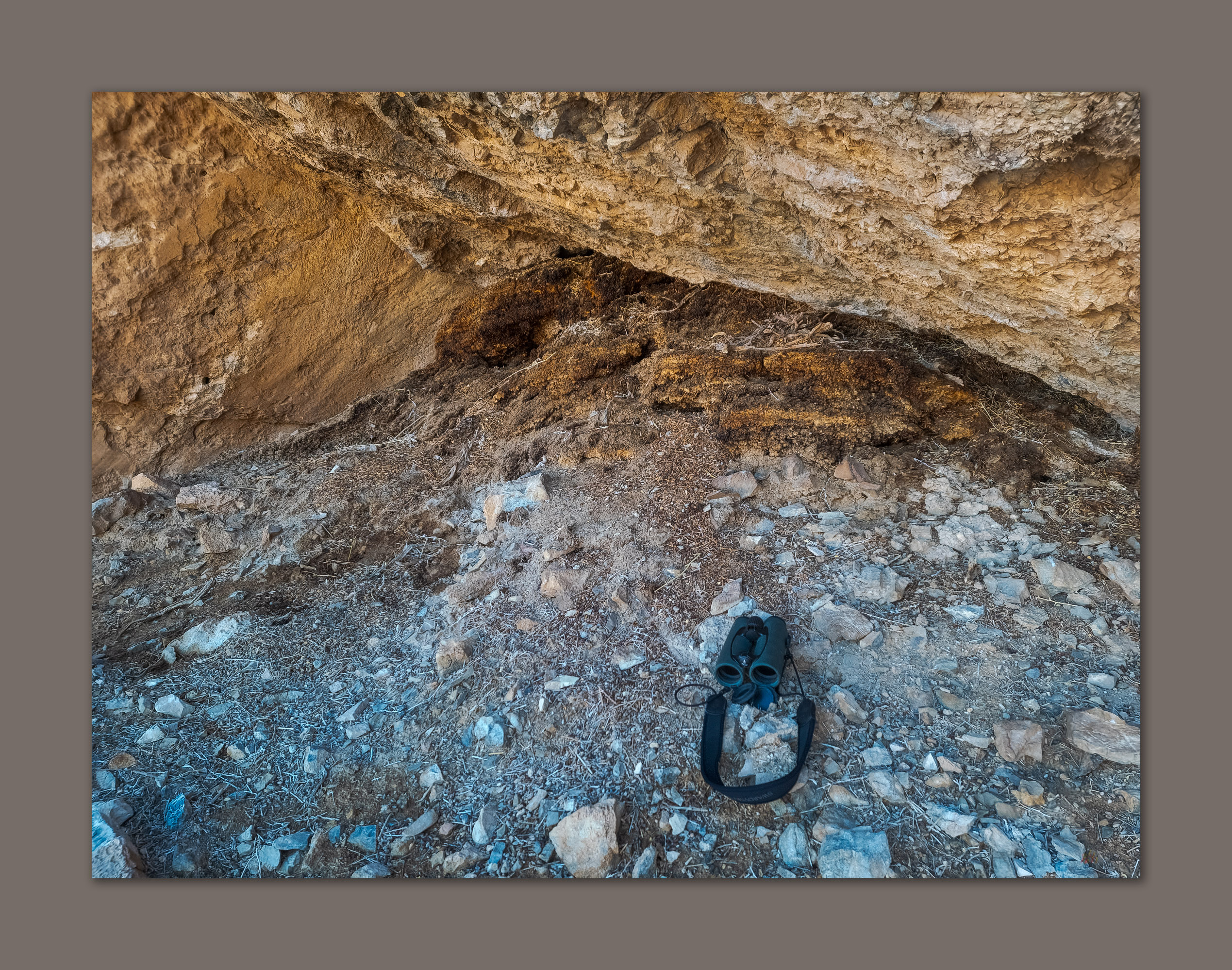
The ledge is fascinating. Limestone and sandstone cliffs rise above me as I walk along uplifted and tilted beds and beaches of a shallow sea now rising into the desert sky. Sleeping circles of big horn sheep are tucked here and there. Jumping in time, I find a woodrat midden packed into a dry alcove at the cliff bottom. These middens hold valuable pollen and plant information, stored by the careful and complete collection activities of the ‘packrat’. These can be thousands of years old, but this one looks like it might be hundreds at most; still, if the local vegetation changes, a recent record is kept in these little indurated nests. I mark the locality and move on.

Neotoma midden. Last Chance Range, Mojave Desert, NV, USA (Map Point #3)
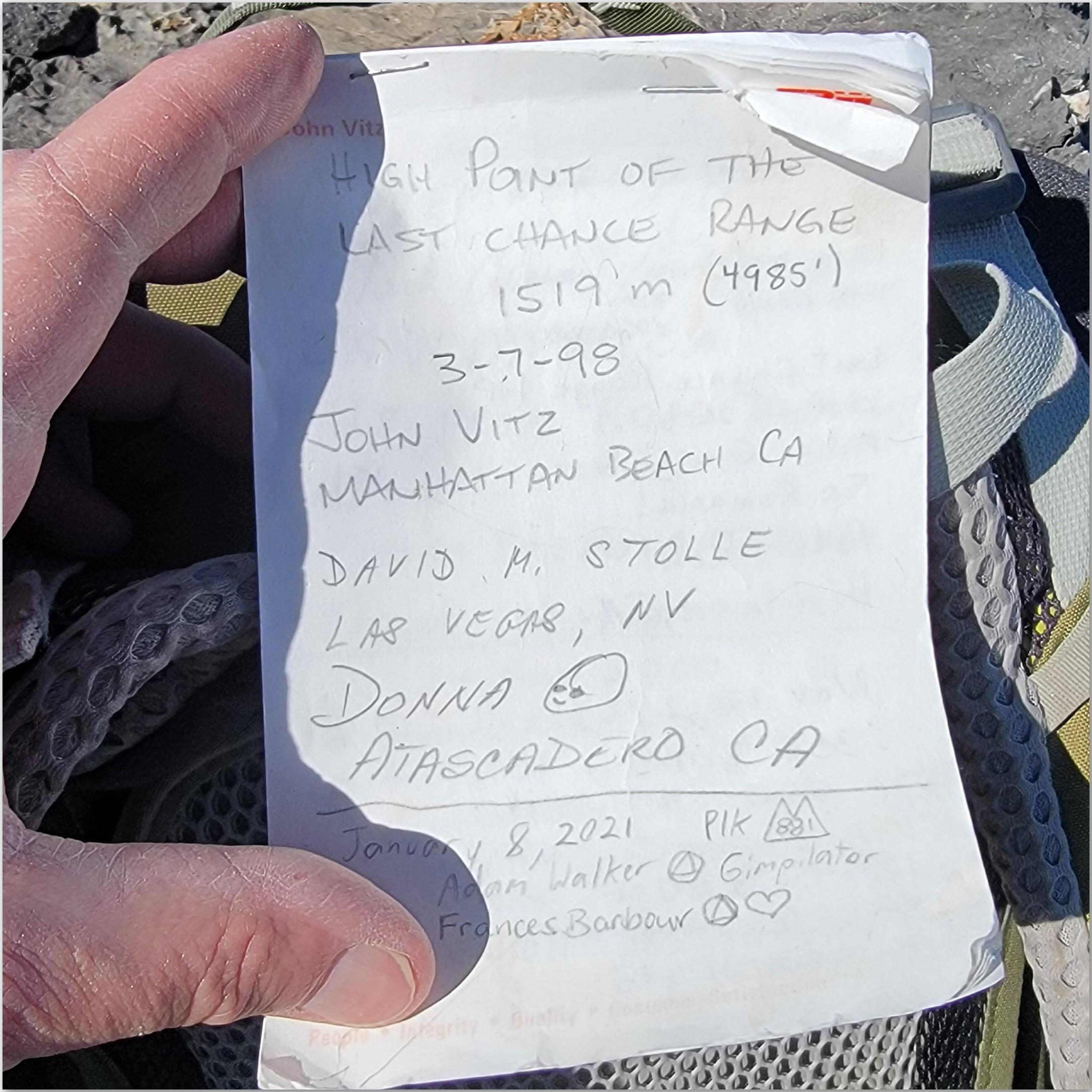
Register. Summit book of the Last Chance Range, Mojave Desert, NV, USA

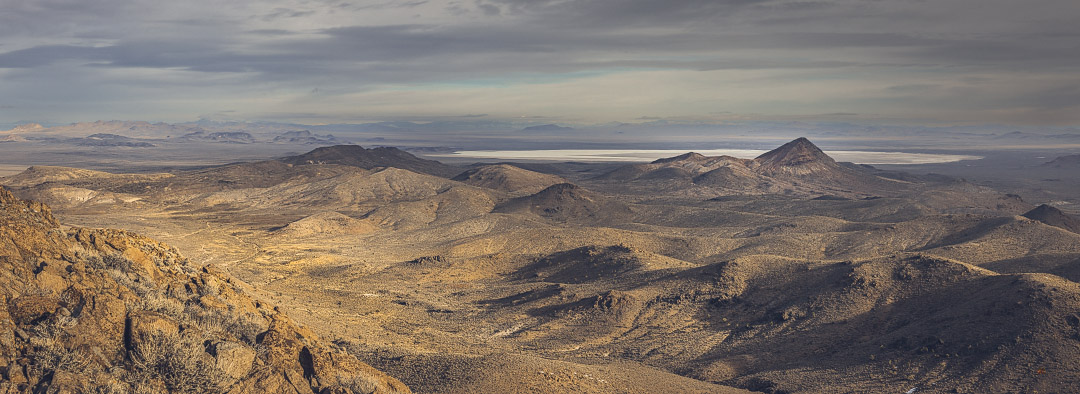
I work my way into a steep but accessible ravine cut into the black limestone of the Last Change summit block. Ah ha, a couple cairns suggest that this might be a common route to the top. I grab the ravine wall in a couple places, but it is easy-going over a last few steps. Like walking onto a narrow balcony, I soon step into a breeze driven upward from the vast expanse of the valleys below. I am bounded by Mount Charleston in the Spring Mountains to the east and the prominent Telescope Peak above Death Valley to the west, both blanketed in new snow. A worthy effort, even without the best planning.

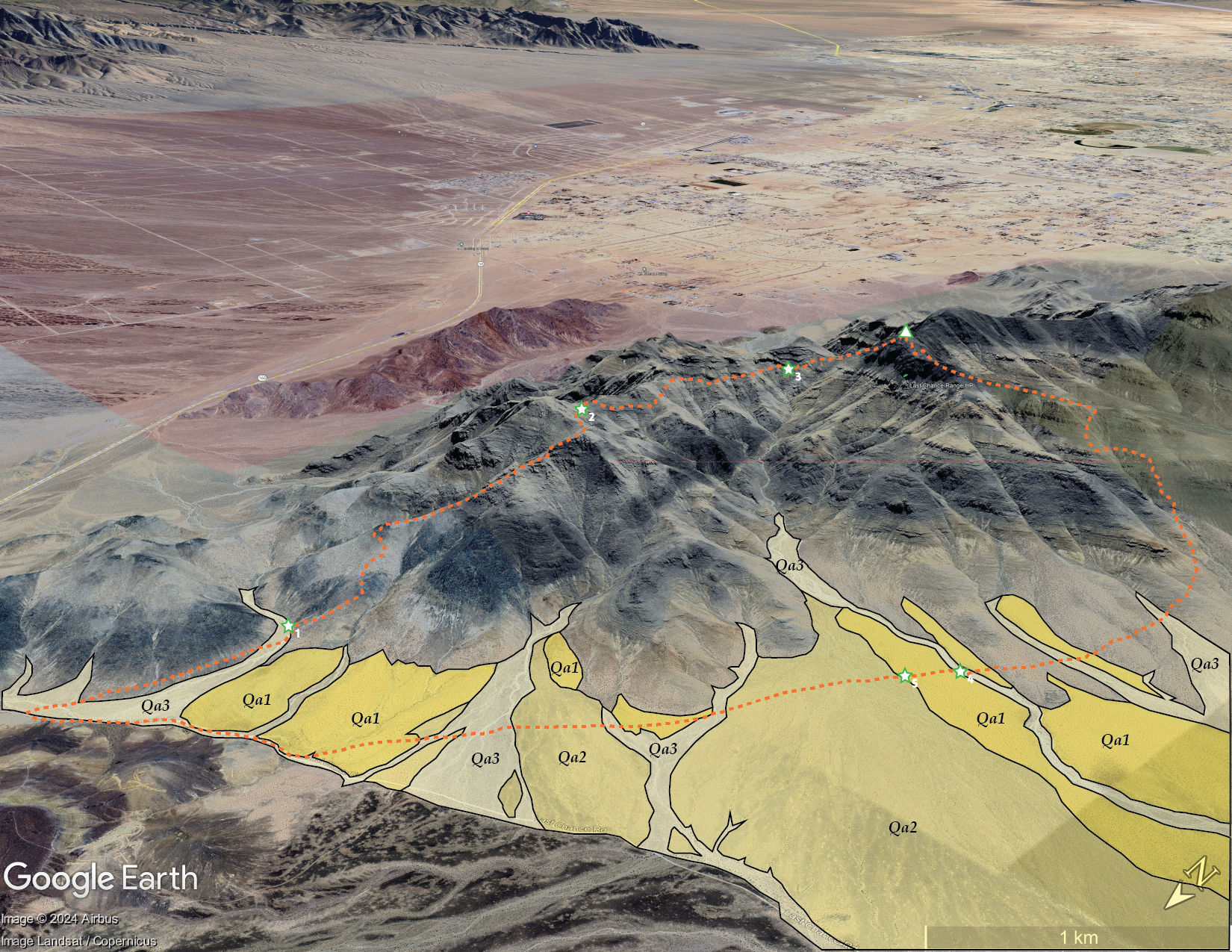
Alluvial fans of western front of Last Chance Range. Qa1: oldest (Pleistocene); Qa2: oldish (Late Pleistocene to Early Holocene); Qa3: recent (Holocene to modern). Stars correspond to map points in image captions.

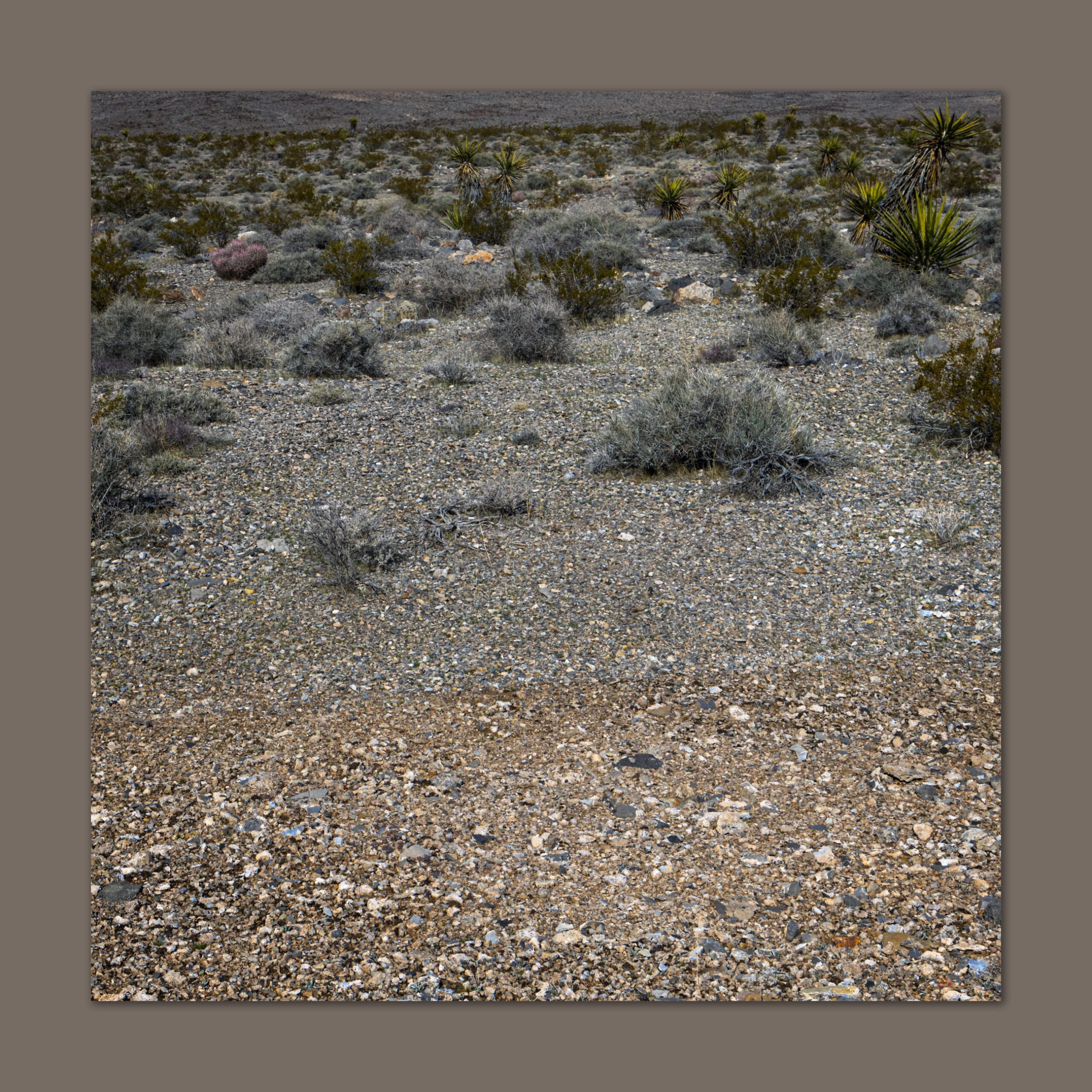
I choose a longer descent following more gradual slopes to the west, prudent when running dry as I am now – missteps may be more likely on the steeper and varied traces of the ledges of my route up. This takes a while, but over a couple miles I cross a nice section of variegated alluvial fan surfaces. The surface changes revealing clues to the age of the alluvial landforms and the soils forming on them. Color changes are abrupt and clear, like someone has drawn a geological map on the ground. Gullies show ancient soils of flaggy carbonate on stained boulders of debris flows and flood levees, the adjacent surfaces red with oxidation and dotted with turbated carbonate gravels. These give way to fine-grained, grey-colored, and recent fans and washes, where floods of the Holocene and maybe last year (!) pushed basinward from the steep, western slopes of the Last Chance Range.

Fan relic and wash. Medial fan segments along Devils Hole Wash, Mojave Desert, NV, USA (Map Point #4)
Temporal change. Variation in the alluvium on the fans below the Last Chance Range, Mojave Desert, NV, USA (Map Point #5)

Last Chance Image Collection

I am back at my truck with many hours of extra-time added to complete the loop. I will have echoes of this excursion for a few days – especially because I now have the muscular stasis of a long drive home, but it is worth it, as usual. I will note my poor planning and resolve to not to make such silly errors on future climbs; I know better (I think). It is good to be in this corner of the Mojave Desert in the closing of winter, and I suspect I will be back a few times in the coming months.

Keep going.

Click here to Subscribe!

Please respect the natural and cultural resources of our public lands.
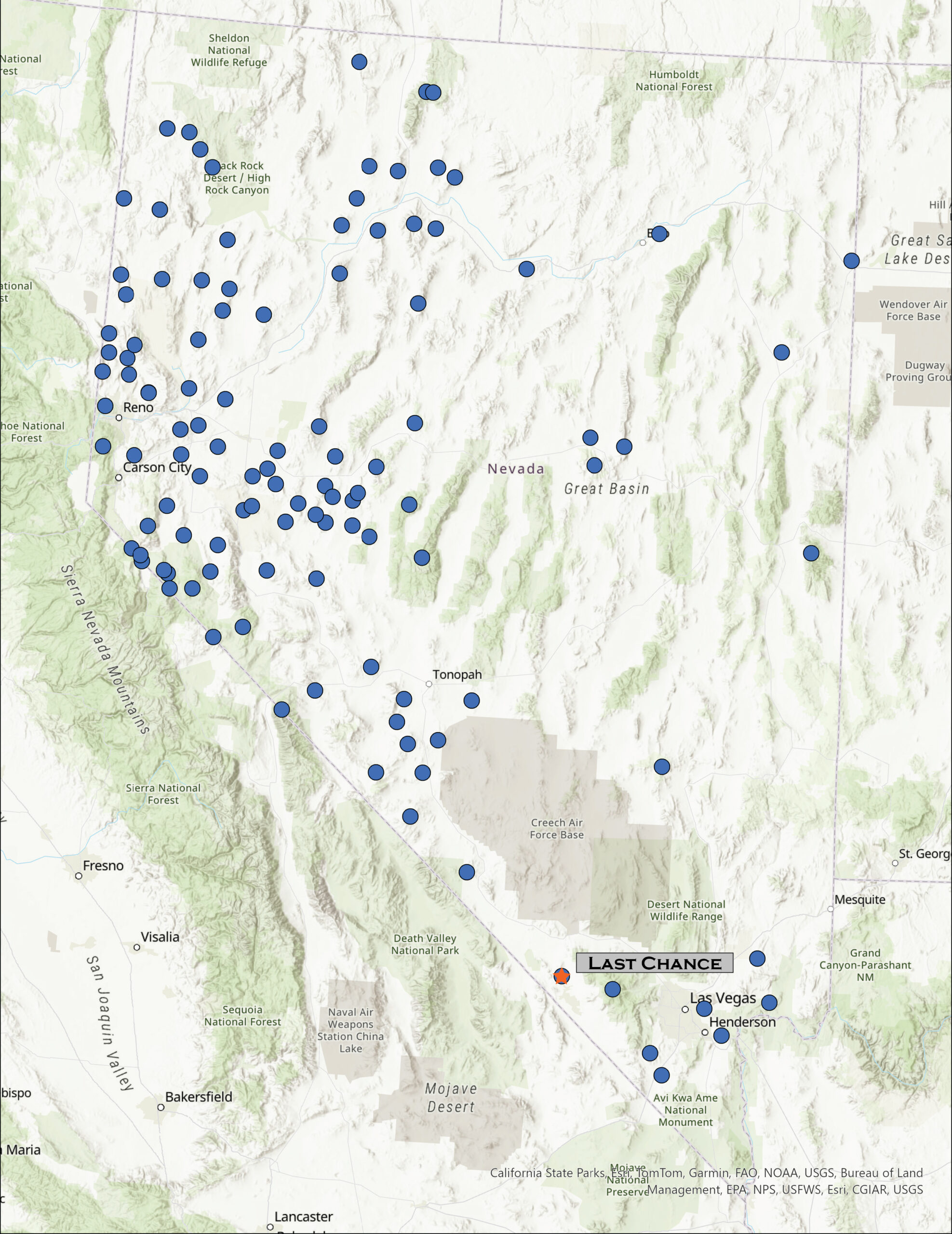
#naturefirst #keepgoing

Nevada High Points #108 – Goldfield Hills

D. Craig Young · March 14, 2023 · Leave a Comment

Mud Lake distance. The playa of Mud Lake is the northern backdrop of the Goldfield Hills, Mojave Desert, NV, USA

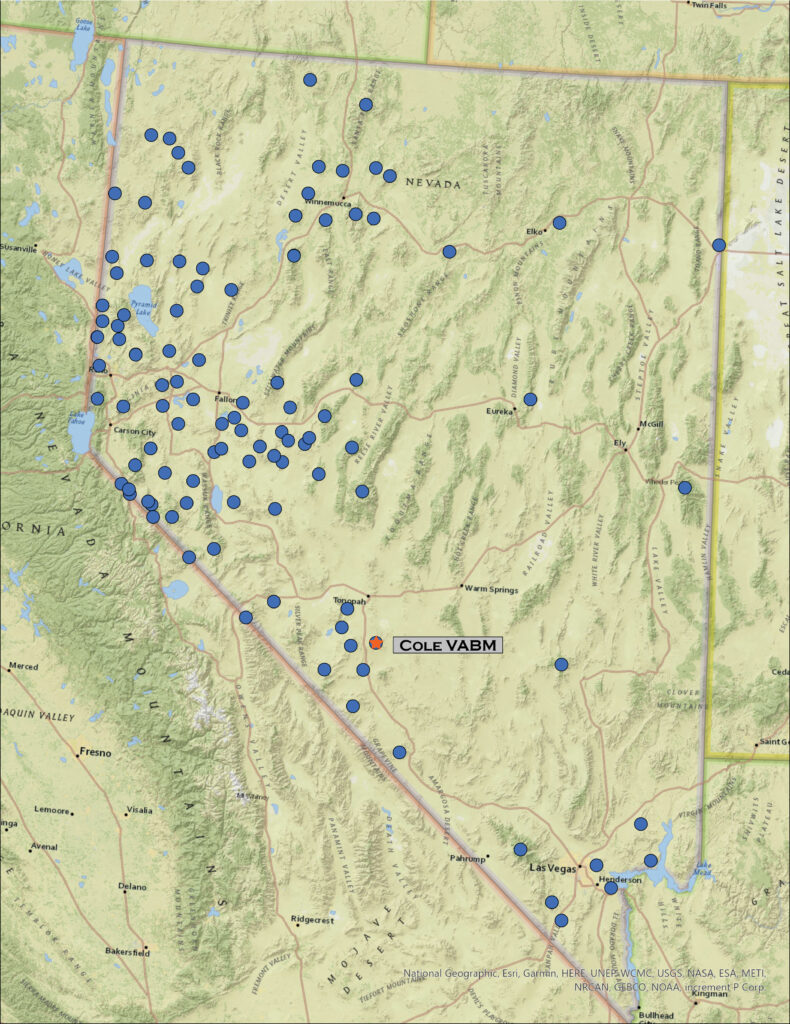
Cole VABM

6862 ft (2092 m) – 1438 ft gain

2023.01.14

Goldfield Hills Image Collection


Sitting at dinner in Beatty, after our nice afternoon in the Bullfrog Hills, Darren and I decided we would explore another small range on our drive home. The Goldfield Hills are a jumble of irregular hills around the mining town of – of course – Goldfield, Nevada. Mine tailings, head frames, and shacks mingle around prospects, some active, most not.

The thing about mining towns, those from the historic-era and otherwise, is that they are crisscrossed by a maze of roads. We turned off Hwy 95 on the margin of town and headed into the predawn among the Joshua Trees and tailings piles of all sizes. I had the high point coordinates in my dashboard Garmin with a background of topo maps; still, I took a wrong turn following a well-used road and missed the lesser track among the beaten down two-tracks. It was indeed a maze. We got it straight and worked our way to the base of Cole. Although it is not an impressive sight, the light of the early morning peaking from the east made it look worthy of a good walk.

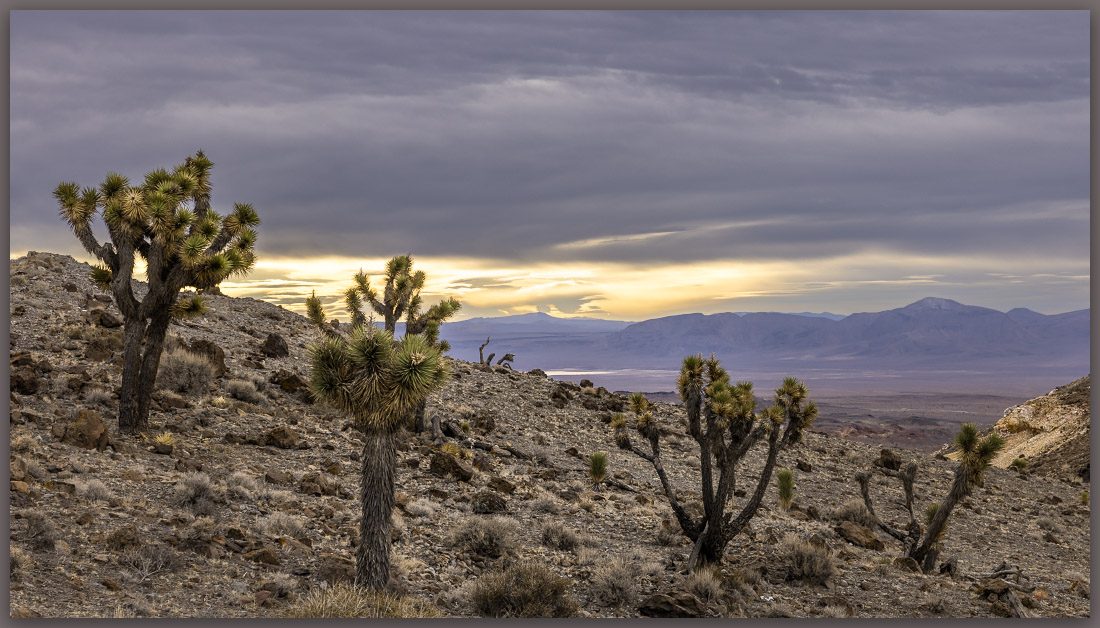
Joshua Trees at sunrise. Goldfield Hills, Mojave Desert, NV, USA
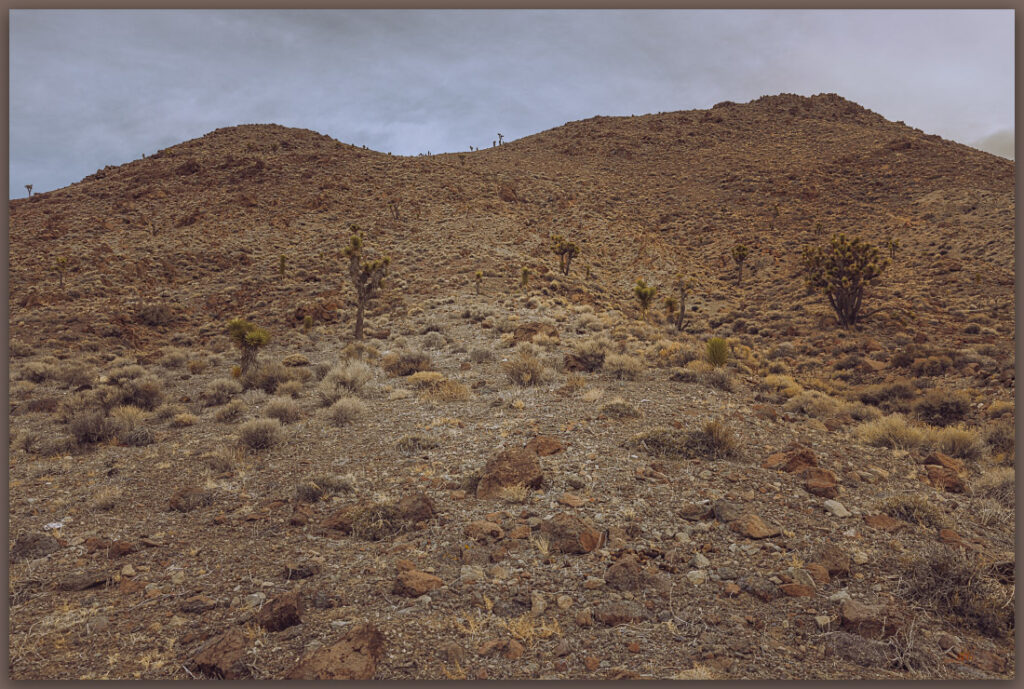
Dry approach. South-facing slopes of Cole, Goldfield Hills, Mojave Desert, NV, USA

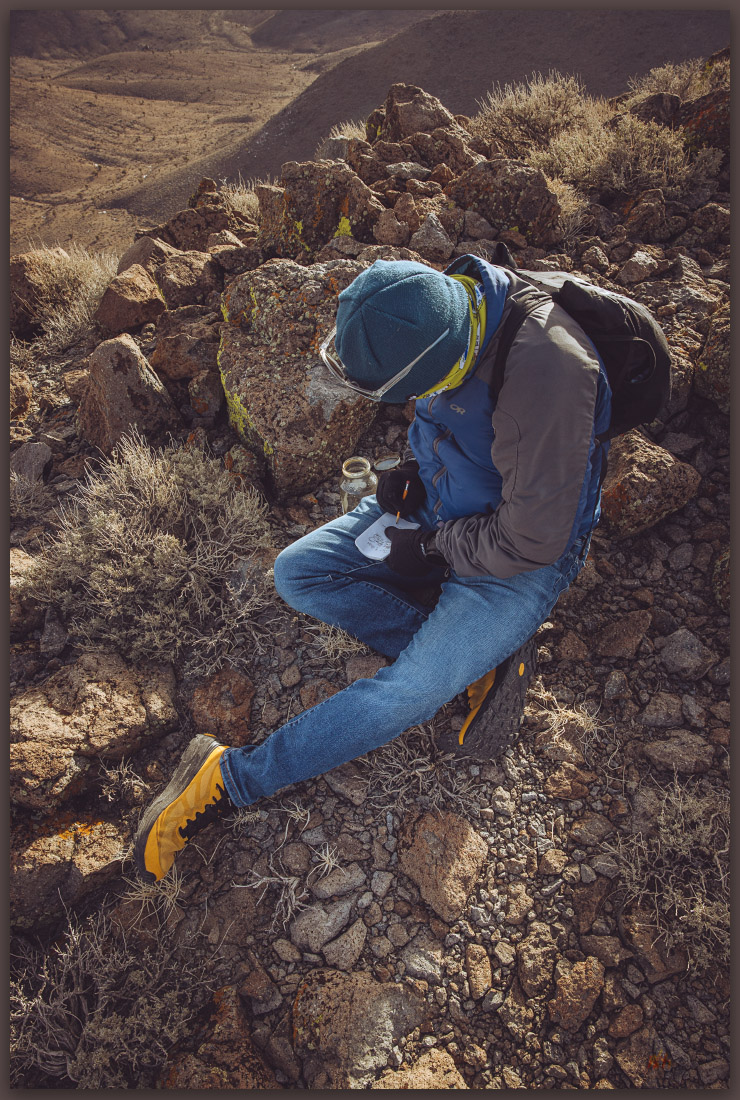
We climbed a sparse ramp on south-facing slopes to gain a rocky ridge. For the first time we could see the great views that the high point provided; we had been somewhat sheltered in the mine-strewn hills only to crest above it all as we approached the summit. A false cairn, maybe an old mining claim, rested on a southerly summit, tricking us briefly. We found a low rock stack protecting the summit register a quarter mile further north. A cold wind picked up as the sun played in-and-out amongst some low-slung clouds. We had walked for less than an hour, but these small hills remain well worth it. Surprising us as usual.

We’re there. Signing the summit register at Cole VABM, Goldfield Hills, Mojave Desert, NV, USA

The summit ridge continues north and curves gradually west to form a crescent with a west-facing opening above a steep canyon that drops to quickly to the wash below. We descended the northwestern limb following steep steps to a low pass. The sun opened up nicely, but the wind kept any warmth away. We did not have far to go, however, as we wandered among tall Joshua Trees before entering a wash that led to the truck.

Goldfield Hills Image Collection

It was quick walk, basically a short detour on our way home. I have written many times that even short excursions to small hills are worth any detour necessary. Cole VABM at the top of the Goldfield Hills is no exception.

Keep going.

Nevada High Points #107 – Bullfrog Hills

D. Craig Young · February 19, 2023 · 2 Comments

Alluvial fire. A fire scar on the north-facing alluvial fans of Sawtooth Mountain, Bullfrog Hills, NV, Mojave Desert, NV, USA
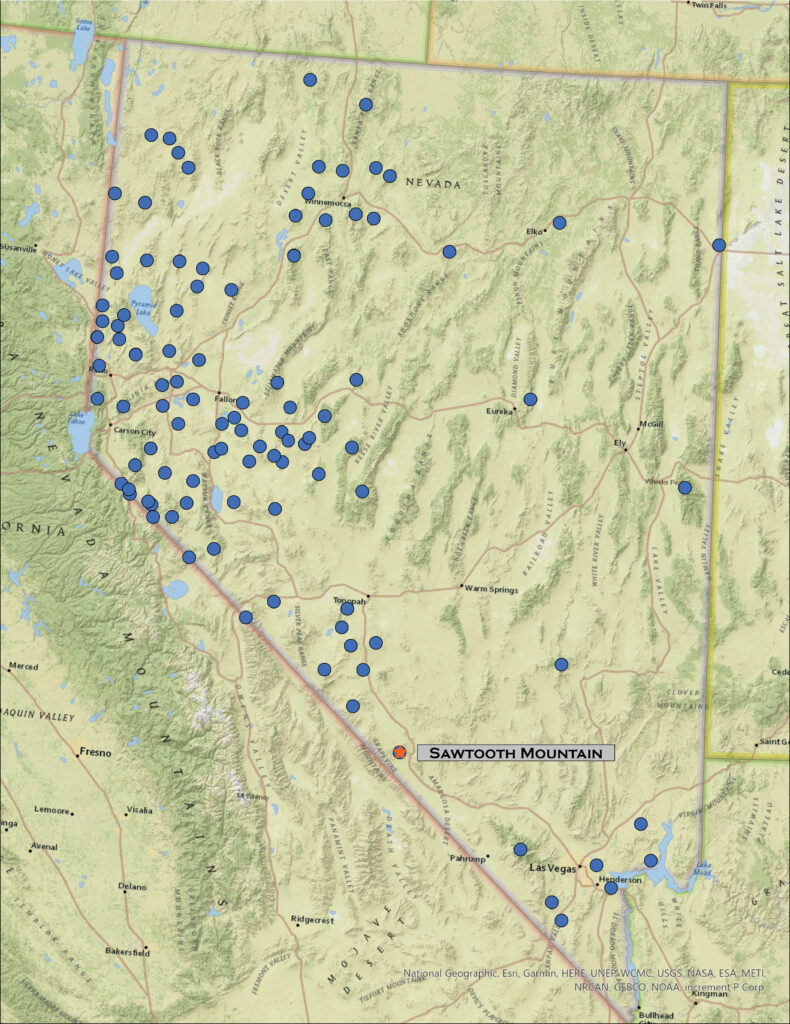
Map of Nevada highlighting Sawtooth Mountain in the Bullfrog Hills.

Sawtooth Mountain

6005 ft (1830 m) — 1438 ft gain

2023.01.13

Bullfrog Hills Image Collection


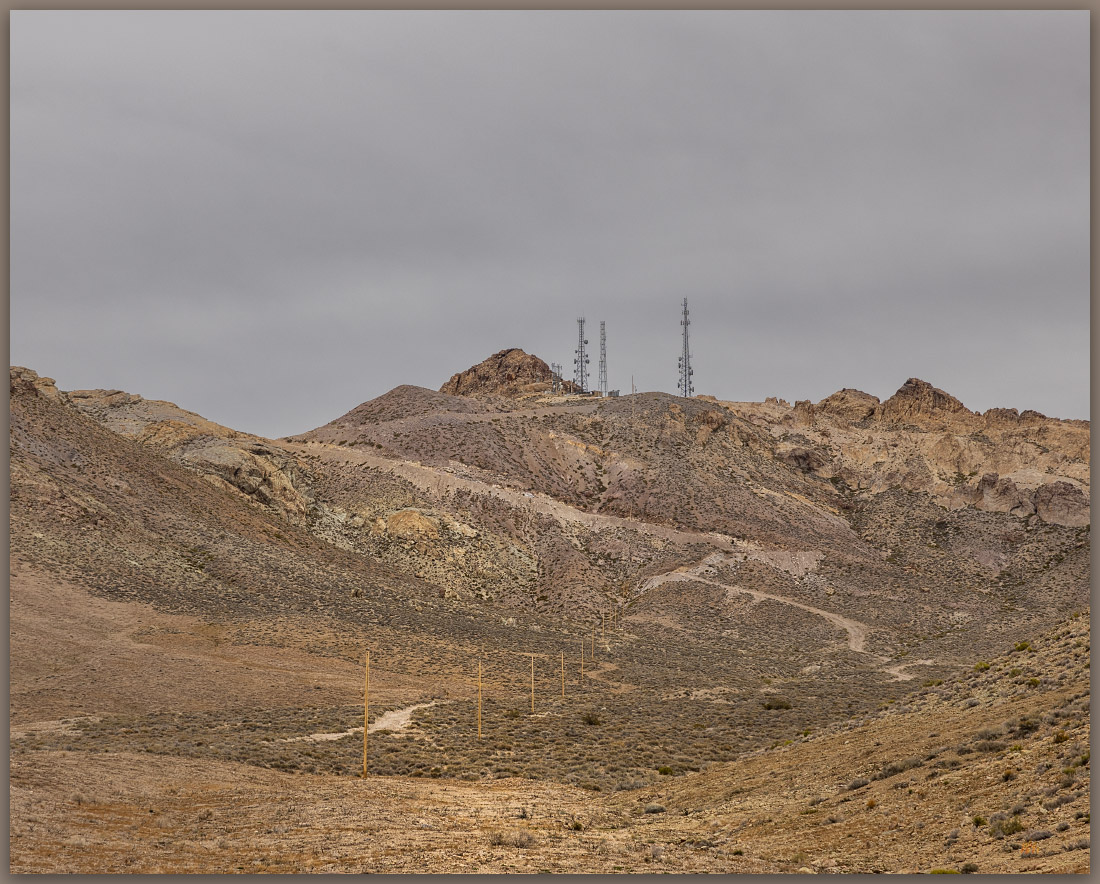
Towers. The unimposing high point of the Sawtooth Mountain hides beyond communication towers at the summit, Bullfrog Hills, Mojave Desert, NV, USA

I have been turned away twice from Sawtooth Mountain, the high point of the Bullfrog Hills near Beatty, Nevada. Dressed in a crown of radio towers, the Bullfrogs do not seem a formidable obstacle; there is even a road heading up their western side. They are, however, a bit of a puzzle.

My first try occurred in 2014 while I was in Beatty for a project on the Nevada Test Range, mapping a set of archaeological sites on the fans below Black Mountain. Trail running was my focus at the time, longer trail runs having diverted my attention from high points, and my run on that evening took me to the west side of the Bullfrogs. I followed the dirt road to the radio towers; elevation gain still a common goal of any outing. I had already decided, however, that I would run to the high point, my attention to summits remained unflagging. I found a ragged, rocky summit ridge with steep clefts and cracks carving the granitic block into the sawtooth of its name. As it grew dark, I tried to find a break in the cliffs. I could not, however, find a way to the top without some serious exposure, not something I would risk on a solo outing.

McLane only mentions one ‘Class 5’ summit in his review of ranges. Indeed, until now I could confirm that – I have been to the base of that summit block at Jumbo Peak in far southern Nevada, where the solo risk also turned me away, but he did not mention anything difficult about the Bullfrog Hills. I returned for a second try the following evening, but again the late-season darkness prevented me from a complete circle of the summit ridge. I did not make the top. Fooled again.

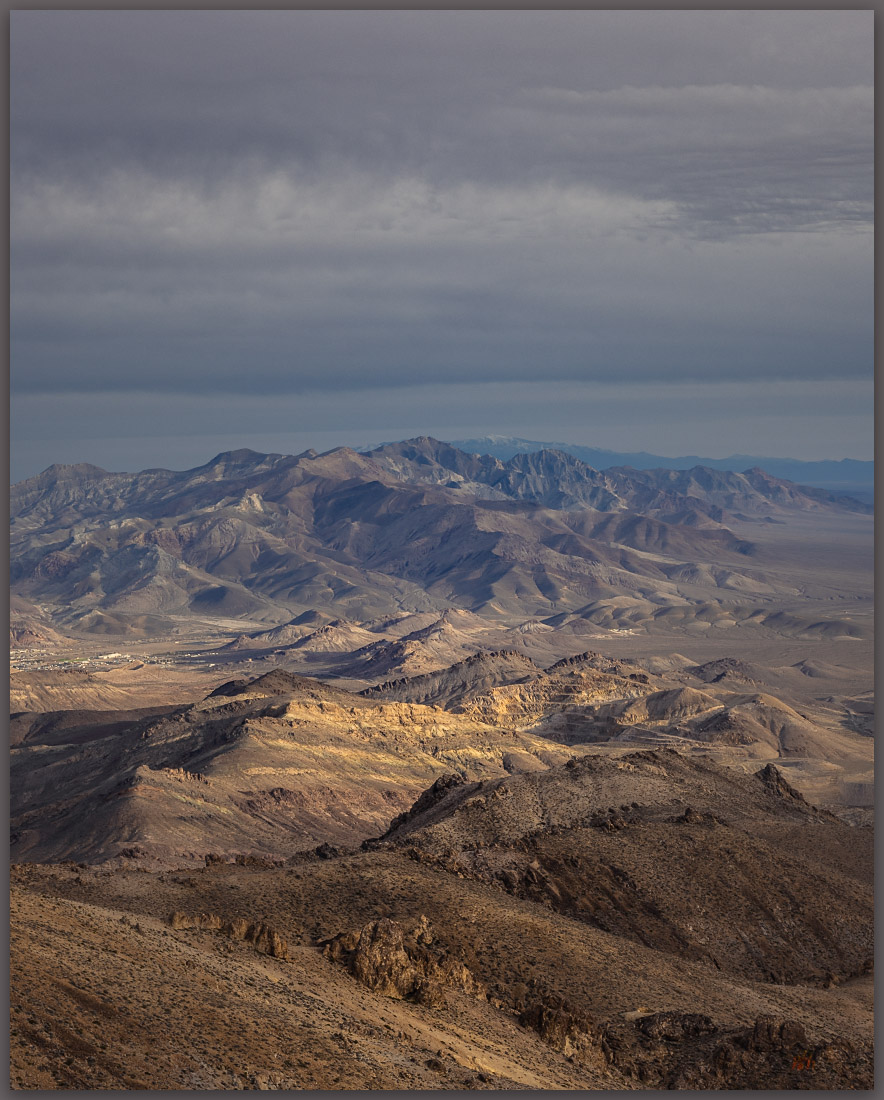
Beatty to Bare. Bare Mountain rises above the town of Beatty, Bullfrog Hills, NV, Mojave Desert, NV, USA
Tuff. Volcanic rocks at last light, Bullfrog Hills, NV, Mojave Desert, NV, USA

So here I was, eight years later for another try. Darren was with me, and we a few pieces of climbing gear just in case. I reviewed my memory of previous visits as we walked the road to the towers – not a compelling approach, but I had been here a few times, of course; the pleasant feeling of exploration was lost. I retraced my past steps below the summit outcrop, introducing Darren to the puzzle. Deciding it best to make a complete circle of the outcrops before taking out any gear, we stashed our packs and set out in opposite directions.

The cliffs rise from steep colluvial slopes with stone stripes and talus cones. Interesting alcoves undercut the outcrops and leaning boulders harbor sandy gardens of desert plants. Moving further east and north along the ridge than I had previously, I tried a few benches that followed seams and breaks in the bedrock. Each one terminated in an interesting but overly steep crack or overhang. Was it really this difficult? My technical rock-climbing days are long behind me, and I was not sure I really wanted to give that a go. And I had not seen Darren in a while.

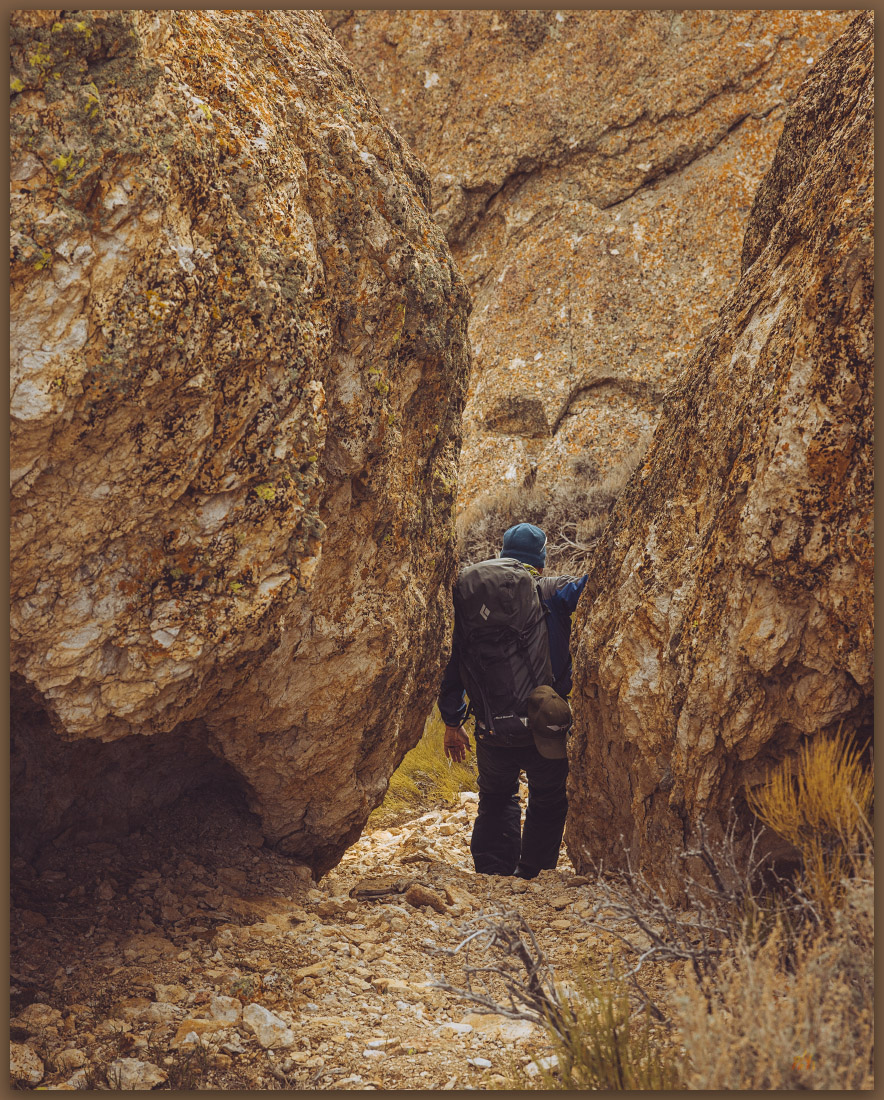
Navigation. Darren finds his way between summit boulders, Bullfrog Hills, NV, Mojave Desert, NV, USA

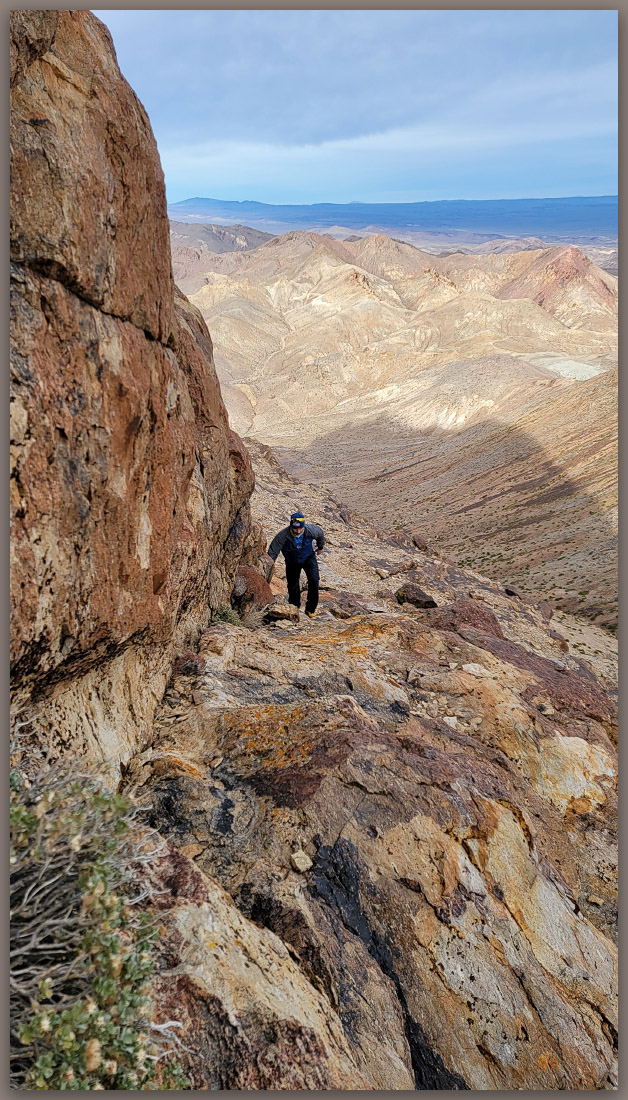
I finally found a faint but safe ledge that led to the northern base of the summit ridge. The views were great in all directions. I could see easy slopes below me but nothing breaking the wall above me from where I now stood. As I turned back, I saw I could take two high steps to access a narrow ledge and, with a couple other moderate steps, I was walking an easy ramp with nice exposure to the summit – not difficult at all, just needed to find the key.

The key. Darren finds the easy way, Bullfrog Hills, Mojave Desert, NV, USA

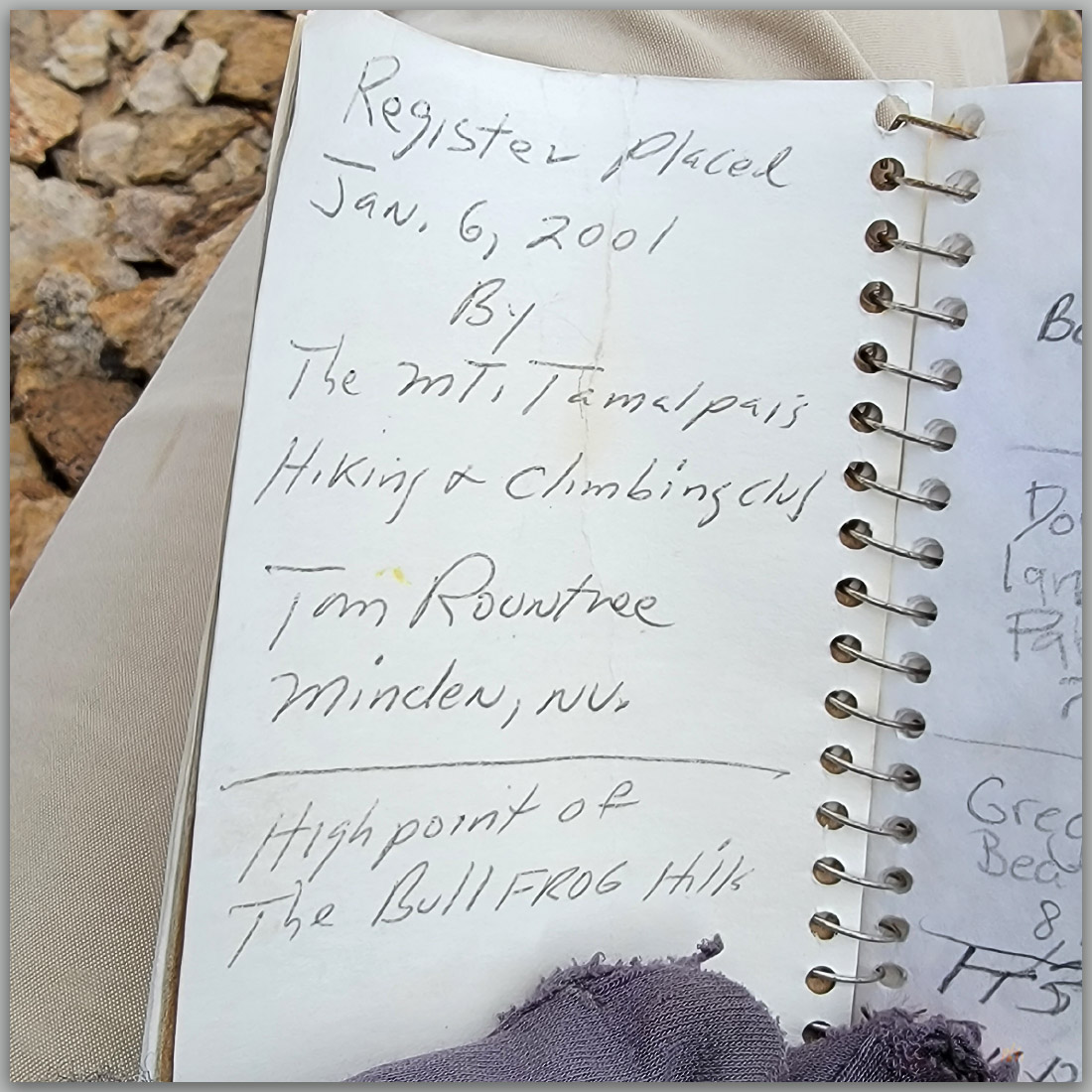
Darren was still working his way along the western cliffs, after following me on a couple dead ends on the east side. I eventually pointed him to the ‘hidden’ ramp at the north end, and we finally met on top. We had an agreeable laugh with a note in the register that read, “Finally found the easy way up.”

Register. Tom’s little notebook on the summit of the Bullfrog Hills, Mojave Desert, NV, USA
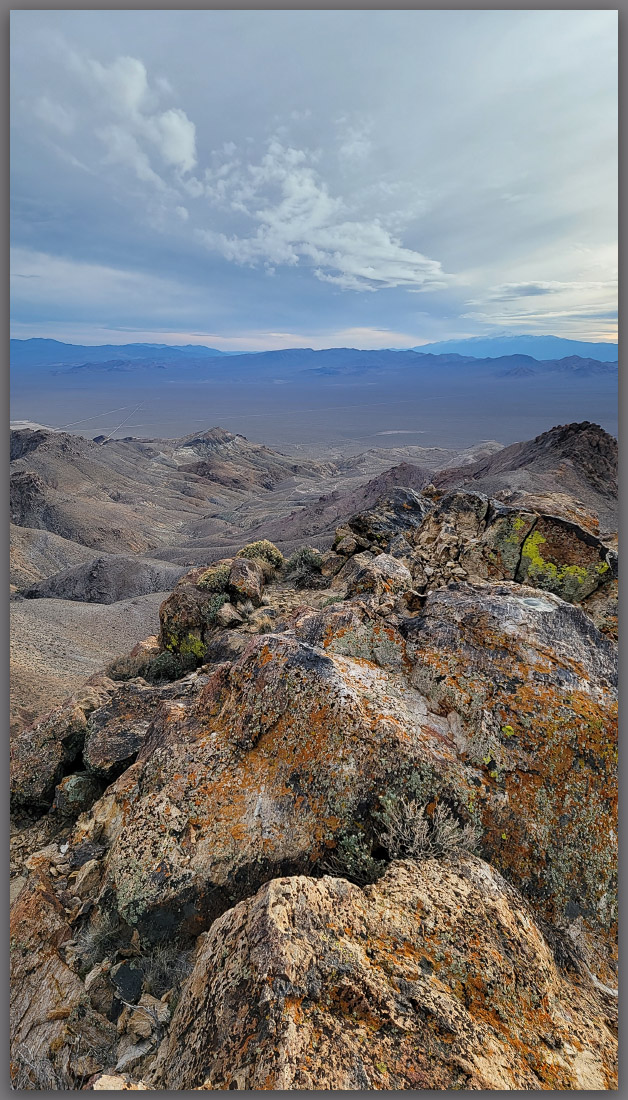
Summit ridge. I felt I had earned this rocky little summit, Bullfrog Hills, NV, Mojave Desert, NV, USA

Bullfrog Hills Image Collection

I have been thinking about persistence. Good work and creativity take practice, discipline, and determined patience. These, for me, are often hard to come by. But maybe I can take something from continuing my efforts in the Bullfrog Hills. Sawtooth Mountain, their high point, is not an epic pursuit, though it has good prominence over the arid headwaters of the Amargosa River. While relatively easy in the end, it was my persistence – and renewed passion for walking among the Nevada ranges – that finally led to success.

Keep going.

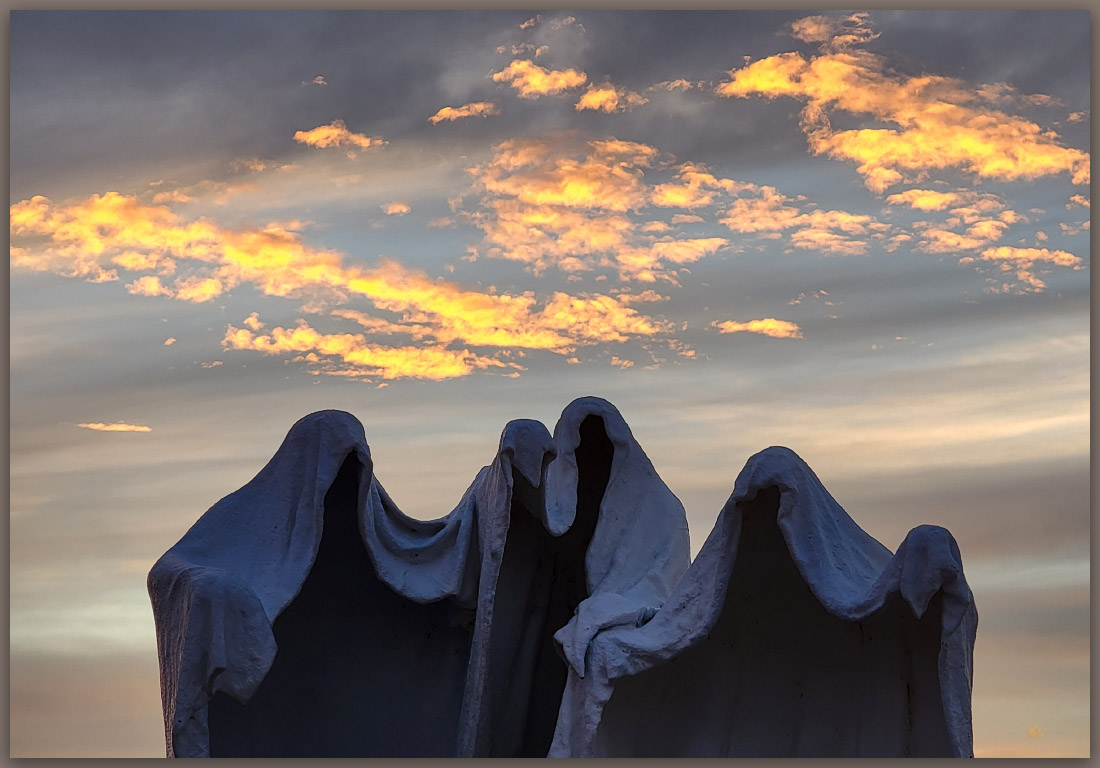
The figures. Szukalski’s sculptures at Rawhide, Mojave Desert, NV, USA
Inquiry. Szukalski’s sculptures at Rawhide, Mojave Desert, NV, USA

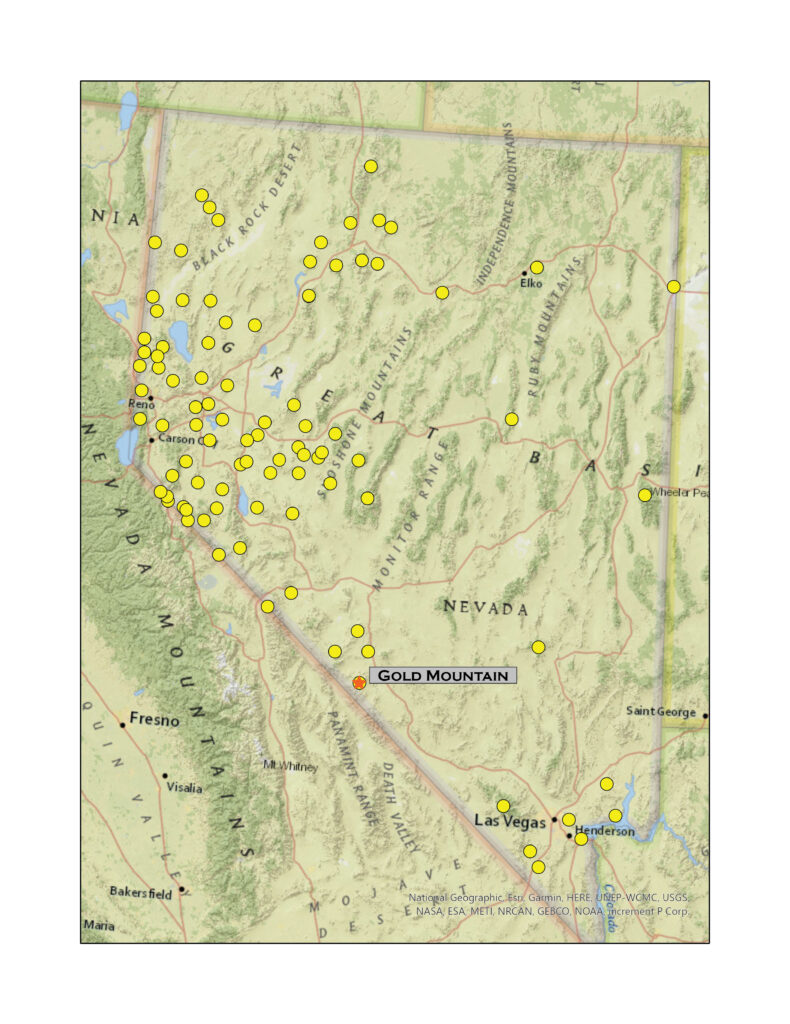
Nevada High Points #98 – Gold Mountain

D. Craig Young · March 12, 2022 · 1 Comment

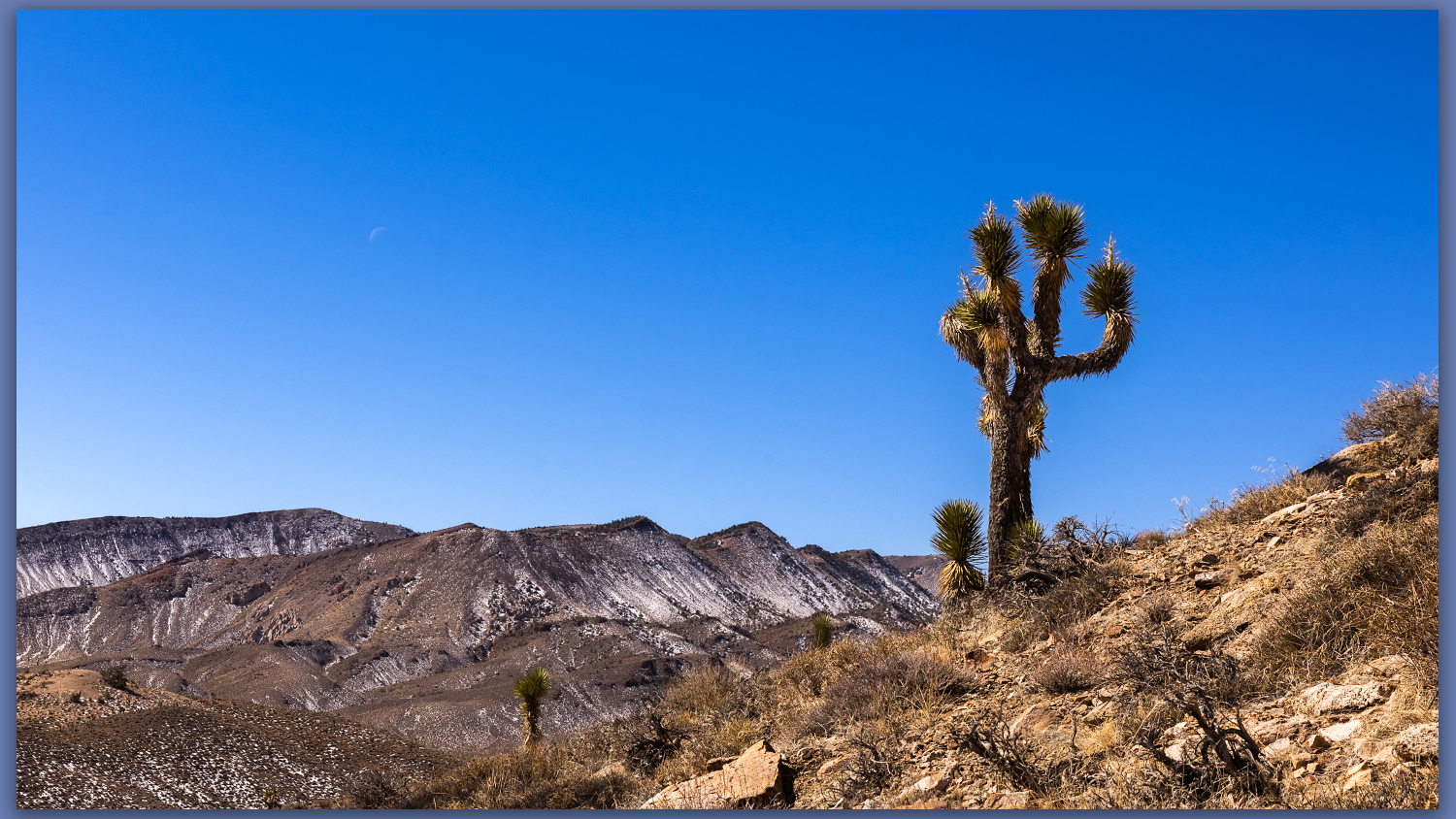
A Joshua. Westward from slopes of Gold Mountain, Mojave Desert, NV, USA

Gold Mountain

8152 ft (2485 m) – 2300 ft gain

2022.02.25

Gold Mountain Collection

It was finally time to get back to a desert high point – my string of monthly highpoints having been broken by a wonderful trip to Patagonia and Atacama Desert in Chile (stories and images coming soon).

Although we have not had good precipitation in 2022, a couple slider storms have left dustings in the high country and access can be an undesired, muddy adventure as early runoff continues. With this in mind, Darren and I ventured southward into the Mojave to find the south-facing slopes of Gold Mountain above Bonnie Claire Flat. It is a long but easy drive through Tonopah and Goldfield before turning west toward Scotty’s Castle and the former northern, paved entrance to Death Valley National Park – the road remains closed where, several years ago, the headward drainage of an alluvial fan reclaimed the highway near the castle grounds. It makes for a quiet section of highway along Bonnie Claire between Gold Mountain and the Grapevine Mountains.

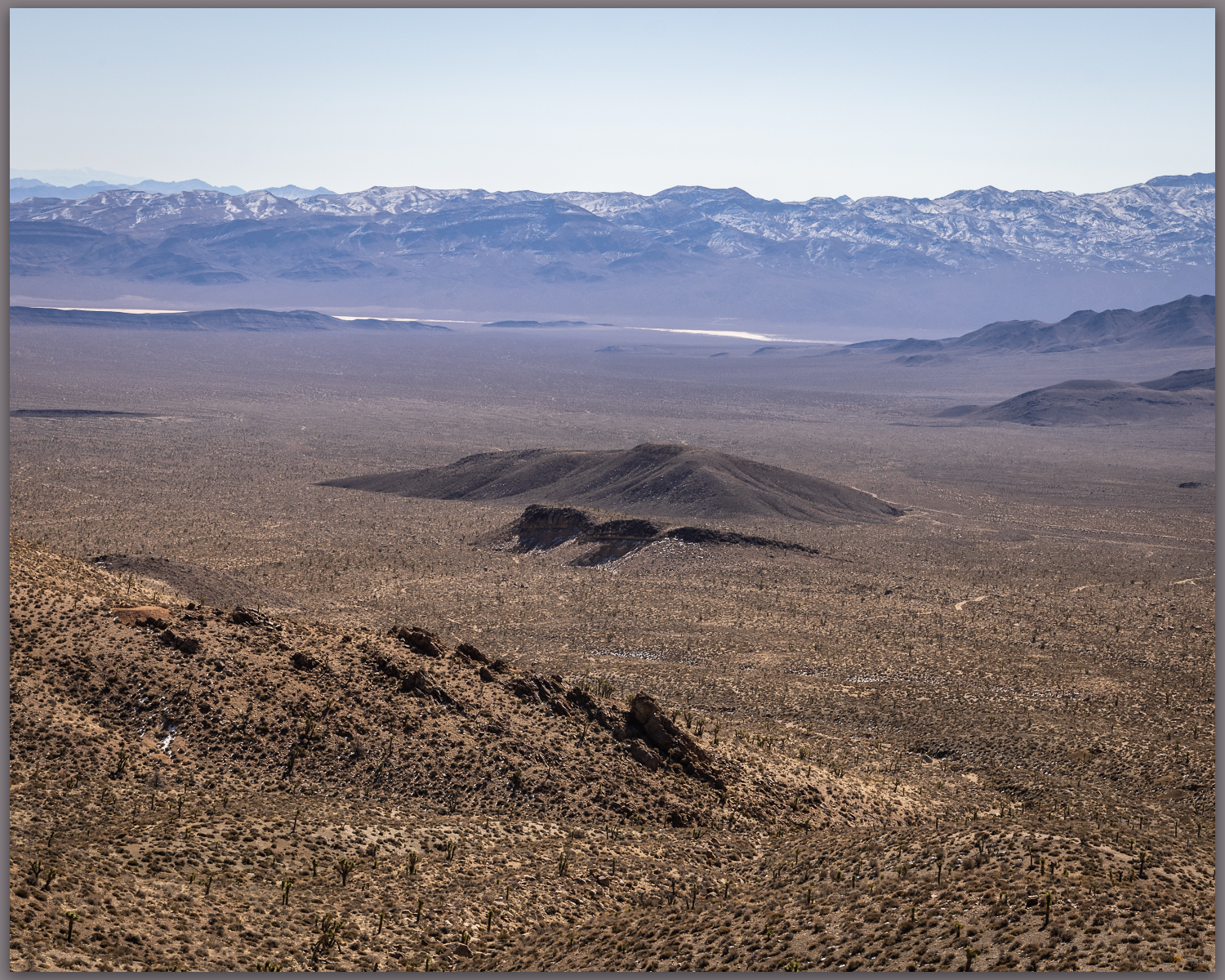
Bonnie Claire Flat. Southern slopes of Gold Mountain, Mojave Desert, NV, USA
Bonnie Claire distance. Southeast toward Obsidian Butte, Mojave Desert, NV, USA
Bonnie Claire Flat. Southern slopes of Gold Mountain, Mojave Desert, NV, USA

We turn northward up the fan, encountering traces of Bonnie Claire Airfield before tracing our way to some mining prospects at the toe of the mountain front. There is a cool breeze as we head out, but we are soon warm as we gain elevation. On a moderate slope we walk up loose, dusty scree with Joshua trees scattered among granitic boulders. Prospects dot the hillsides where seams of hydro-altered rocks and occasional volcanic dikes run through their host outcrops; these intrepid miners chased riches promised by the historic strikes of nearby districts, and who could pass up “Gold Mountain”?

Snow remains. North slopes hold fading winter moisure, Mojave Desert, NV, USA

The scattered Joshua trees give way, with elevation, to a pinyon woodland where a few Pinyon Jays call out – I fail to see the talkative birds, however.  Darren reaches a small cornice which preserves the recent snowy turbidity of recent storms; the small wave climbs from the ridgeline but we step over and through to reach the rocky slope of the summit outcrop. A square cairn protrudes from the summit where we can look westward to the Sierran Crest and eastward into the Basin and Range. It is a simple but very worthwhile summit, as is most often the case in the smaller isolated ranges throughout Nevada.

Gold summit ridge. Pinyon woodland near the summit of Gold Mountain, Mojave Desert, NV, USA
Summit time. The brothers at the summit cairn of Gold Mountain, Mojave Desert, NV, USA
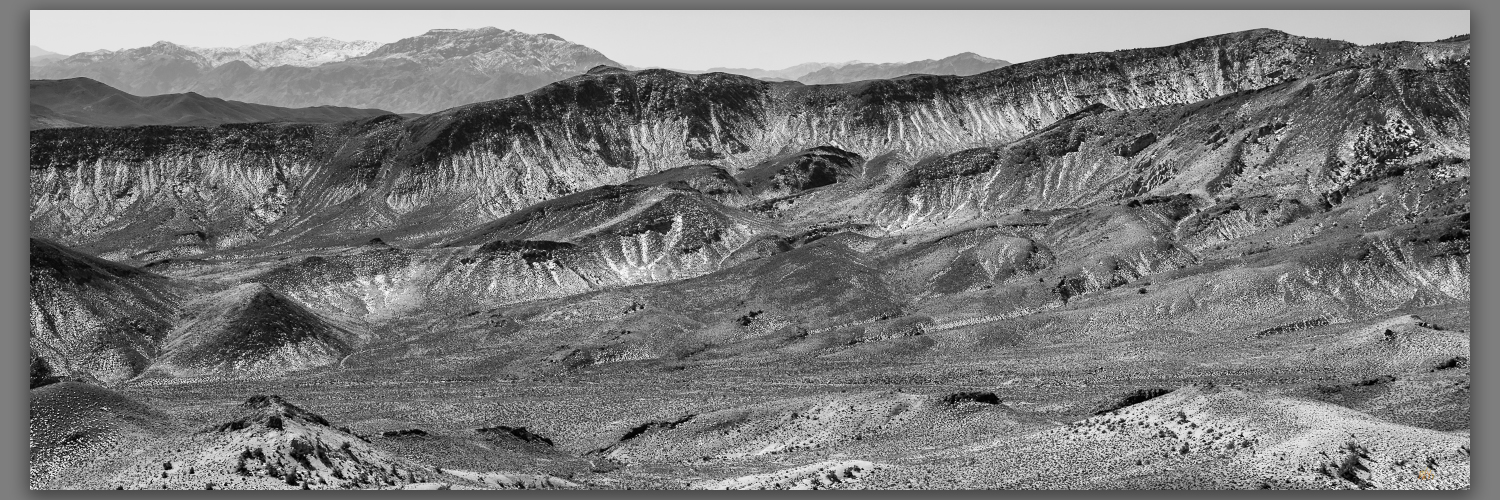
Gold Mountain. The summit rises above Joshua tree canyons, Gold Mountain, Mojave Desert, NV, USA

Gold Canyon Collection

We drop southward to look for one of the larger prospects among a dense pinyon grove. Our descent takes us too far west, a bouldery outcrop and sandy canyon drawing us downward.  I am not, however, overly fascinated by the old mines, so we take the descent following game trails toward the fans that feed into Bonnie Clair. We are quickly back to the truck where we marvel at the afternoon warmth. It is time to return to the chill of the northern valleys and we head homeward. A good day for a high point outing, taking advantage of windshield time to catch up with my brother and feel the warmth of a winter day at the edge of Death Valley. 

Keep going.

Please respect the natural and cultural resources of our public lands.
#naturefirst #keepgoing

  • Page 1
  • Page 2
  • Go to Next Page »

Trail Option

Copyright © 2025 · Monochrome Pro on Genesis Framework · WordPress · Log in

  • Contact TrailOption
  • Substack
  • Waypoints Bibliography
  • Young Archives