• Skip to primary navigation
  • Skip to main content

Trail Option

A personal geography of landscape and place, art and geo-science.

  • Home
  • TrailOption Blog
  • About
  • Contact TrailOption
  • Subscribe!
  • Lost Journals
  • Show Search
Hide Search

smoke

Nevada High Points #87 – Anchorite Hills

D. Craig Young · September 6, 2021 · 4 Comments

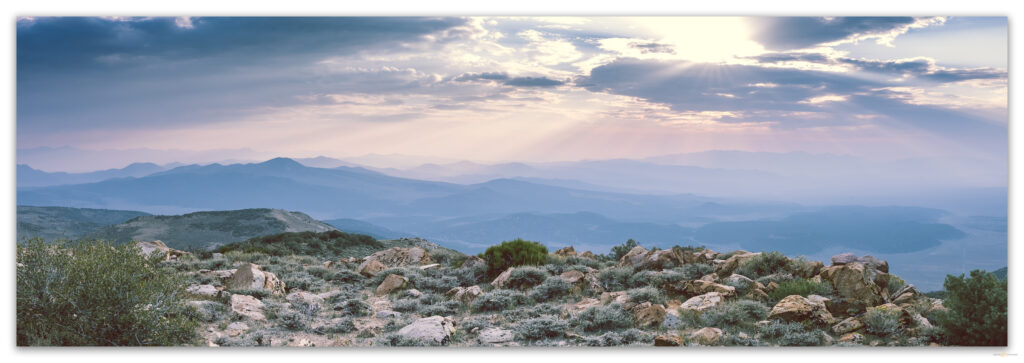
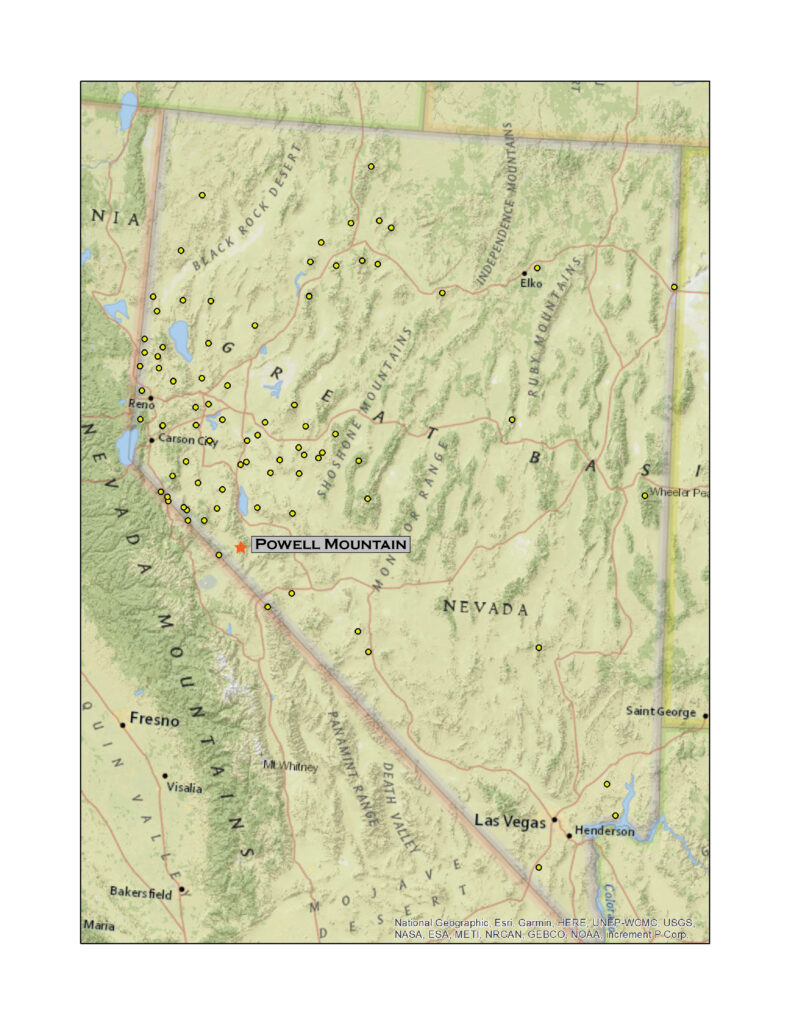
Evening skies over the Bodie Hills from the summit of Powell Mountain, Anchorite Hills, Great Basin Desert, USA

Powell Mountain

9530 ft (2905 m) – 1988 ft gain

2021.08.13

It took a long time to get going today. Smoke from Sierran wildfires has filled Carson Valley for weeks it seems – now the typical summer atmosphere, and the heat has been oppressive, forged one-to-one with the unending haze. Could I drive out of it? Climb above it? It was hard to get motivated.

The Anchorite Hills rise as an afterthought, like a comma, on the southern end of the Wassuk Range, the home of Mount Grant above Walker Lake. Low mountains of rhyolite and granodiorite host thick pinyon woodlands that give way to old fire scars where, high up, a few limber pines stand haggard and scraggly in protected canyons and bowls. I found Curleaf mountain-mahogany (Cercocarpus ledifolius) wrapping the highest ridges and extending to the range’s highpoint at Powell Mountain. However, boulders scatter among the vast areas of open Montane Zone shrubland, which makes for nice walking on open slopes, approaching ridges, and intervening hummocks.
HP #87 Collection

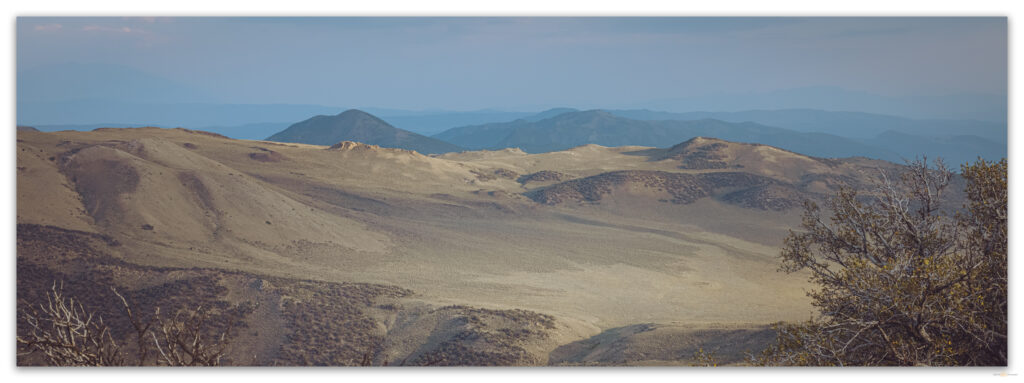
Southern view toward Table Mountain from Powell Mountain, Anchorite Hills, Great Basin Desert, USA

I approached the Anchorites from the West Fork of the Walker River, following the Hawthorne Road toward Lucky Boy Pass. After watching an Osprey dance above the Walker, I skirted Rough Creek and traced along Mud Spring Canyon and its numerous tributary washes to get to the broad pediment of the Borealis Gold Mine. I turned south to cross a beveled landform cut by dry washes with clear evidence of being not so dry very recently. Detritus of sticks, weeds, and mud hung as snags in washes were bedforms showed ripples and pools of a passing flashflood. I was a day or two late, but new thunderstorms were brewing. The monsoons of recent days had been rather weak and primarily anchored to local topography – the cells built above highpoints and stayed there, mostly. I was headed for a highpoint, but it wasn’t as high as Corey Peak and Mount Grant to the north, and that was where today’s storm held its ground.

A few raindrops pelted me as I scouted on foot for a camp. I had driven the rig and trailer to a good turn-around and searched ahead for a spot that was not too tight and would not get damaged if I brought the trailer further up the two-track road. I had already made a sketchy turn-around exploring the pass between the Wassuks and the Anchorites; that track being riddled with flashflood debris stuffed into a typically good dirt road. Tonight’s camp would be below Powell Spring where pinyon-juniper woodland transitions abruptly to valley shrubland at the foot of the Anchorites. Four pinyon jays and a pair of western bluebirds checked on me as I set camp.
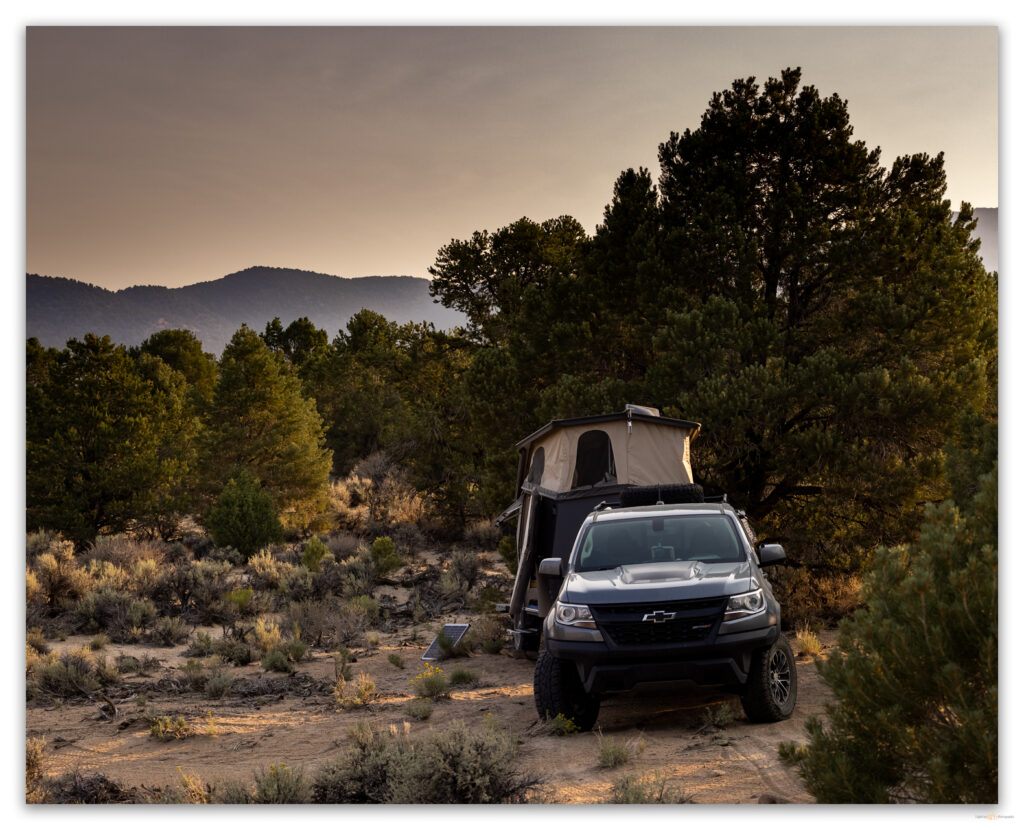
Quiet camp in the pinyon woodland of the Anchorite Hills, Great Basin Desert, Nevada
Powell Mountain, high point of the Anchorite Hills, Great Basin Desert, Nevada

I had originally planned to climb the short distance to Powell Mountain – about a mile and half from and two thousand feet above camp – in the morning, but the brush of rain had cooled and cleared the skies, so I set off. If I could get through the riparian brush of Powell Spring and the canyon above it in less than an hour, I should be able to access open country and get up and back before dark. I did not want to navigate the densely enclosed canyon by the light of my headlamp.

There is a broken-down cabin at Powell Spring; it spooked me as I came through a patch of Desert rose and willows – I do not want to visit this in the dark either! The canyon was just navigable. I walked along the dry runnel of the canyon floor, climbing onto outcrops that walled the canyon to get around ‘steps’ where groundwater allowed a fluorescence of willow. Here and there, dense skeletons of willows, blown flat by the weight of a snow avalanche, possibly, blocked my forward progress. While this half-mile took quite a while, I made the steep open slopes below the summit in good time. Here, I started the difficult steps into the gravelly soft sediment, a mix of dust and slopewash alluvium, that blankets the bouldery slopes below the southwest ridge. I could reach out and touch the hillside I was climbing; it was much steeper than I expected. I stumbled between shrubs and boulders, but I quickly gained elevation.
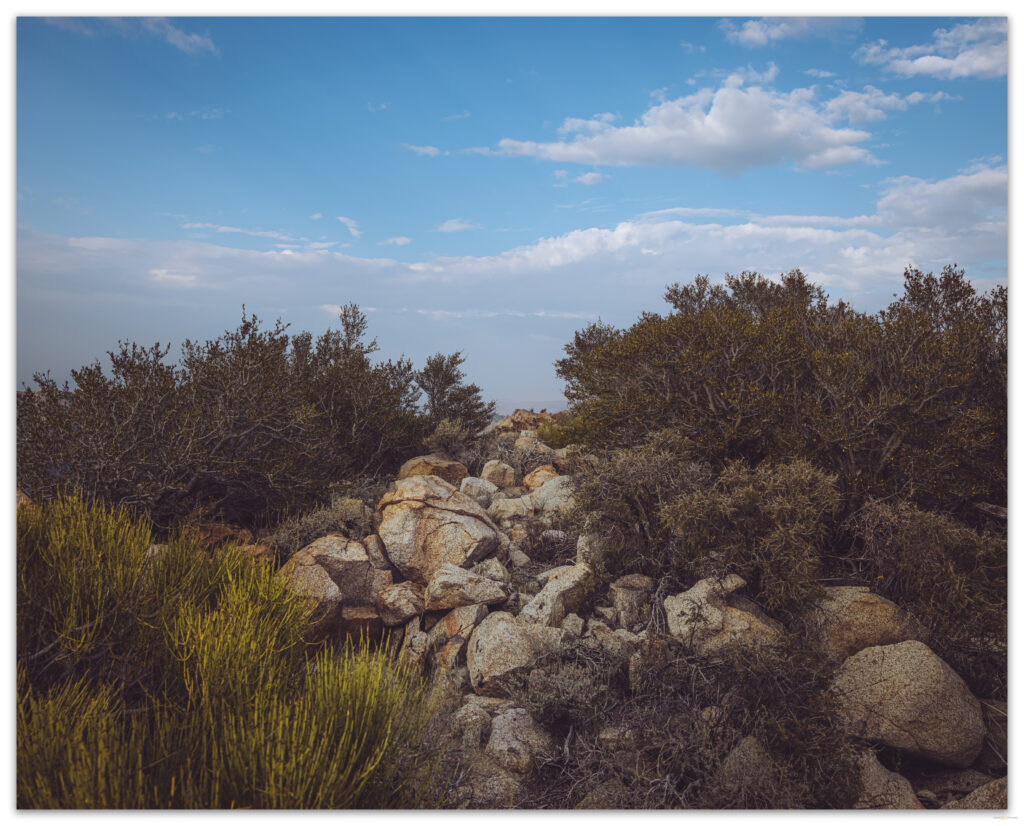
Final approach to the Mahogany woodland at the summit of Powell Mountain, Anchorite Hills, Great Basin Desert , USA

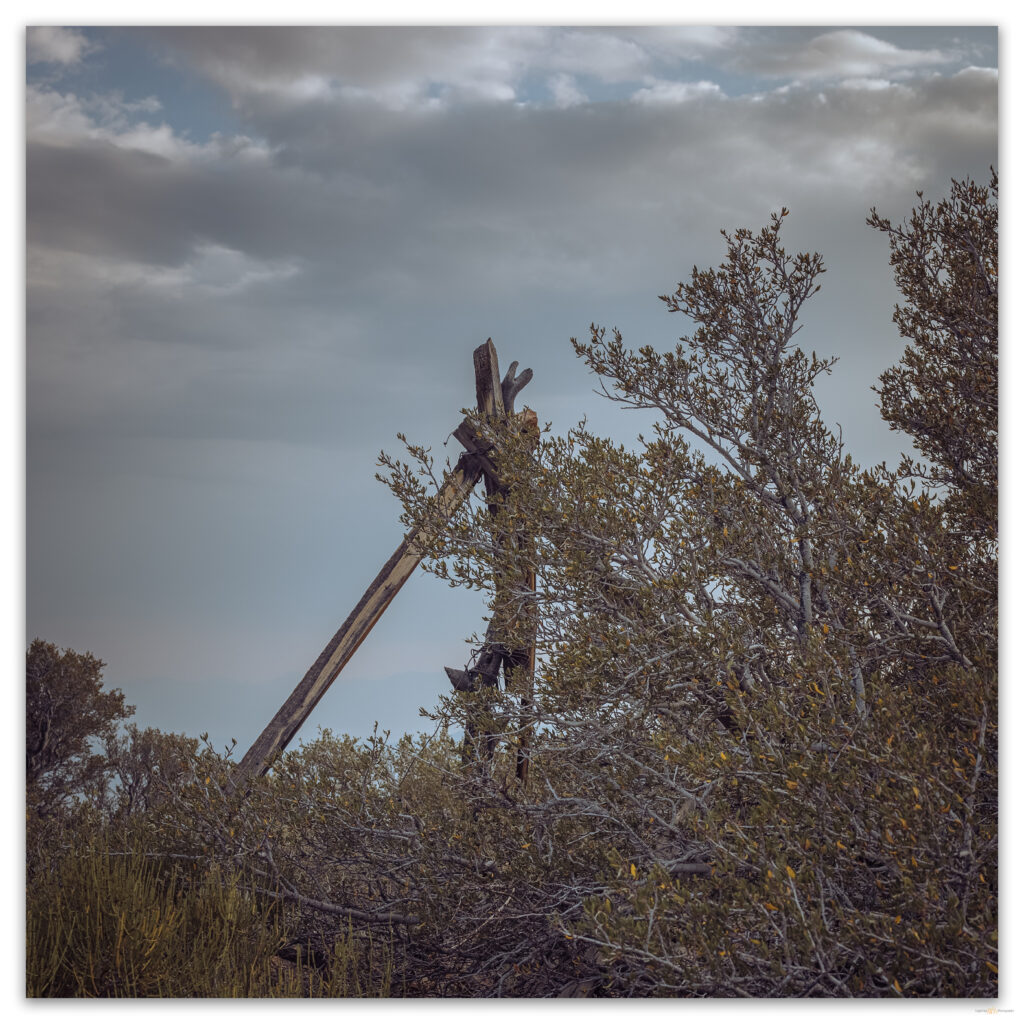
As I gained the boulder-strewn summit, I was surprised by the seemingly sudden appearance of little, packed woodlands of mountain-mahogany. It took me a few minutes to find the actual summit marked by a wood-staked survey marker hidden among the shrubby trees. The register was lost among a thicket of branches. It is not a popular summit, though I found one of the few groups to visit had hiked up here only last weekend. After signing in and watching the smoke begin to block the sunset, I knew I could not linger. I had to get through the thicketed canyon before dark.
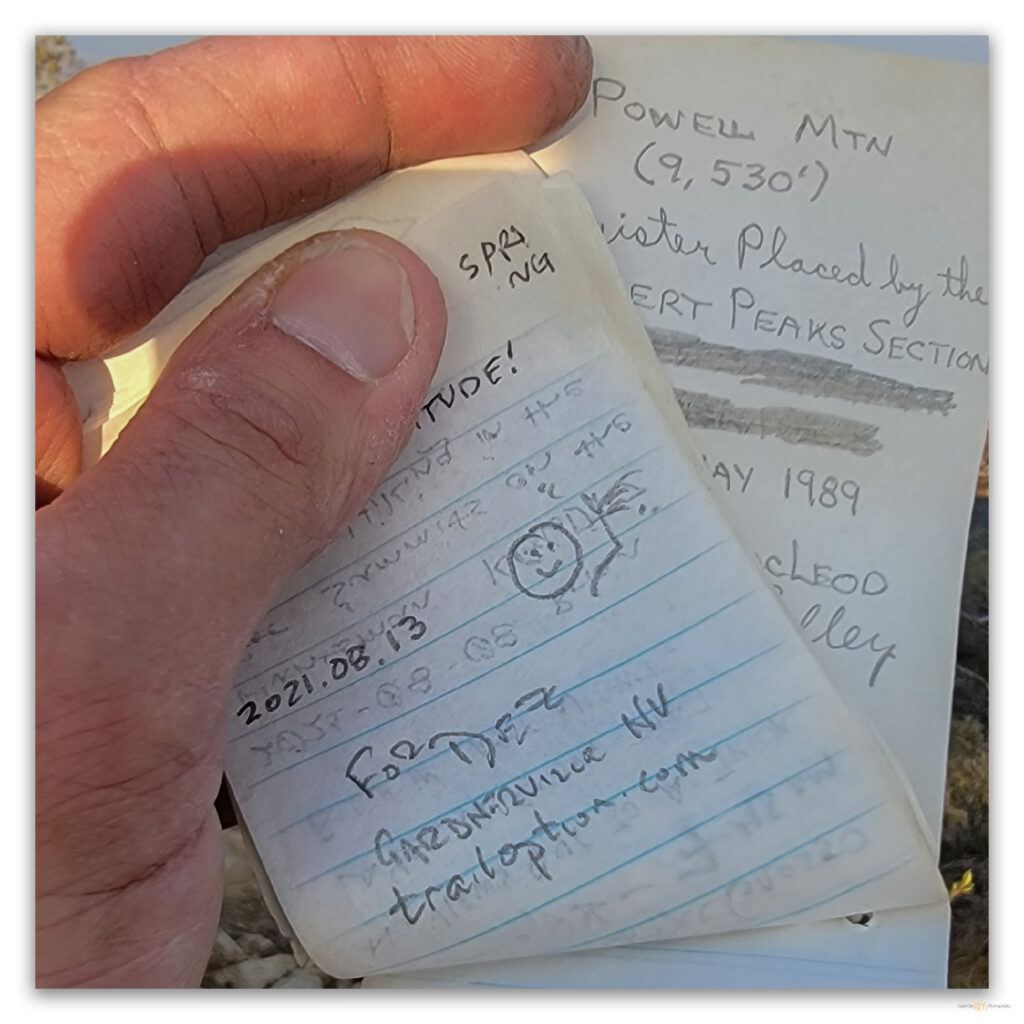
Summit register – Powell Mountain.
Triangulation marker at summit of Powell Mountain, Anchorite Hills, Great Basin Desert, USA

There is some ease in descending a dirty, grussy slope. It goes quickly until a foot gets caught in root or branch, a reminder that gravity could easily win. In the steepness of the upper canyon, I startled a small owl – likely a Northern Pygmy (Glaucidium californicum) – that had been feeding on a finch-sized songbird. It was likely a recently fledged juvenile in a daily roost, benefitting from a parent-delivered meal. It was too dark for photography, and I did not have patience to wait while the canyon floor darkened.
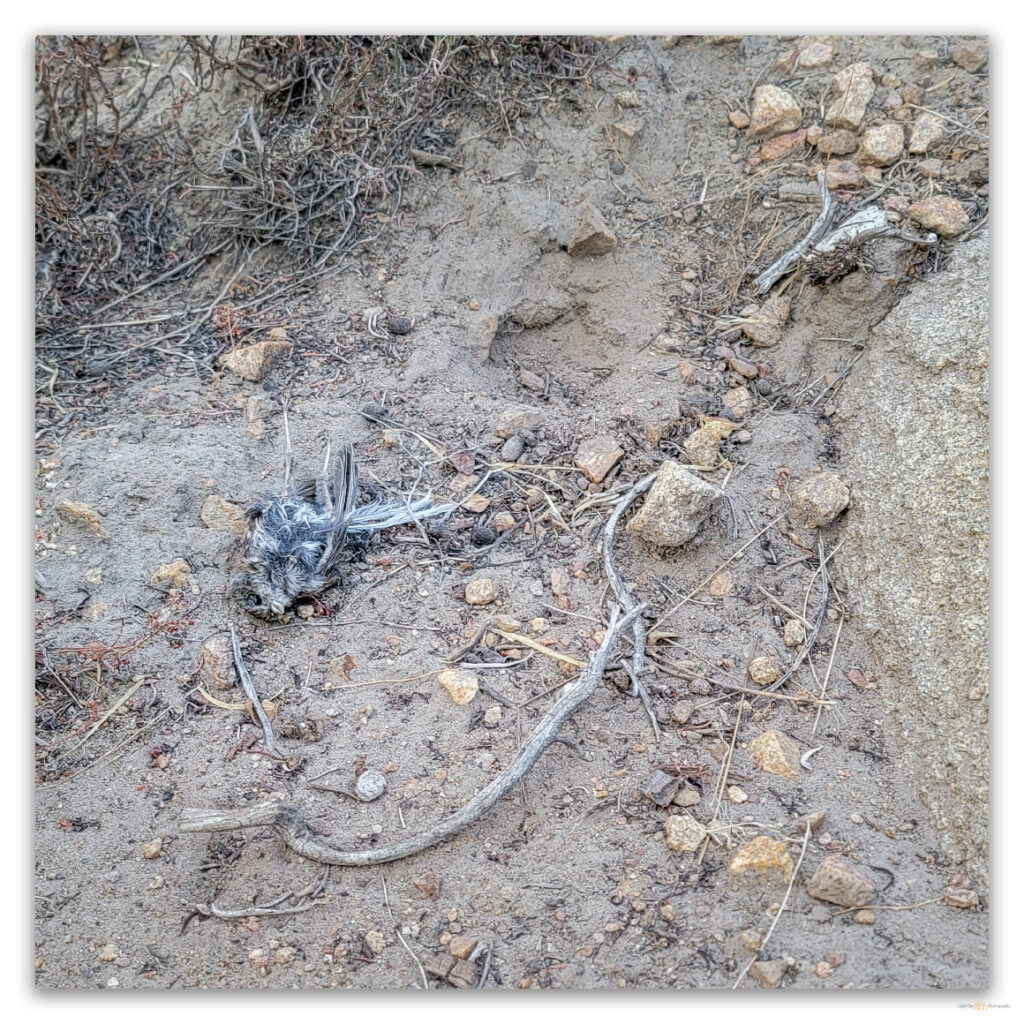
An owl’s interrupted dinner, my apologies.

I felt my way along the canyon floor, following my approaching footprints through the small, dry streambed. The bends in the canyon seemed to alternate from noisy with songbirds and insects to the quiet of enclosed woodland. With my eyes focused on the red of the infernal sunset, the pinyon loomed as blackened shadows, sad portents of once and future fires. As the woodland darkened, I could just make out sandy gullies in gaps between trees, arriving eventually and abruptly at the imploded cabin below the spring. It was time to get the headlamp out, but I enjoyed the last few steps to my truck, happy to have had the summit walk at the end of a slow-starting day.
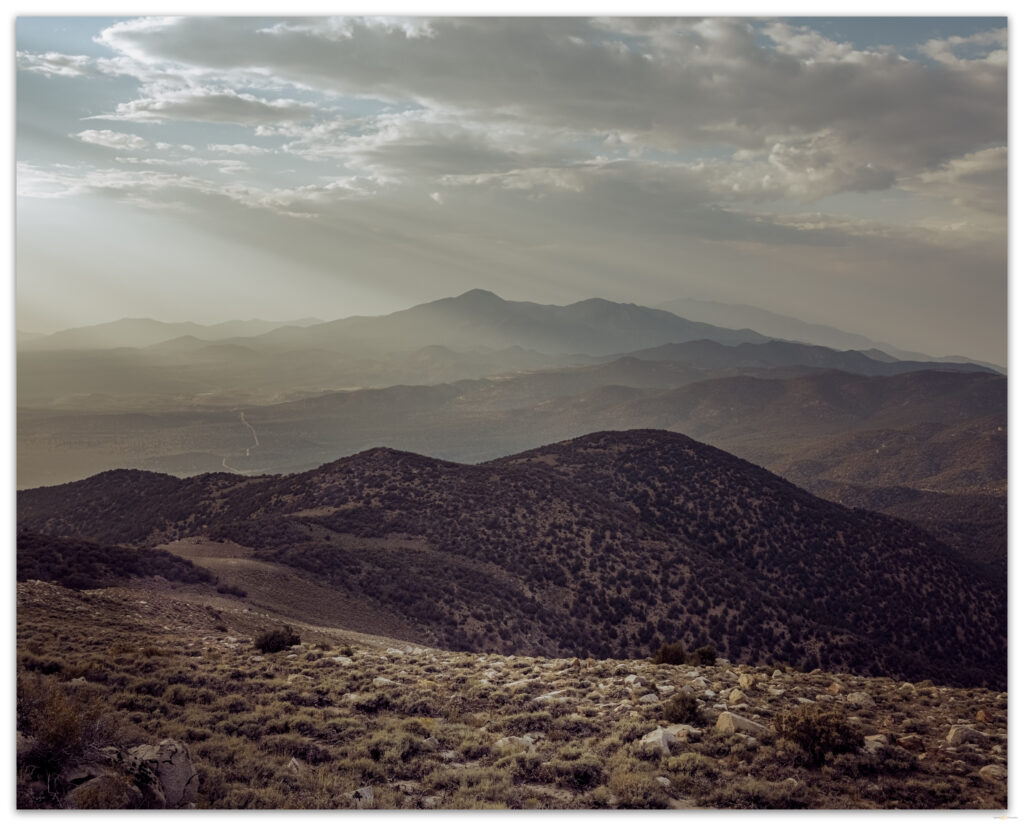
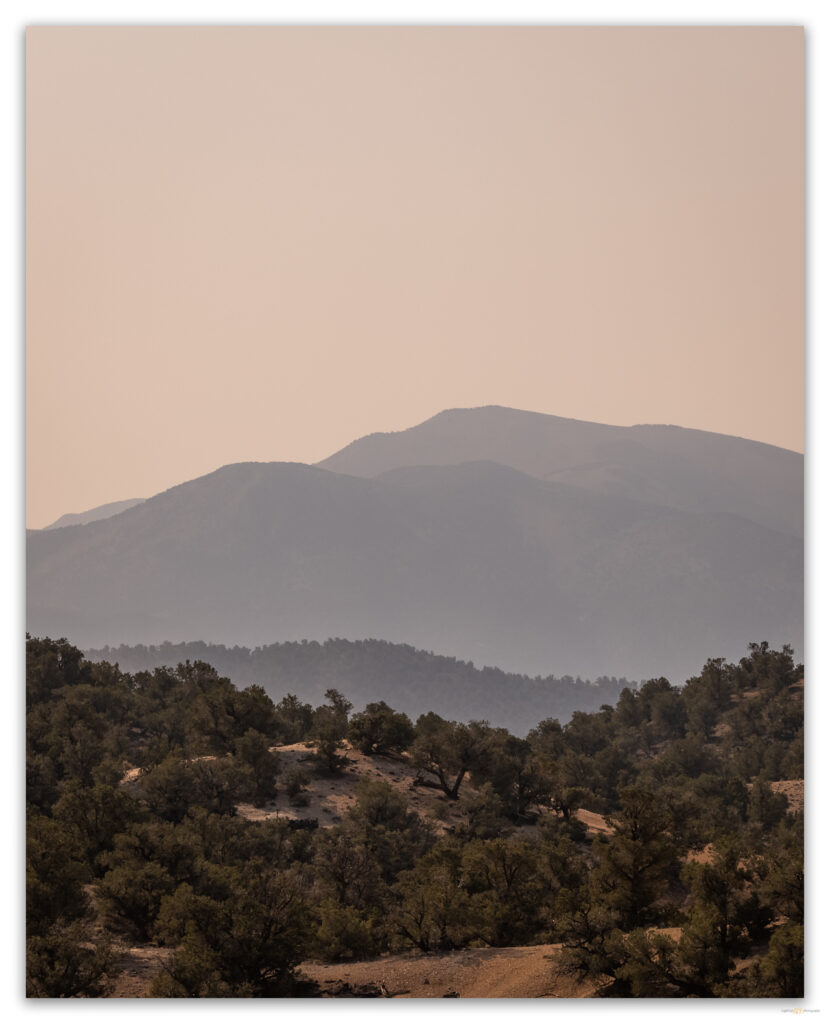
Corey Peak and Mount Grant rise through the smoked shade of the breaking monsoon, Wassuk Range, Great Basin Desert, USA

HP #87 Collection

Keep going.

Please respect the natural and cultural resources of our public lands.
#naturefirst #keepgoing

Nevada High Points #85 – Broken Hills

D. Craig Young · August 1, 2021 · Leave a Comment

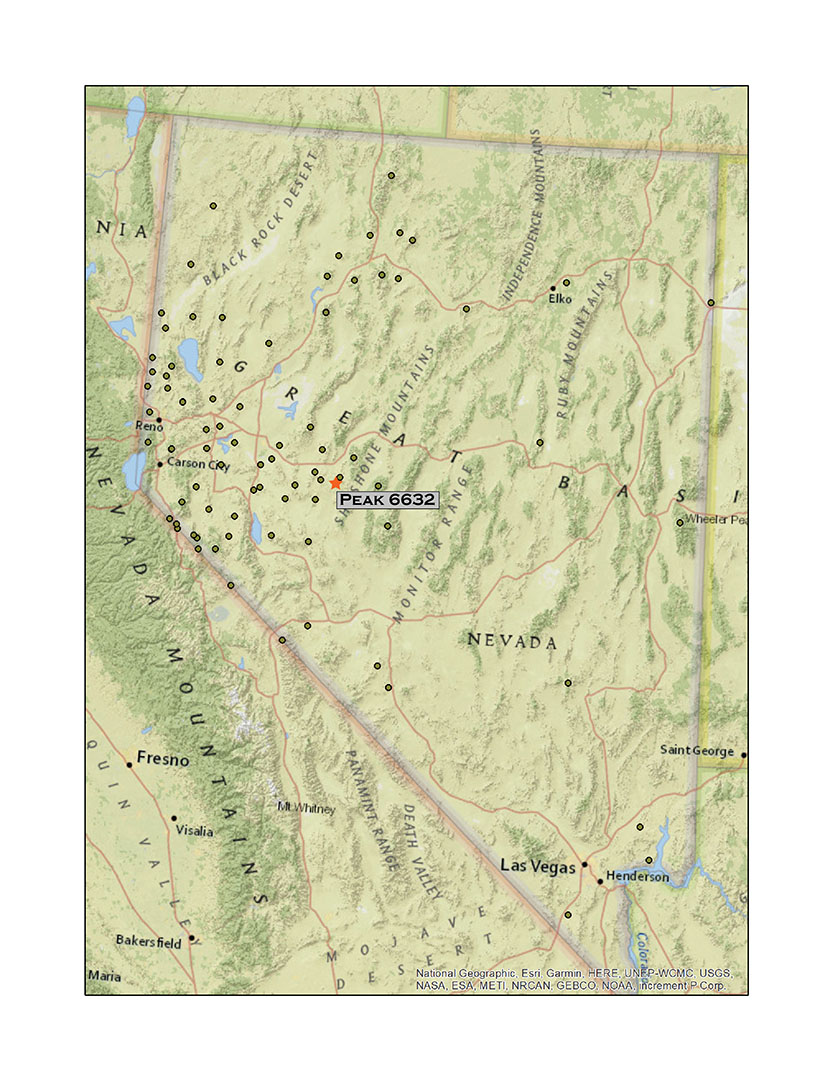
Peak 6632

6632 ft (2021 m) – 600 ft gain

2021.07.10

It has been a strange week, but maybe this is just how they are now. A 5.9-magnitude earthquake shook our house, Portland hit 113° (and Gardnerville not much less), the Beckwourth Fire Complex continues to rampage, and monsoon-like storms knocked the power out at StoneHeart. The latter occurred after I had left on a Second Friday excursion targeting the High Rock Country. I had met Darren at his house just as Des described a powerful storm cell at home – a lightning strike resulted in a local power outage. She said it was intense but not that unusual, so Darren and I headed north toward Gerlach. But at Nixon, on the shores of Pyramid Lake, Des let me know that the power had returned but the well had not. We tried various fixes, but it would not kick in. Although our well contractor is always quick to respond, I would not rest easy in the backcountry without the water on at StoneHeart. We turned back.

However, Second Friday still goes – even if it is now Saturday. Waiting through the punishing heat of the day, Darren and I finally set out eastward on Highway 50 in early evening. We have a new plan for the short excursion. We will avoid the heat as much as possible, climbing at night and in the early morning to get high points of two smaller ranges in west-central Nevada.

It is 106° in Dayton Valley but a thunderstorm squall at Lahontan Reservoir drops the temperature along with a brief heavy rain. For a few minutes it is 76°. By the time we reach Fallon, however, it is a cloudy 104°, and it stays that way into the evening even as we hit the dirt tracks of the Broken Hills slightly higher in the Great Basin desert.

Ragged hills of rhyolite and volcanic tuffs comprise the unorganized range of the Broken Hills. On the edge of the hills, the site of Broken Hills saw a brief boom as silver discoveries drew miners to the area in the late 19th and early 20th century. McLane writes that the hills are named for either the mining district – a call to prosperous mining area in Australia – or the disparate, broken nature of the knolls, outcrops, and hummocks that make up the small, east-west-trending range. A sagebrush community forms a low-density cover with widely spaced small plants on local hillsides. There are very few trees. These are clustered in small stands of Utah juniper, typically one or two trees standing lonely along contacts between the rhyolitic rocks and volcanic tuffs, it seems. Pinyon can be found in the wash separating the Broken Hills from the East Gate Range, where the pines form a thick woodland subject to recent patchy wildland fire. The boundary between the two ranges is structural – the East Gate Range being a relatively clear north-south fault block extending away from the Desatoya Mountains, while the Broken Hills appear random and rolling. The high points of the two ranges are only a few miles apart, so our camp at Mud Springs should provide a quick base for two short climbs.

HP #85 Collection

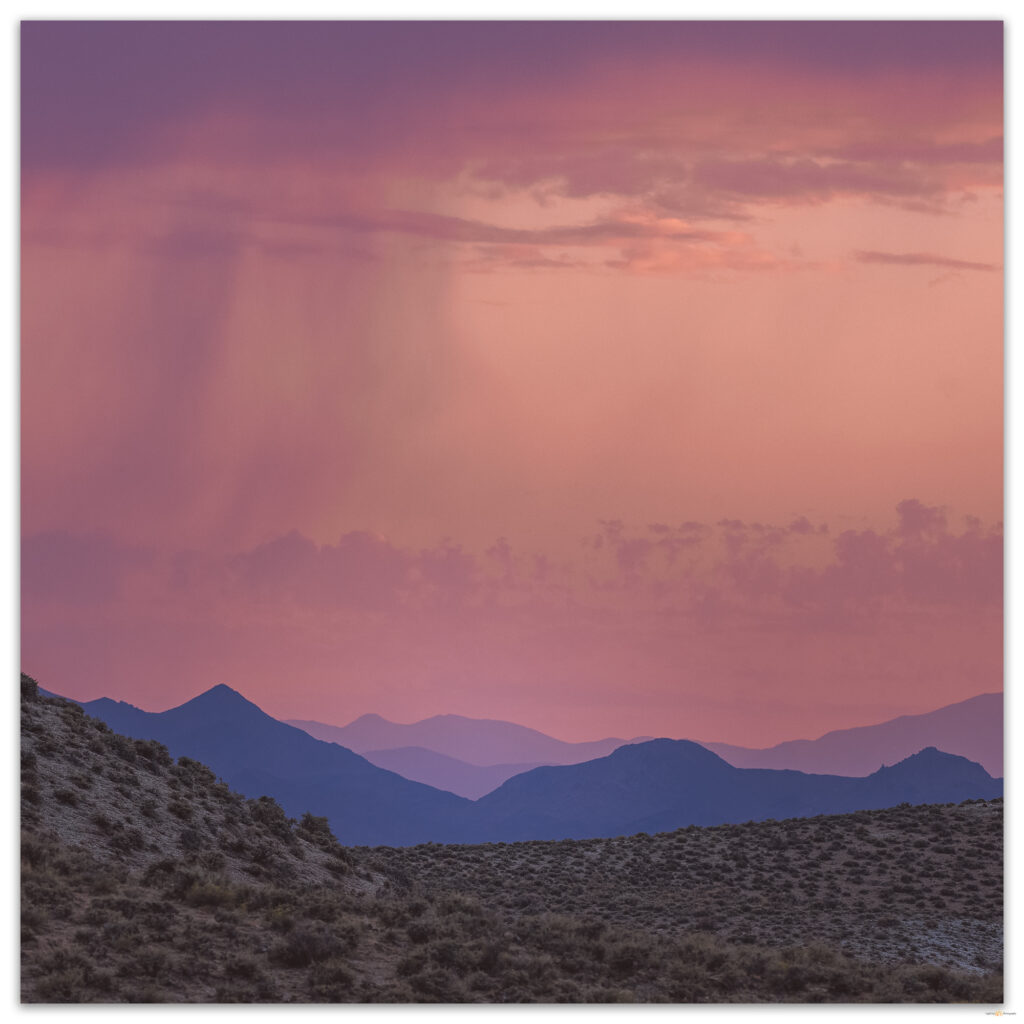
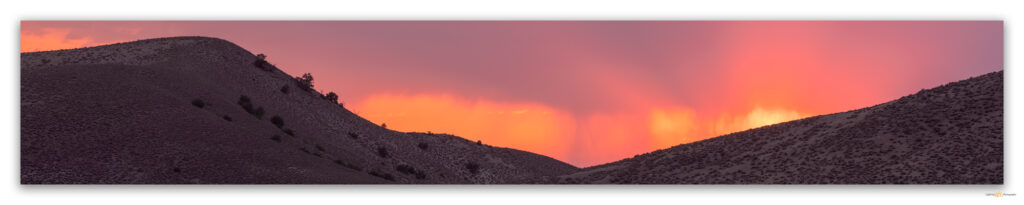
Smoke from the Beckwourth Complex wildland fire transforms a needed rain at sunset, Broken Hills, Nevada

As we set camp, the smoke from the Beckwourth Complex alters the western sky. Storms struggle in virga, as gray curtains evaporate in the heat without nourishment. We make dinner and wait for the relative cool of night. It is 10 PM when we set out with headlamps, leaving the truck on a side-road a ridge away from camp. We have arachnids immediately. Scorpions and fierce-looking spiders patrol beneath our headlamps, dodging our footfalls and we dodging them. A black widow has strung a hopeful trap across one rut of our two-track path, a reminder that the hunters are busy in the understory and best to keep the headlamps and attention on. This desolate path to Peak 6632, unremarkable in daytime, is bustling after dark.

A storm fades in the smoke of western Nevada Ranges, Broken Hills, Nevada

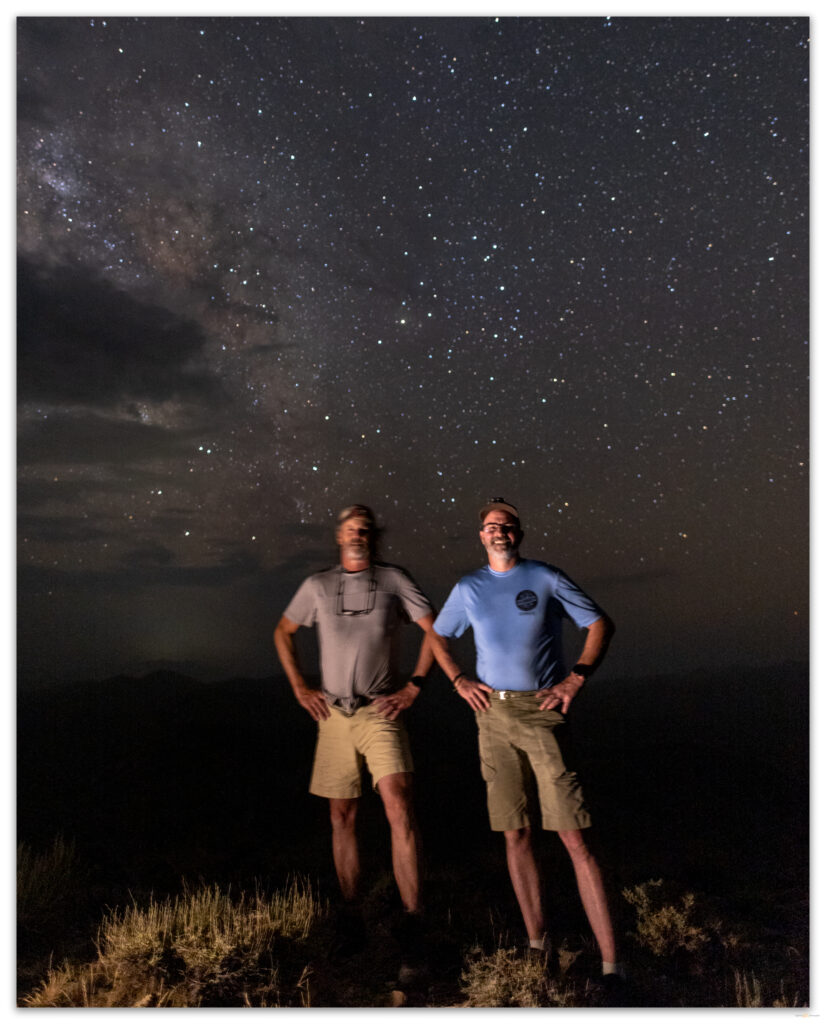
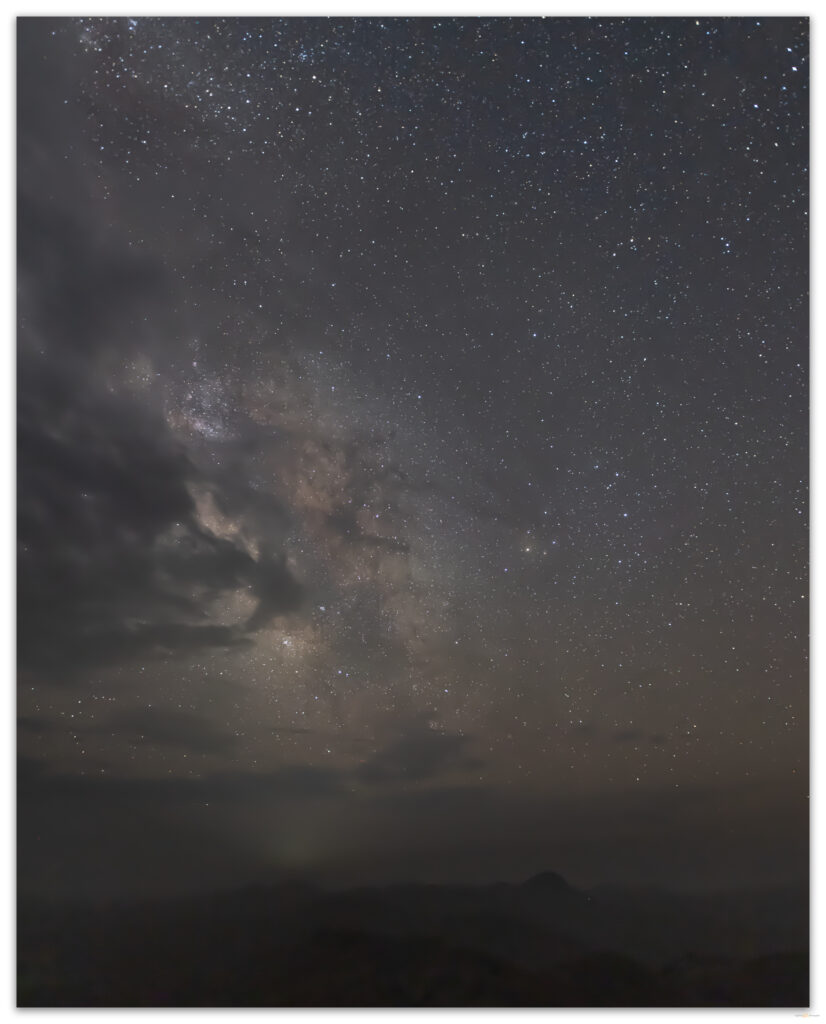
The dome of Peak 6632 steepens considerably in its final 500 feet. Darren finds the small summit cairn and we complete our first night-time summit. And it is dark as night. Clouds and smoke mute any meager light, and we realize, with no stars to guide us, we have lost our bearings. The smokey haze fills the horizon like ground-fog, and the glow of distant towns and bigger cities is almost imperceptible. Finally succumbing to checking GPS, we are baffled by our confused dead-reckoning. A moment ago, we had, with certainty, thought we were facing south, only now do we realize that that direction is north; we were 180° off. Soon, however, the parting clouds reveal the Milky Way core, and we are grounded again. A large scorpion watches our confusion – it too likely confused by our curious illumination – and we keep an eye on it as we check the summit register.

Ghosts on the summit, Peak 6632, Broken Hills, Nevada

We linger for an hour or more. As the smoke blurs the shadows of hills and horizon below us, the Milky Way appears hauntingly among the clouds. Forgetting the ground-hunting creatures for a while, we turn off our headlamps to feel the dark. The wind is warm and tastes sadly of distant embers. Again, a small hill, an otherwise no-name place of interest to so few, provides a unique experience that is the dividend of motivation and the simple desire to explore the forgotten backcountry.

The Milky Way appears behind a haunting night-haze of wildland smoke, Broken Hills, Nevada

HP #85 Collection

Keep going.

Please respect the natural and cultural resources of our public lands.
#naturefirst #keepgoing

Sunrise and Smoke: An Early Morning Decision

D. Craig Young · August 5, 2018 · 1 Comment

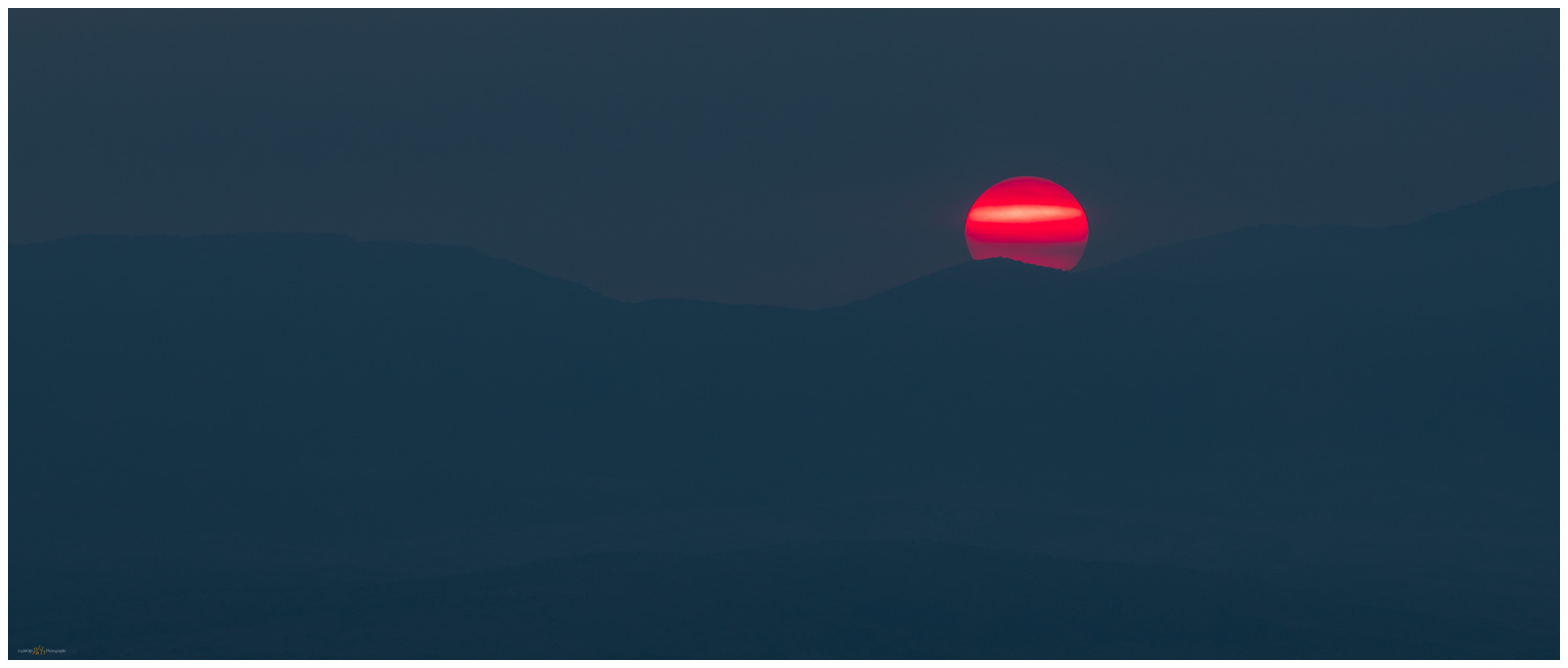
Is this real? Great Basin, Nevada. Sometimes spontaneous works. This is pretty much the image I imagined waking up an hour earlier.

Landscape photography typically involves planning, at least for me. I usually get some idea of place, story, mood, or composition, and begin by flying around in Google Earth, searching a few maps, checking the weather, and logging into PhotoPills or The Photographer’s Ephemeris. It is part of the fun, but this morning was not all that…

Sunrise and Smoke Collection

It has been miserably smokey in Carson Valley, with air quality commonly in the unhealthy range due to the disastrous and all too common fires in California and Nevada. We are in the smoke-plume of the Ferguson Fire at Yosemite. My trail running has ground to a halt, and there isn’t much motivation to get out for some landscapes. And yet, for some reason, I woke up at 4 AM — spontaneously, for otherwise no good reason — with the thought of catching the orb of the rising sun filtered through the smoke-plume haze. My pack sits ready and the tripod is in the car, so why not?  Let’s go.

I brewed some tea, toasted a bagel, and started out for Kingsbury Grade in the moonlit pre-dawn. I’d climb to a roadcut about half-way up the Carson Range and scramble over the edge to gaze down on the shadows of the Pine Nut Mountains. I knew I would keep it simple — my 70-200 to the horizon, and that’s it. The sun and smoke would do the rest.

I waited about 20 minutes and for much of that time I thought the thick curtain of smoke on the eastern horizon, with haze settling into the foothills, would block the sunrise completely. But soon a sliver of red appears, as if the ferocious fire had itself jumped from the High Sierra to the lowly Pine Nuts. The orb was here, pretty much as my dreams must have known.

Portal arch, Great Basin, Nevada. After capturing an earlier image, I watched the sun disappear and expected it would soon be too bright in the cloudless sky. As I began to pack, the orb crested the densest plume and seduced a second shot. This may earn a large print, to be viewed at a distance.

Sunrise and Smoke Collection

My smoke-themed photos tend to be rather dark, a reflection of the foreboding plumes of the destructive fires in our midst. Please be careful out there and I hope those affected — the people and our wild lands — can soon recover. Please feel free to comment below.  Too dark?  Fire and smoke affecting you?

Keep going.

Tufa and Smoke, Mono Lake, CA

D. Craig Young · July 29, 2018 · 9 Comments

It was time to take advantage of a break in the work routine. The summer monsoons had recently encroached on the Pine Nut Mountains above StoneHeart, so maybe there would be some dramatic clouds and lightning to chase. Or, the exhausting California fires would continue to pour smoke onto the eastern Sierra, creating another saturated sunset.

I checked my radar apps all afternoon but the bright red blobs of the past few days were absent, and only a few yellow-level squalls bloomed momentarily and then scurried away in the afternoon heat. Nothing to chase in those. But I saw cumulus remnants in the direction of Mono Lake, so I steered south-bound on Highway 395 – a little later than I planned – with the goal of wandering among the near-shore tufa formations at the Mono Lake Tufa State Preserve. Smoke from the Ferguson Fire, the one that closed down Yosemite National Park for at least this week, should add some character to photographs of the tufa.

Tufa and Smoke Collection

It is always a good drive through the Walker River Canyon. The drive was relatively quiet this evening, probably due to the smoke-filled skies keeping tourists away. I notice once again several outcrops and exposures along the canyon that could make splendid compositions in the right light and with the addition of some low-hanging clouds or a back-drop of fog. I will have to plan for that.

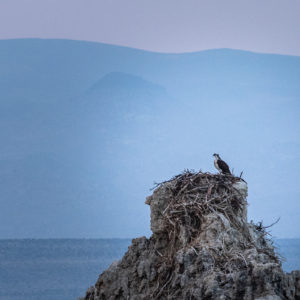
Osprey waiting

The Reserve basically circles the lake, and with the light fading fast, I dropped in to the easy access of the Old Marina parking area just north of Lee Vining. It isn’t the most dramatic tufa on the lake, but there are plenty of outcrops and towers – some with nesting Osprey – where one can find a composition or two. I dropped the three-dollar fee into the bin, grabbed my pack, and hiked out the boardwalk. I could see a group of hunched-back photographers at the distant end of the boardwalk, a workshop almost certainly; only a couple other photographers strayed from the cluster of tripods. With a happy hello – they did seem to be composing their images at the prime and fleeting moment of the smoky sunset – I circled away from the small crowed, eastward, off-trail among the sedges and flat-lying tufa mounds. It was getting dark fast, but I liked the darkening mood as the last light saturated the smoke and blurred the horizon.

Looking back, I noticed the group had departed, but a lone photographer remained, and for some reason he seemed to be composing his shot where I would be in the frame. I did not notice anyone working this direction when I passed by. I hope I’m not ruining his composition, or maybe he wants me for scale. I am, as yet, unaccustomed to wandering among landscapes with other photographers in them.

My feet were soaked and I’d stumbled into some deeper shoreline bogs here and there. But I’d found what I hoped for. Wading into knee-deep water, I picked out a tear-drop shaped rock leading to a set of tufa towers under a fiery, glooming sky. I set up a wide, vertical composition to get the low dynamic range, with hints of saturated color, from sky to foreground.  I took a few images in case I needed to focus stack, but I ultimately liked the first capture.

Immersed. Smoke at sunset over Mono Lake tufa formations. 2.5 sec, f/20, ISO 100; Canon 5DmIV, 17-40 mm.

I waited into the blue-hour and the smoke settled into red-to-pink pall as I zoomed to the middle-ground towers to get them in the mirror of sky and water. As I was packing away my gear, a large coughing or huffing sound echoed from a nearby outcrop. I froze for a moment as the sound repeated itself. Where and what was it? It was strangely loud for being invisible, though it was practically dark. And then two large deer bounced from behind a tufa block, pogo-sticking through the grassy wetland of the nearby shoreline. Cool.

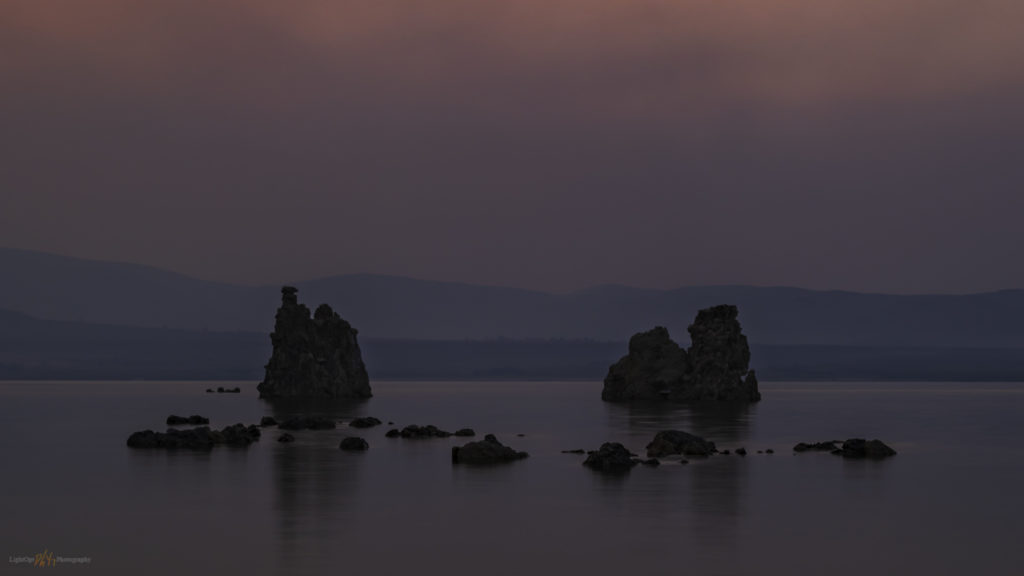
Tufa and Smoke. A long exposure as early darkness set the mood at Mono Lake Tufa State Natural Reserve. 2.0 sec, f/11, ISO 100; Canon 5DmIV, 17-40 mm.

I returned to the lone photographer at the boardwalk and apologized for possibly crossing into his image. He had no concerns and was merely waiting for the full moonrise. I set up to wait with him, trying to capture the red, smoke-tinted orb.  I had no luck, having not practiced much on the puzzle of the quick orbiting moon in a long lens with little or no foreground. It was an awesome sight, however. I left for the highway and turned toward home, where it would soon be midnight.

Tufa and Smoke Collection

I processed the two images shown here to capture the mood of the smoke-filled basin and subdued lake in the coming night. The images are dark and saturated, captured after the heat of a long day as the destructive fires weigh on our minds and we cannot yet see the season’s end.

Keep going.

Smoke and Sunset: Grass Valley, NV

D. Craig Young · May 15, 2017 ·

I’m back in Grass Valley, NV, working with a team of archaeologists and mapping the landforms along the valley margins. I left home this morning and I always enjoy traveling Highway 50, cutting across the middle of Nevada. The highways moniker as “The Loneliest Road” has lost its romance as daily traffic increases. I do remember driving east of Fallon and not seeing other travelers until approaching Austin or Eureka. But that was over a decade ago. It isn’t a busy highway, but it isn’t lonely.

I’m pulling the camp trailer and that unfortunately cuts into the gas mileage. I can’t make it from Gardnerville to Austin – probably could just manage it, but it would be tight – so I fuel in Fallon and top-off in Austin. I also have 40-gallon reserve tank. This will allow me plenty of fuel for several days of backcountry travel in Grass Valley.

Smoke and Sunset Collection

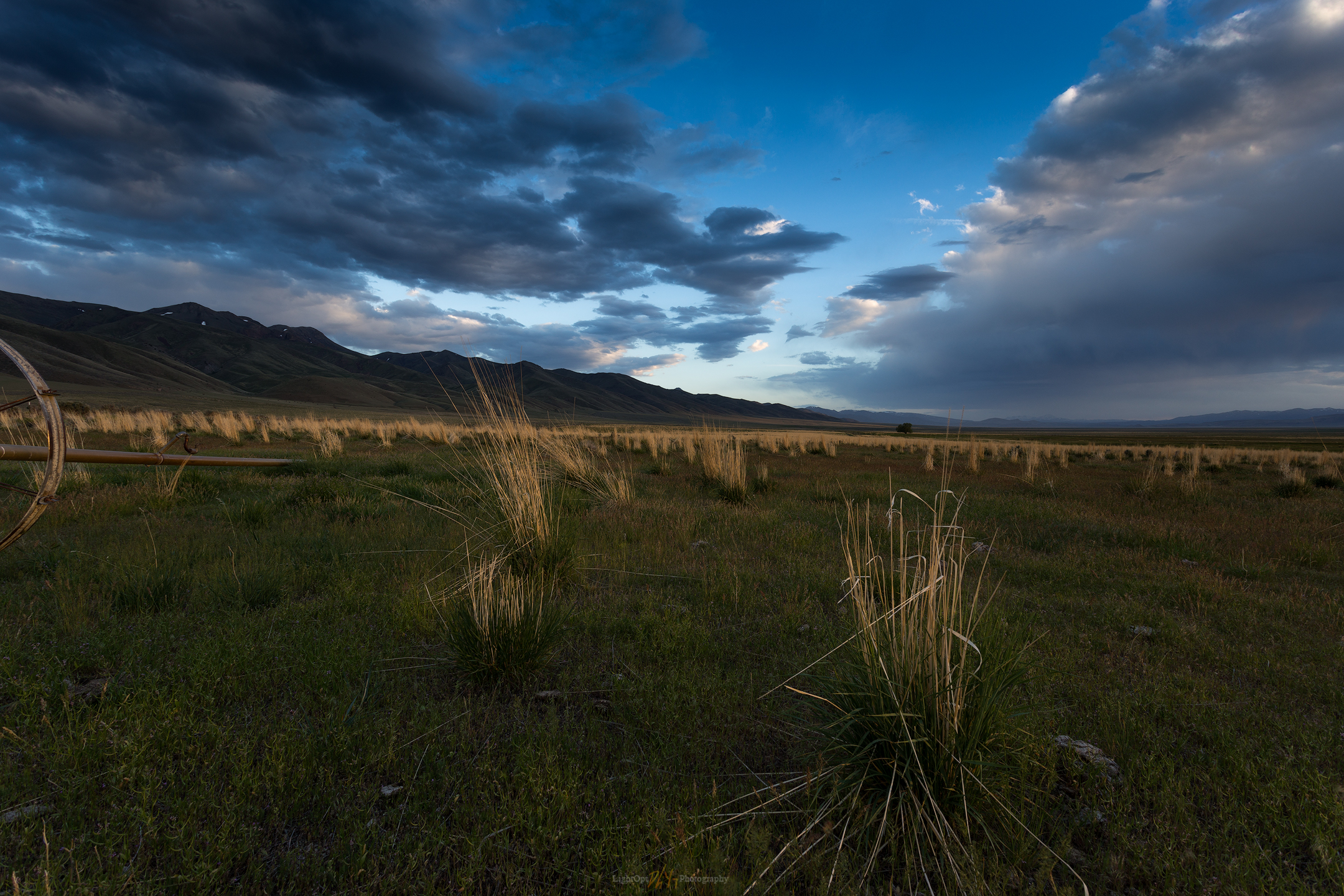
As I work my way north into the valley, I find the archaeologists surveying along Callaghan Creek. After checking in with the team, I set camp near the corrals at the Gund Ranch. I talk to the ranch manager to make sure my camp is out of the way. Out to work for the afternoon, ground-truthing my landform maps and age relationships I’d worked on over the past few months. In the evening I visited with the crew for a while and then headed into the evening light for some photography. I had often driven by a set of corrals a few miles south of the ranch and I thought it would be interesting in the developing sky. I wanted to experiment with foreground elements, here that included clusters of Great Basin Wild Rye and a piece of sprinkler equipment. Right off, I was greeted by a cloud of happy mosquitos.

Rye returns. I like the sense of scale in this image, but the foreground composition suffered from a lack of attention on my part. Neither the wild rye nor the sprinkler tell the story I’d hoped. 1/6 sec, f/14, ISO 100; Canon 6D, 17-40mm (17mm).

I’m not real happy with the image. I waited for the light but my patience, and the mosquitos, limited my attention span. I think the pasture, grass, and sprinklers would work if I took more time. Lesson learned.

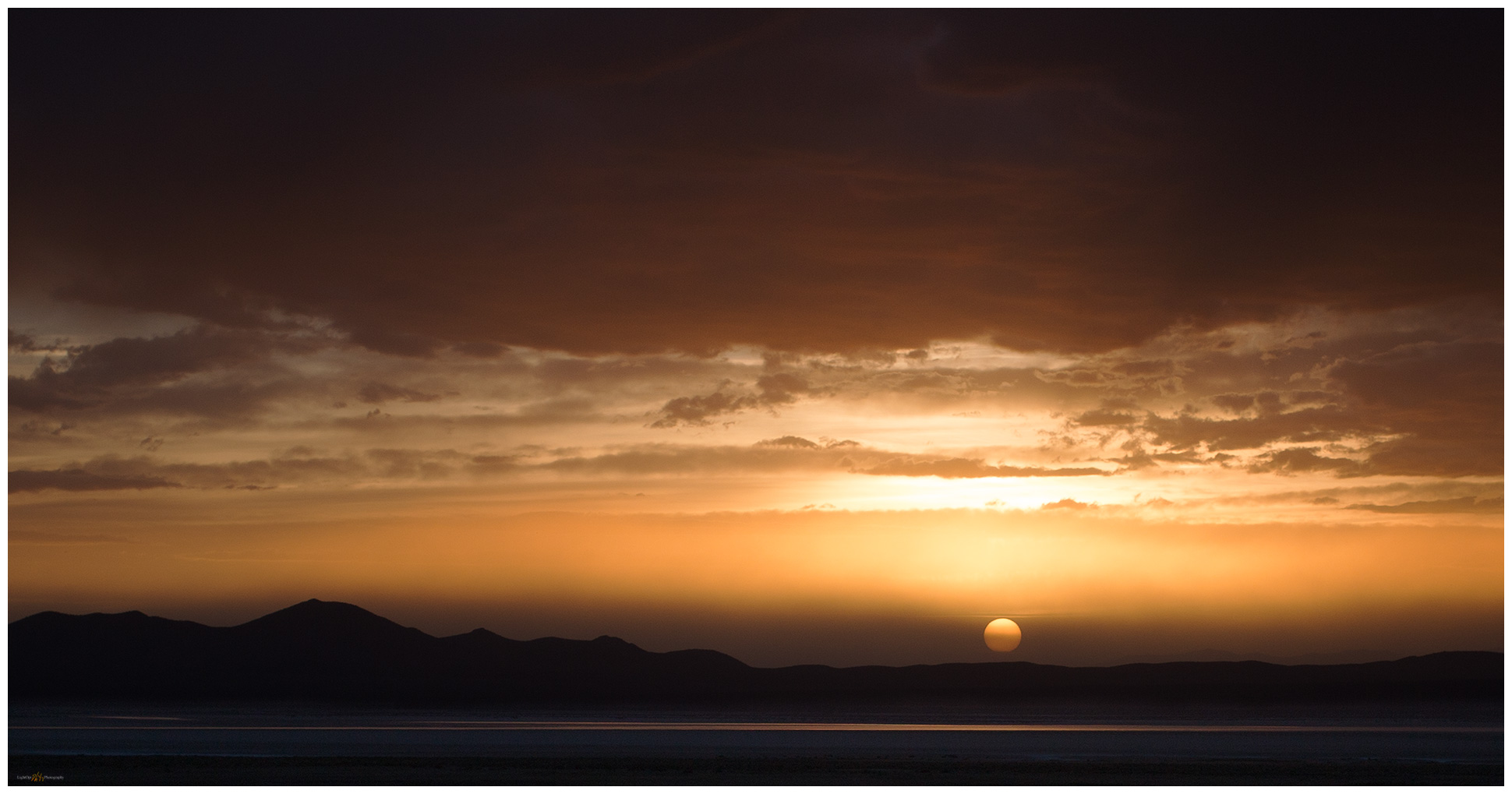
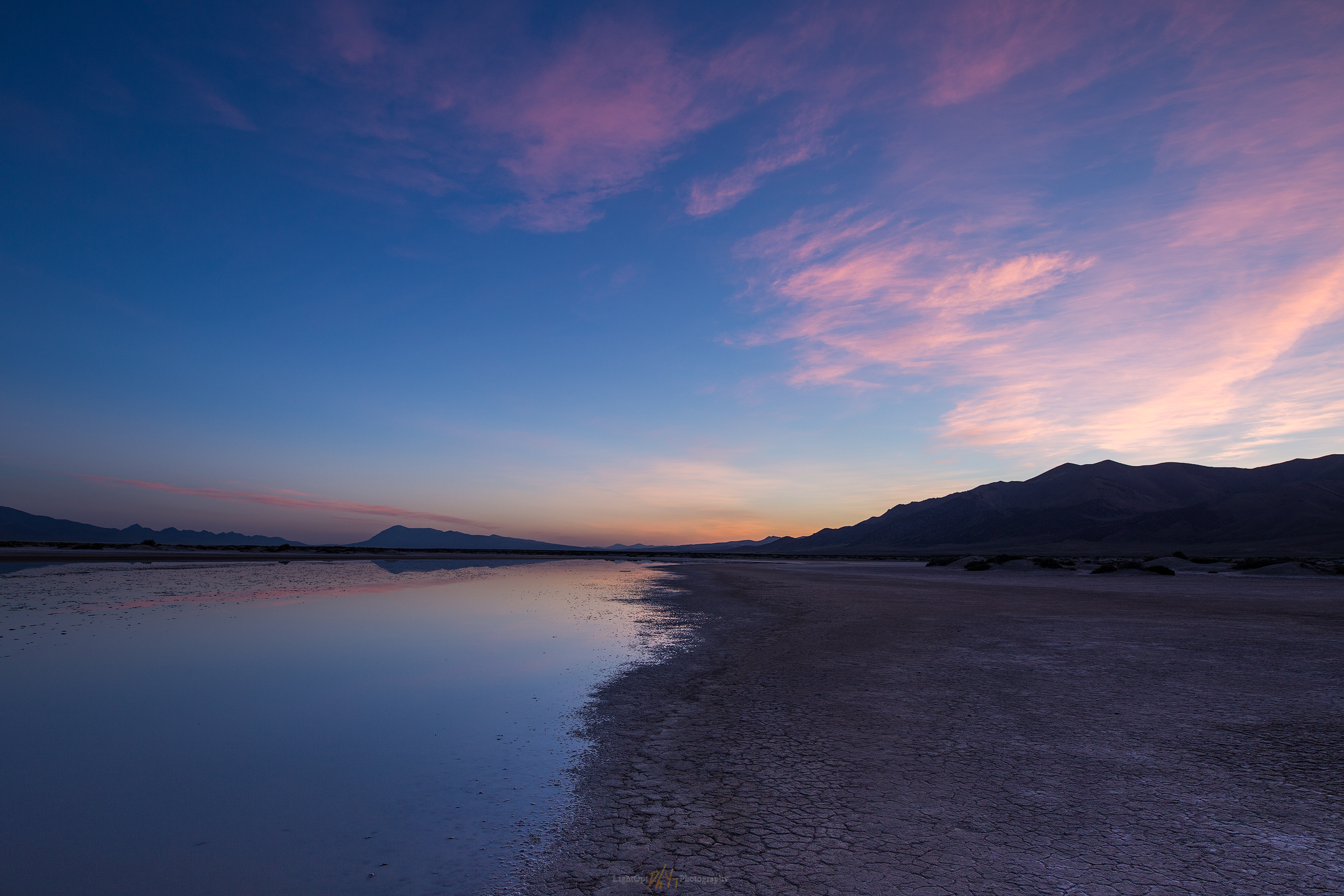
Although I may have left the pasture too early, it gave me the opportunity to watch the sunset develop right in front of me. A cluster of wildfires in western Nevada provided the scene for a wonderful sunset over the playa of pluvial Lake Gilbert. The sky highlighted a shallow playa pool far across the valley, detailing the shadows of the northern Toiyabe Range. This remains one of my personal favorites, a significant image in my portfolio from early in my practice. Sometimes the space just gives it to you.

Playa fade, Great Basin, Nevada. One of my favorite images. It is easy to have patience sitting on the tailgate at camp.

I stayed up too late with the crew last night, and my alarm at 4AM surprised me. The sky looked promising, however, and I knew I needed to get to the southern playa to hopefully capture some dune pedestals in the morning light.

I need to remember to prep gear in the evening, or otherwise keep it prepped for mobility rather than simply tossing the pack back into the truck after finishing the night before. I walked the playa where the late spring pool curves between a few dune pedestals. The scene is nice in the full moon and the dawn glow is pretty good, but the clouds aren’t doing much this morning. I worked on some video and timelapse, with some intent on vlogging about the playa and its interest to Paleoindian archaeologists, but this needs practice.  For another day.

Receding dawn. The playa pool is almost as ephemeral as the colors of sunrise. 1/15 sec, f/8, ISO 100; Canon 6D, Sigma Art 20mm.

Smoke and Sunset Collection

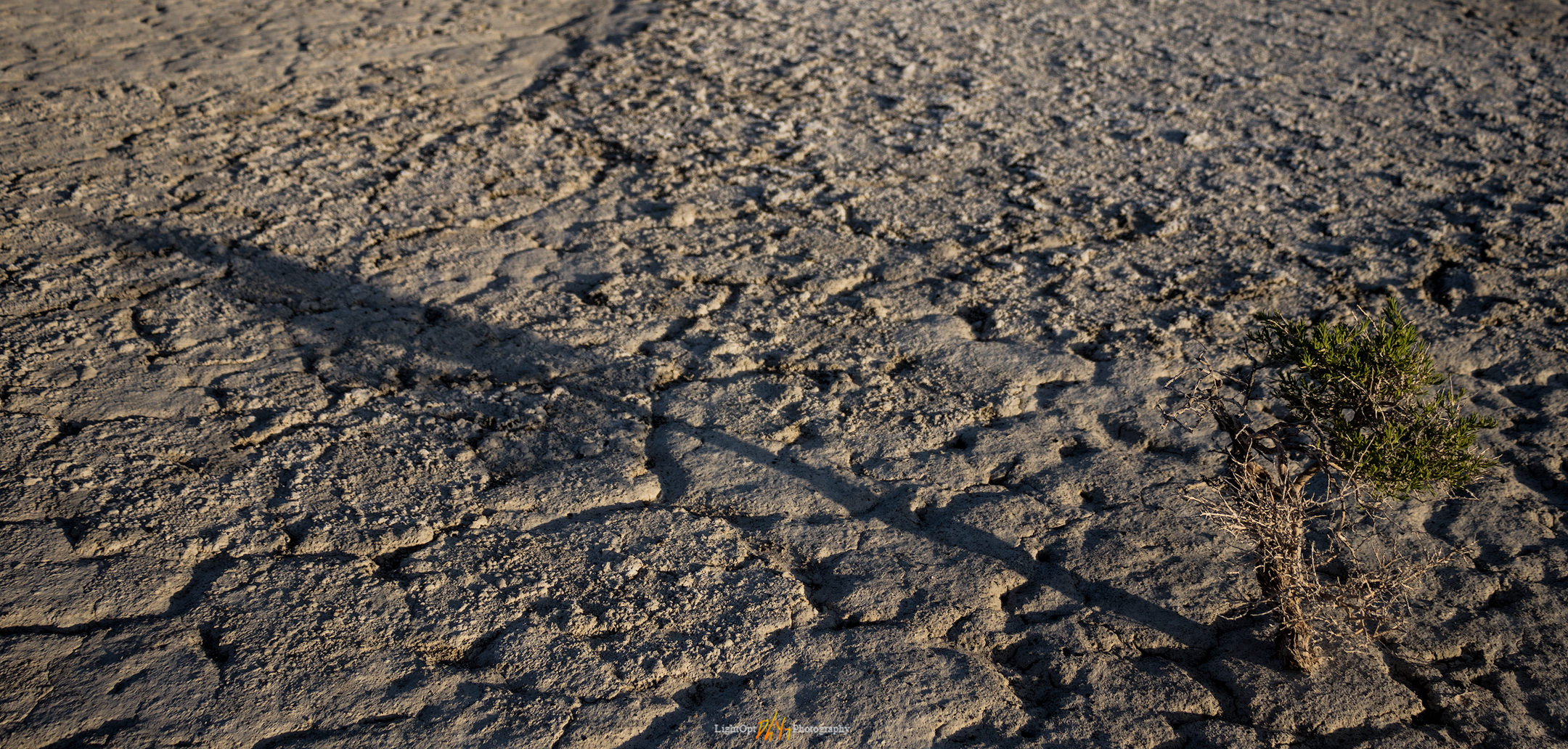
Trying to be tall. This small greasewood casting a grand shadow caught my attention. 1/125 sec, f/11, ISO 100; Canon 80D, 18-135mm.

Keep going.

Trail Option

Copyright © 2025 · Monochrome Pro on Genesis Framework · WordPress · Log in

  • Contact TrailOption
  • Substack
  • Waypoints Bibliography
  • Young Archives