• Skip to primary navigation
  • Skip to main content

Trail Option

A personal geography of landscape and place, art and geo-science.

  • Home
  • TrailOption Blog
  • WayPoints
  • Galleries
  • About
  • Contact TrailOption
  • Subscribe!
  • Show Search
Hide Search

landscape photography

Luther Pass: Success of ‘Fourth Friday’

D. Craig Young · January 30, 2020 · Leave a Comment

As I mentioned in my previous post, after months of futile attempts, I have resolved for 2020 to stick to a pattern of ‘second’ and ‘fourth’ Fridays. Second Friday is an outback or travel excursion combining field studies and photography, while Fourth Friday brings in a weekend of focused local photography. I am not sure how this will work out in the long run, but I have started well so far. The Clayton-Ione weekend provided an excellent bout of gouging around volcanoes and arroyos, while this past weekend – Fourth Friday – produced a combination of experience and photography that resulted in some of my best photographic work. I hope you think so too.

January weather has been relatively calm in the Sierra; in fact, our snowpack is currently shrinking after a series of good December storms. Yet, the forecast for Fourth Friday hinted at a quick-passing, early-morning snowstorm at higher elevations. I loaded up early, a little after 4AM, heading for Luther Pass and Grass Lake. I am on Hwy 89 regularly and often gaze into the glacially carved basin of Grass Lake, where pines grow in fingers of glacial outwash that extend into a wetland basin. Aspen groves punctuate the surrounding pine forest. I have often visualized photographs at Luther Pass, either of a small grove of pines isolated in the wetland against a dark forest backdrop or of a stand of fiery-fall aspens rising among the forest at the wetland shore. When I thought of Friday’s possible storm, I immediately prepared for the former – I would snowshoe into the frozen, snow-buried wetland and work with the emotion of snow flurries or low-hung clouds. There were stars above my driveway, but I could see them fading toward the abrupt rise of the Carson Range. Even in the dark of pre-dawn, this meant clouds were blowing in.

The snowplows had carved some parking pull-outs along the stretch of highway at Luther Pass. I pulled in and sat in the dark. No snow fell as I shut down the headlights; my hopes in the forecast were similarly dimmed. Thinking the snow was simply late, I strapped on snowshoes, shouldered my pack, and headed into the snow-covered space of Grass Lake. My trees were there, and I set up my composition quickly as dawn approached. Just as quickly, I knew this was not going to work. Without the ambience of snow or clouds, I could not separate the foreground grove from the background forest. I waited.

The skies above were stormy with dramatic clouds dancing among the mountain peaks. The sunrise was fantastic, beaming through the small gap at the eastern (of course) end of the wetland perched above the canyon of the West Fork of the Carson River. I practiced some timelapse settings, but this was not the image I came for. My wait continued.

Finally, the sun broke through, spot-lighting the small grove, isolating it against the dark backdrop just as a snow squall broke over the distant forest. This was not what I visualized, but I was ready for it. The trees lit up warmly, like candles overwhelming the surrounding snow. It was good to be here. I like the image, but it lacked the satisfaction of my visualization.

Standing out. Waiting on the snow, the sunrise brought this momentary gift.

On Friday evening, after some time working and writing at home, having left my pack in the truck, I drove to the south end of Carson Valley where I climbed a set of hills to frame the expanse of Silver Peak and Raymond Peak, far south near Ebbets Pass. The clouds of the day still danced among the peaks, but the good light did not come. Still, I worked shots to continually develop the instinct of watching the land and using my equipment. Practice.

Luther Pass Collection

Although the weekend is about local practice, I decided that Saturday needed a journey to Mono Lake. Some of my friends from the 2018 Iceland trip are coming in February and I wanted to scout a bit of winter access to the tufa localities around the lake. I need not have worried; it has been warm enough to keep most of the paved and dirt roads clear. As a plus, the weather forecast called for a Sunday morning storm. Maybe its approach would award me with Sierra lenticulars or high clouds for a good Saturday sunset.

The South Tufa boardwalk was relatively crowded but, to my surprise, I was the only person only a mile west at the less developed Sand Tufa. I have wanted to photograph this tufa for a while, but a compelling composition is a definite challenge. It is an even greater challenge when the sky does not provide a backdrop. On the other hand, as the promised storm approached, having blocked all sunlight in the west, an amazing calm overwhelmed the lake.

Mono still. A vast serenity and the beauty of loneliness at Mono Lake.

This may be a greater reward than the drama of the near-iconic photography of tufa against a fiery sunset. The song dogs serenaded my walk on the placid shore. Nothing moved. I will be back for the icons later, but tonight this serenity is mine and mine alone.

I was home from Mono by 9PM. I am so very fortunate to have this as my ‘backyard’. I thought about the plan for Sunday morning. The coming storm seemed weak on radar, should I go back to Luther Pass? I made a promise to myself to focus on this weekend. Yes, I would.

Because I was keen on the working in the snow and still visualized the image I wanted to create, I realized I did not need sunrise. If the snow-bearing clouds arrived, I would have the natural diffusion I wanted throughout the early morning. I slept in a bit, but it was not too long before I was parked and donning snowshoes in the same pullout of two mornings ago. It was not snowing.

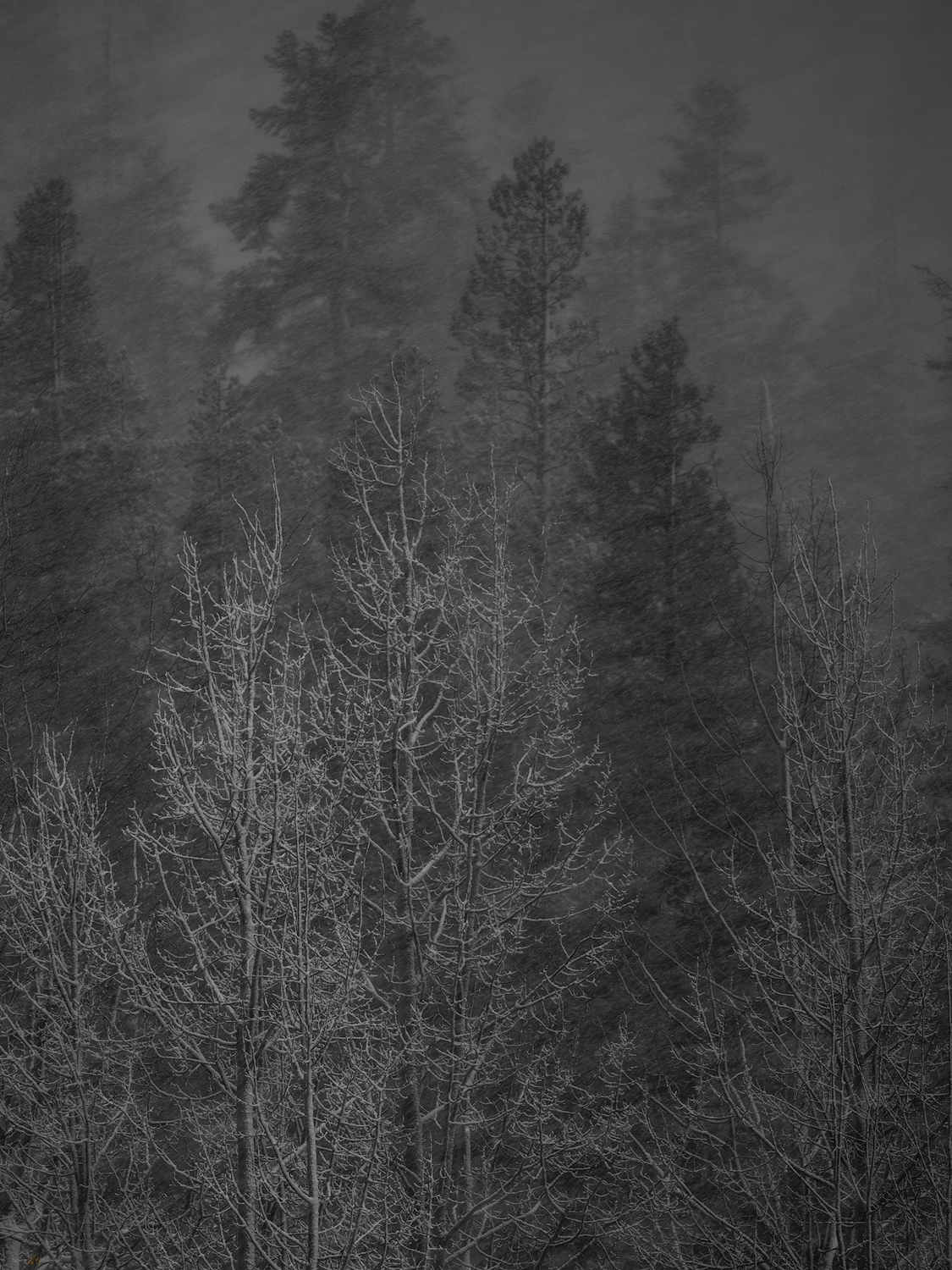
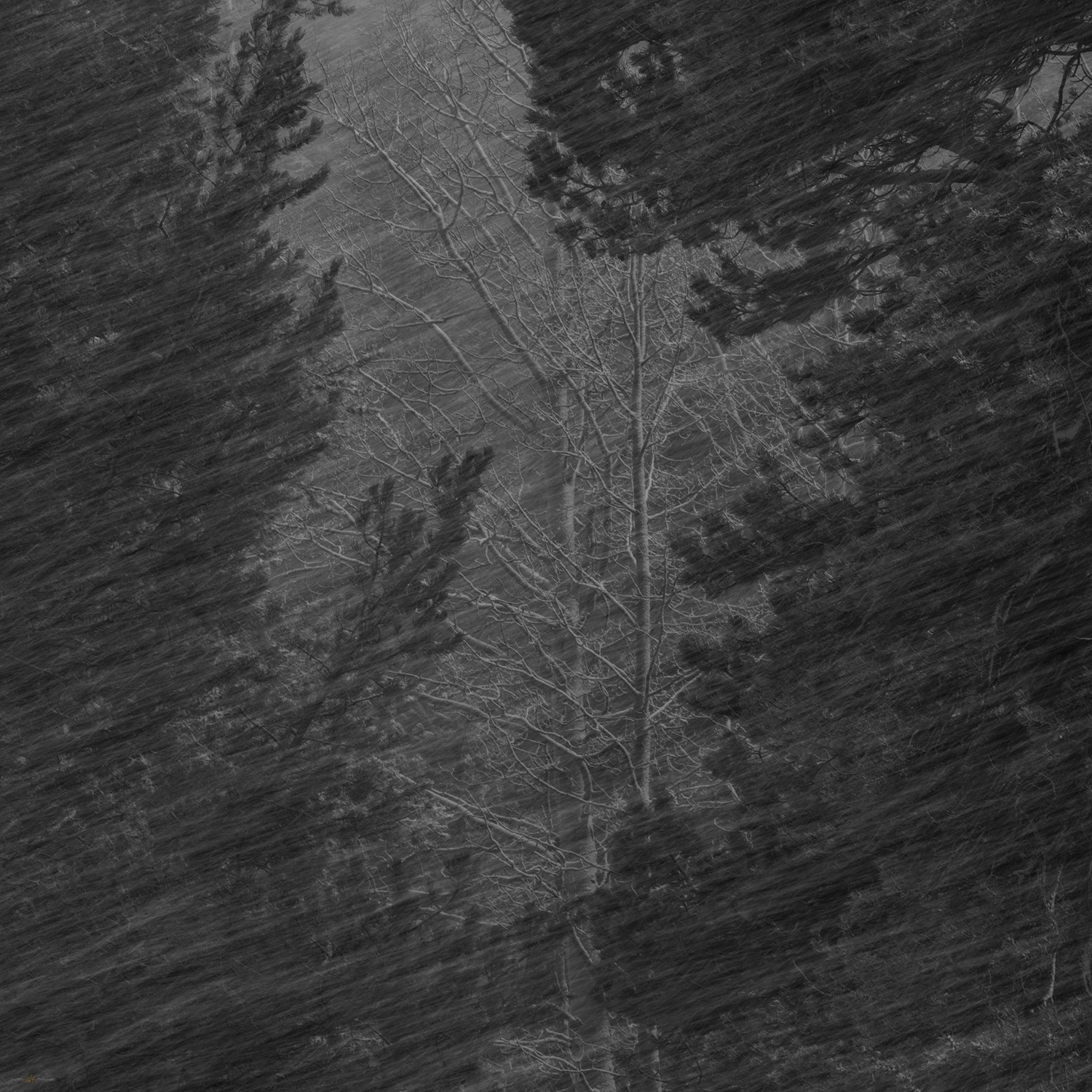
I dropped into the snowfield of Grass Lake and turned toward my target. A snow squall, like an expansive white sail, fell before me and a laugh sprung from my throat. Right on time. I could tell, however, that my little pine grove was fading into the snowstorm and its backdrop was too distant to meet my visualization. I continued on, heading toward a grove of leafless aspens I had spied in the autumn. Carefully crossing a creek, I climbed into a willow thicket and a new scene appeared before me. It was a version of my original hope, but it was framed within the forest rather than standing on its own. With framing and a compressed crop, I felt the image come alive. The snow was pounding and practically sideways in the wind.
Frontspace
Keyhole vision

From one spot, with only minor – but ultimately significant – movements, I created a pair of images that met completely the hopes of my visualization after months of driving across Luther Pass.

Luther Pass Collection

So, Fourth Friday. I kept to my plan and it paid off. Maybe it is a breakthrough. It feels like it might be. However, what is the most important thing I learned? I benefited from a string of days that include consistent focus and practice. Although I responsibly spent part of the days working with Des around StoneHeart, I made sure to keep focus, getting out for extended shoots and experiences each day. It is ultimately good to keep focused time set aside because I cannot photograph every day, or each week for that matter. I may not benefit from dramatic conditions when on a Second-Fourth schedule such as this. And yet, I will have my camera in hand with regularity and consistency; if I keep my eyes open and my feet moving, I bet it pays dividends. It did in January 2020.
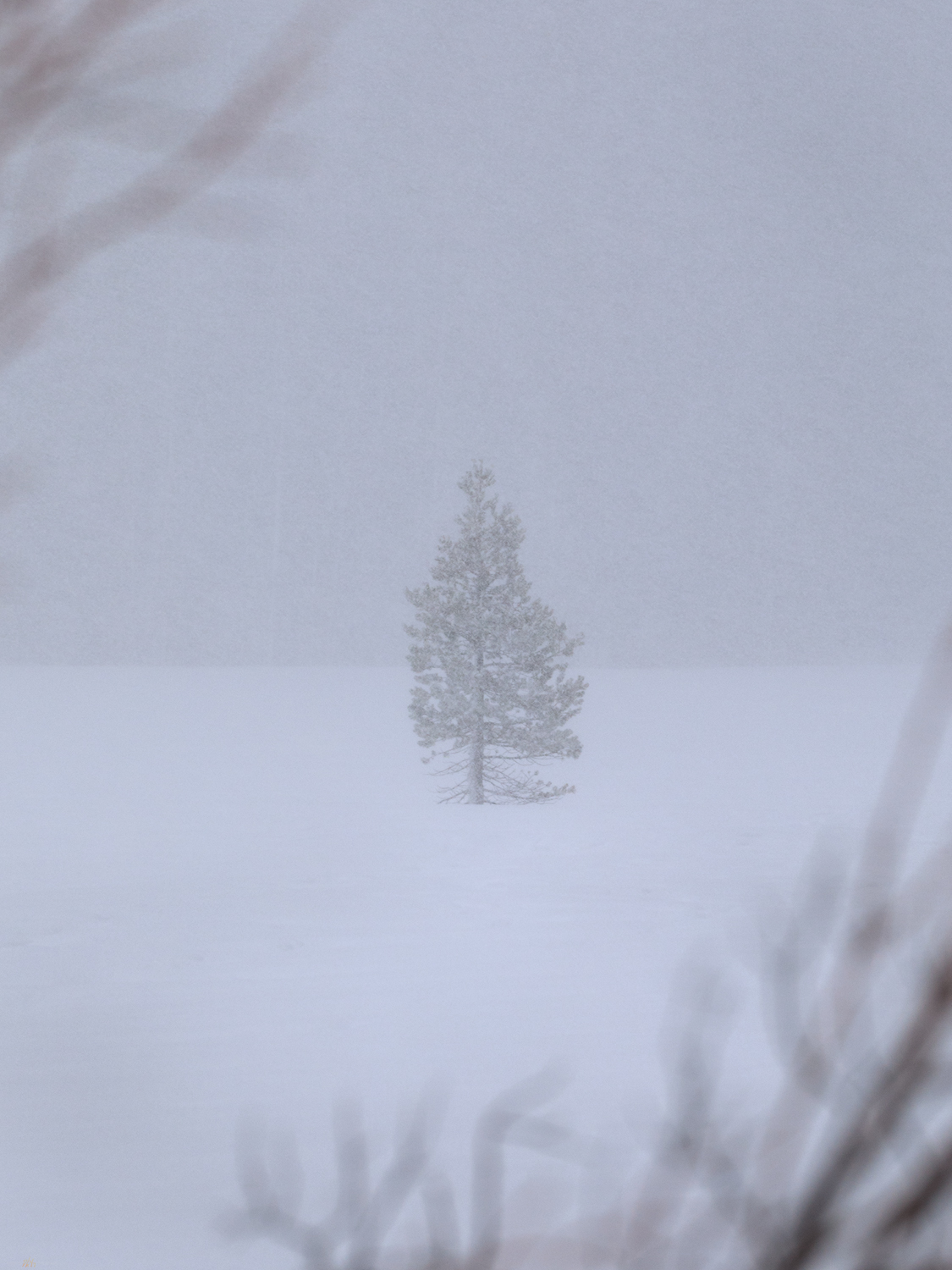
One in the wind

Keep going.

Please respect the natural and cultural resources of our public lands.

#naturefirst #keepgoing

Palouse Photography: A Roadtrip

D. Craig Young · June 17, 2019 · 6 Comments

Although photo workshops can feel like a one-off experience, and often the expense makes it so, it is likely that you will develop a few long-lasting friendships and collaborations during the workshops you attend. And so it was that a group splintered from last year’s Iceland Workshop, and an excursion to the Palouse of eastern Washington gathered. I think Erno sparked the idea, and Jeremy committed to driving from the Midwest. Soon, Quinn and his son Corbin would fill out the team, meeting in Colfax, Washington, for a long weekend of light-chasing and storytelling. Although I typically prefer to photograph on my own, these guys are good landscape photographers and plain fun to travel with; no better way to practice and engage with the iconic wheatfields, buttes, and scablands of the Palouse.

I left StoneHeart after prepping the new field rig with camp gear (just in case) and a short week’s worth of supplies. The stout little Chevy is brand new and we, the truck and I, hit Highway 395 north for its maiden voyage. The weather promised some scattered storms all the way into northeastern Oregon, so I routed through Alturas, California, and Lakeview, Oregon, turning east toward Warner Valley, my haunt through the days of archaeological field schools and a geoarchaeological dissertation. Along with my girlfriend (still my life-long partner almost 30 years later), I spent countless evenings and rolls of Kodachrome 64 photographing sunsets from our camps. Any excuse for a visit.

Warner Valley, the selfie spot. I have a series from here starting in the 1990s.

I dropped off the back of Hart Mountain into some good storms on the dirt roads of Catlow Valley. The furtive skies chased me all the way through Malheur Wildlife Refuge and into the volcanic badlands of eastern Oregon. The day culminated as I went full storm-chaser along a rolling storm-front slashed with lightning and dust-curling winds. I got soaked and humiliated in a plowed field in western Idaho; so very fun.

Storms building at Poker Jim Ridge, Warner Valley, Oregon.

Day 1

After stopping for the night at the Frontier Motel in Cambridge, Idaho, I was ready to head into the Palouse and join the team at Colfax. I checked into the room I would share with Quinn and Corbin, but finding I was the first to arrive, I set off on a scouting mission. I had some ideas for some astrophotography, having run across mention of abandoned buildings here and there.

Ending up rather far to the west, I found a perfect (I hope) lonely building just off a dirt road near Lamont. It is quite far from the hotel, about an hour drive, but it seems accessible and oriented for Milky Way photography. I plotted a late-night visit.

I ended my day’s drive on Steptoe Butte. It is quiet in the afternoon, but it is easy to see why this becomes an iconic spot for photographing the waves of green and gold extending to all horizons below the stand-alone butte. There is a minimum of a dozen shots from Steptoe adorning the hallway walls in the Colfax hotel. It looks like I will soon have some of my own.

Palouse Collection

Erno and Jeremy planned on meeting me on Steptoe Butte for some sunset shots. Time enough to get a run in, so it’s downhill to the gates of the State Park. Thinking I would turn around at the gate to climb back, I soon noted a black Nissan barreling toward me. The occupants of the SUV kindly offered me a ride, so I climbed in, happily greeting my friends, last met in Iceland, as we drove back to the summit for an evening of photography. The sky gave it a bit of a go at sunset, but we spent much of our time working the rolling wheatfields for patterns revealed in the low-angle sun. The Palouse is where intimate landscapes become iconic.

First patterns. Getting the intimate perspective from Steptoe Butte.

Day 2

The early, pre-dawn morning finds us at a twin tree below Steptoe Butte. Because I tend not to look for local images prior to photographing an area that is new to me, I did not realize this isolated tree in a green field would be a local attraction; and yet, we arrived in the blue hour before dawn and were soon joined by several other photographers. I would not call it ‘crowded’, nice folks, but it seemed odd to be on a dirt road along some random field and have cars show up – I am quickly learning these things are not so random. Shooting into the rising sun is always a challenge. A few of us got low looking for the little orbs of dew on the young wheat. I wanted the sun within the split of the trees, though the mass of Steptoe in the background, due to the position of the rising sun in June, was a distraction I could not avoid.

Twin Tree Sunrise.

As the angle of the sun increased into the morning, we decided to head back to the Steptoe summit. Quinn and his son Corbin had arrived and because Steptoe is the local highlight, we had this landmark as an anchor and planned the rest of our day, and much of our visit, around its light. The forecast hinted at storms further south and we hoped maybe they would creep north. This encouraged us to indulge in a broad tour, hunting for colorful scenes and hoping for a thunderhead. We eventually crossed the Snake River and guessed that a turn up Alpowa Creek to gain access to Knotgrass Ridge would get us closer to the storms. We did not have any prior familiarity with these geographic names, just picking hopeful roads on the map.

Chasing squalls. Random roads in the highlands south of the Snake River.

I kept saying that the storms must be down in Oregon, well beyond our drive plans for the day, but the team remained hopeful. We were out of mobile signal so the radar clues we might normally get were not available. It did not matter, near Peola, WA, we hit the squalls – storms on the windshield are closer than they appear. It was a great tour, not a lot of photography, but we were getting the lay of the land. Sunset found us back at the twin trees to see what that might bring. The storm clouds had long subsided and a hazy sunset left us rather unmotivated. We should rest up for some astrophotography.

Is there a Milky Way here?

We would return to the ‘schoolhouse’ I had scouted near Lamont. I knew it would be at least an hour’s drive, but after leaving Colfax at about 10PM, the journey seemed to take forever. I know Erno and Jeremy, in the rig behind me, began to question the sanity of following me prophetically into the scablands. Quinn and Corbin had already had a very long day. The trip seemed short the previous morning, but everything was new then, and I clearly had lost track of time. Now my estimate seemed well short of reality, would it even be worth it? Does the Milky Way even rise over eastern Washington?
Palouse Collection

Finally, I stopped on a dusty road where my GPS showed my earlier plot, ‘house’. There was nothing, apparently, here in the dark. Nothing. The stars looked good and I promised the guys there was a building right over there, and there it appeared in our combined headlamp beams. This might work!

I had some low-level lighting we could use for the interior, but that meant getting inside the ramshackle wood structure. Quinn and I approached the windows, cautiously listening to the rustling wind and to the scratches of scurrying critters inside. I peered across a pane-less windowsill, shining my headlamp into the musty interior. Its narrow beam barely penetrated the darkness.

“Hey Quinn, this looks pretty good,” I said quietly as he came up behind me. “We should…”

A rush of ghostly feathers carrying a pair of large beasts swooped toward my lamp and out the window, I tumbled sprawling into the deep grass and thistles. Or, maybe I was in Quinn’s arms, having defied gravity at the explosion of ill-disturbed owls. The others only heard a youngster’s sharp squeal and then laughter.

“Ok, you go in first.” Quinn started and I followed, stepping over woodrat collections that blocked our path. We got lighting hints from the gallery of Erno, Jeremy, and Corbin, but it would take some back and forth to get the shots we came for.

Owl School. The experience often outdoes the imagery.

In the end, we had a great time, spending a couple hours beneath the Milky Way and growing accustomed to hanging out in the dark of the school to get the lighting set. We were careful to maintain our respect for the property, leaving things just as we found them during our brief visit. Thanks to the owls for letting us use their roost for a while, sorry for the silly disturbance. I hope the team still thinks it was worthwhile.

Palouse Collection

Day 3

We skipped any sunrise shoot, following the late night and early morning return. In the meanwhile, I gouged around the scablands and loess plains of the western Palouse, the pleasure of exploring.

Quinn and Corbin on the trails of Palouse Falls. Watch your step boys.

Our goal for the day became Palouse Falls, another local icon. We spent the late afternoon hiking its trails; it was nice to experience the powerful falls surrounded by columnar basalt buttressing volcanic tablelands. After all my time in the sagebrush steppe of the dry Great Basin Desert, I found it mildly unsettling to observe the constant spill of so much water and power but still be surrounded by sagebrush and volcanic rimrocks. The Humboldt and Truckee rivers, nearer home, might look the same, I imagine, if they encountered a resistant cliff and dropped a few hundred feet. It does not seem possible, but on it roars.
Beyond the falls. I’m not sure if this image ‘works’, but it captures the long wait, lost in thought, above the falls.

I waited for several hours at cliff’s edge in hopes of engaging the falls with the Milky Way arc. I wanted more practice at blending the blue hour landscape with a starry night scene. I need a lot more practice, and the falls, deep in the gorge, do not hold any lasting light. Clouds partially blocked the galaxy core, but I often like a few clouds in my night images. I find that clouds add something unique to an otherwise constant, from our humble perspective, Milky Way.

Day 4

Jeremy letting it in.
Our mobile barrista.

Our final morning shoot was, I believe, our most productive of the trip. Jeremy had scouted some locations yesterday and we left the gravitational pull of Steptoe Butte for a while. Rambling among wind turbines, rolling wheatfields, and abandoned homesteads, we took our time with sunrise, enjoying Jeremy’s hand-ground beans as we brewed coffee on the tailgate. We met Quinn and Corbin later in the morning among the wind turbines; they had camped at the falls.

Erno, sunrise turbines done, processed, posted. What ya’ll been doing?
Wind flower. A blended composite, after watching the turbines for hours.

Palouse Collection

Rolling east. This is the image I had visualized as my creative goal for the Palouse landscape. A favorite from the trip.

We would return to the heights of the butte for our final evening, and the light rewarded us. I think I got the hang of the rolling fields today. First in the morning capturing layers of color toward the horizon, and then, second, from the vantage point of Steptoe. I have several that I like but it is the icon of the Whitman granary that stands out to me.  If only because, every day on this trip, I walked past a very similar—exact? – image outside the hotel room I shared with Quinn and Corbin. Why not have a local icon to remember the great four days among good friends.
Wheatfield icon. Although I walked past this image in the hotel hallway many times, it indeed captures the essence of the Palouse.
Palouse Crew 2019

Day 5

A long day for a nice, thoughtful drive home. Would I return to the Palouse for photography? I enjoy a few of my images, but it is not the kind of area that captures my imagination. I loved the falls, not to capture images of the towering cascade, but its power engaged me, and I particularly enjoyed the patterns of columnar volcanic outcrops (here and everywhere). I would go back on the hunt for summer thunderstorms. I am happy for the journey and the great visit with the team, but the rolling fields are best left on their own. The patterns of the Palouse are wonderful, whether in the good hands of local farmers or on the walls of a hotel. I belong in the desert.

Creviced flow.

Palouse Collection

I bet you’ll enjoy checking out the Istagram feeds of the team; certainly some Palouse highlights there.

Erno @ernogyphoto

Jeremy @jrleder

Quinn @qjkventurephotography

Iceland Day 11: South Coast Return

D. Craig Young · December 7, 2018 · 8 Comments

It was the final day of the Iceland Workshop, and it felt like we had some locations to catch up on. Although the storm had faded, it left a sky that couldn’t decide if it was going to be a backdrop of interest or a curtain of gray. We’d try to make the most of it before heading back toward Reykjavik and the departures at Keflavik.

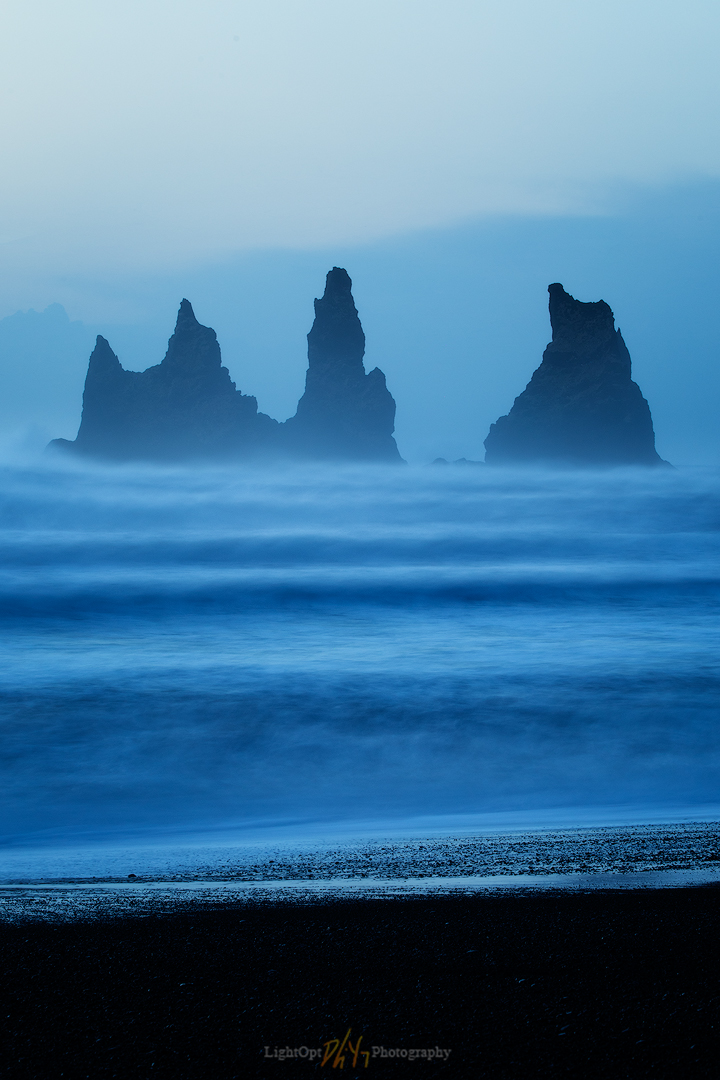
We dropped to the beach at Vik where dawn unfolded. The shore was blue and breezy as wet mist clouded the sea-stack Trolls just off shore. I worked a variety of compositions and played with exposure times, long and short, trying to capture the trolls in their habitat. The muted sunrise kept the scenes somewhat flat, the foamy sea providing the only highlights against the dark rocks. High clouds would bloom with color momentarily, but their distance relative to the rocky subjects made them feel disconnected. I worked hard without much success.

Trolls at dawn. Long exposure at the Black Beach below Vik; stopped down so the long exposure time produced the feeling I wanted. 5 sec, f/18, ISO 100.

Iceland 2018 Collection

I then noticed Jeremy or Erno, can’t recall whom, maybe it was Mike or Quinn, shooting straight down at their feet. The troll scenes had called for the telephoto, so pointing my 100-400mm at the repetitive texture of the perfectly rounded beach gravels, uniformly dark with misty highlights, created a mesmerizing but relaxing composition. I loved it. Here and there, a random red stone highlighted the gray-black clasts, and a wet sheen revealed a self-reflection in each of the million stones. Oddly, one of my favorite compositions of the trip, right at my feet and I might have missed it had others not suggested a look.

One of red, Iceland. Self portraits in the simplicity at my feet.

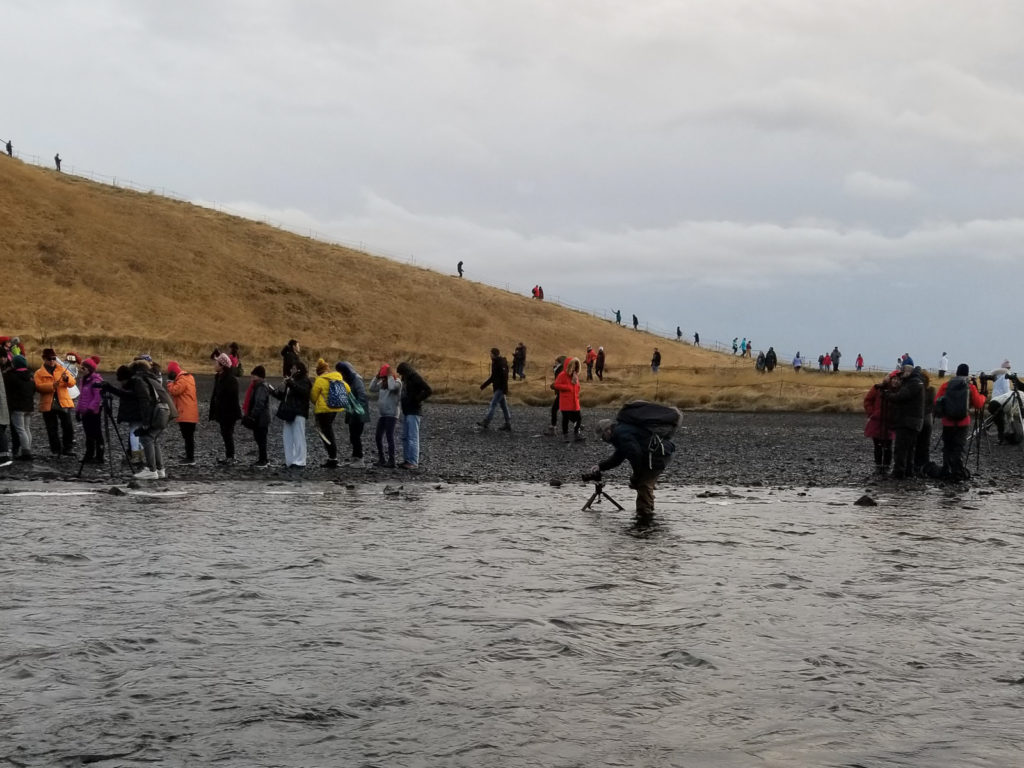
Then came the waterfalls, the icons of the South Coast. Having been a generally rag-tag workshop group operating mostly away from the crowds over the past several days, it was disheartening to pull into the crowds of Skógafoss (I can’t imagine the summer scene). I know we are an element of the crowding and the falls are certainly an accessible attraction, but being surrounded by the bustle of busses and their denizens changed the vibe of the day.

Quinn at his craft; seeing it differently.

The light had turned flat. I waded into the stream to work some foreground rocks and ice into the looming Skógafoss. I could not get the mid-ground figures—sightseers and photogs at the iconic falls—out of my frame. Worse, and all my fault, I did not pay attention to the mist collecting on my lens and all my images were spotty, even though I was happy in the moment with the live view on the camera-back. This haunted me endlessly as I reviewed my waterfall photos later. Nick had warned me, but I didn’t dry the lens often enough. When I did remember, it wasn’t the composition I’d hoped for. When I’d forget, the composition was good. No keepers from Skógafoss!

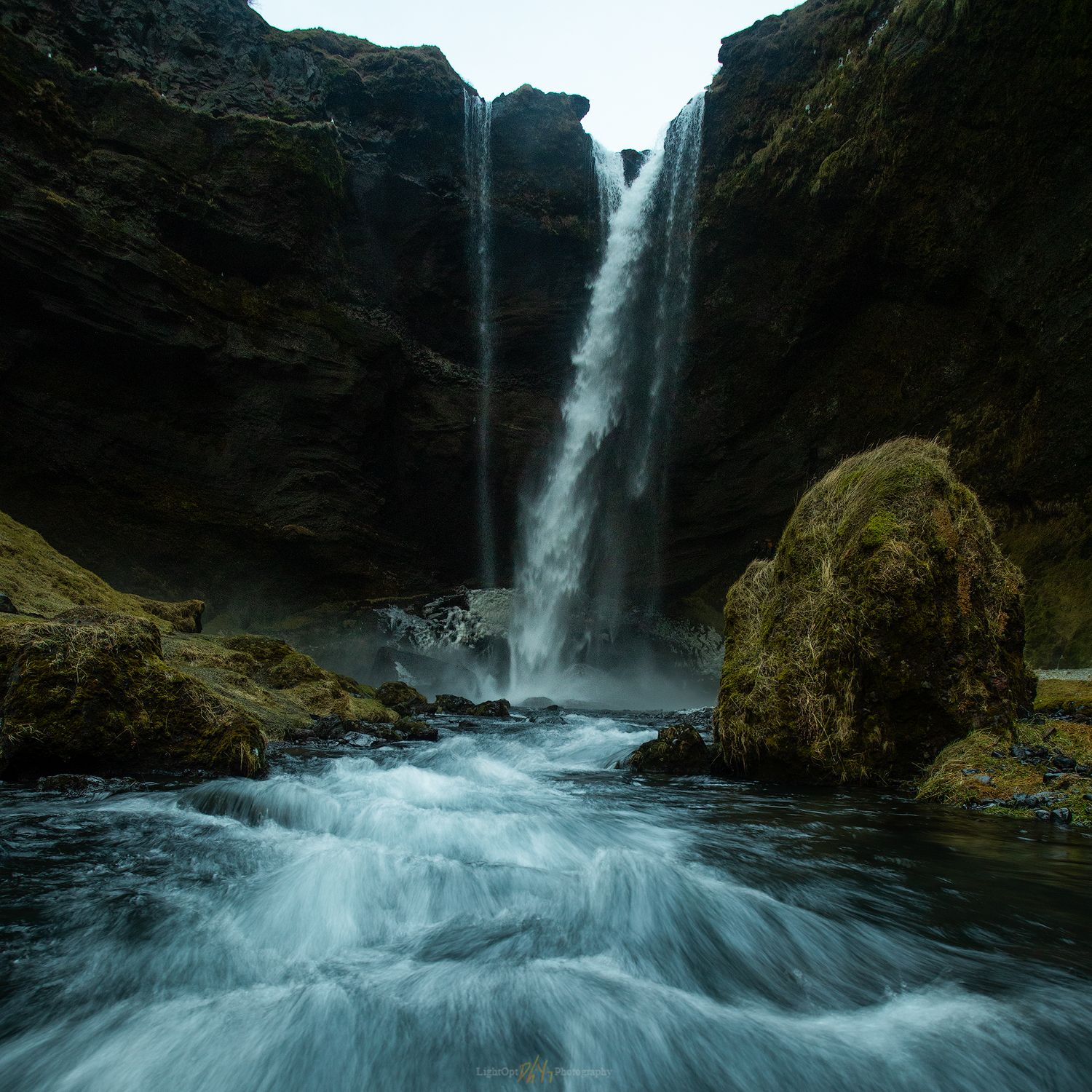
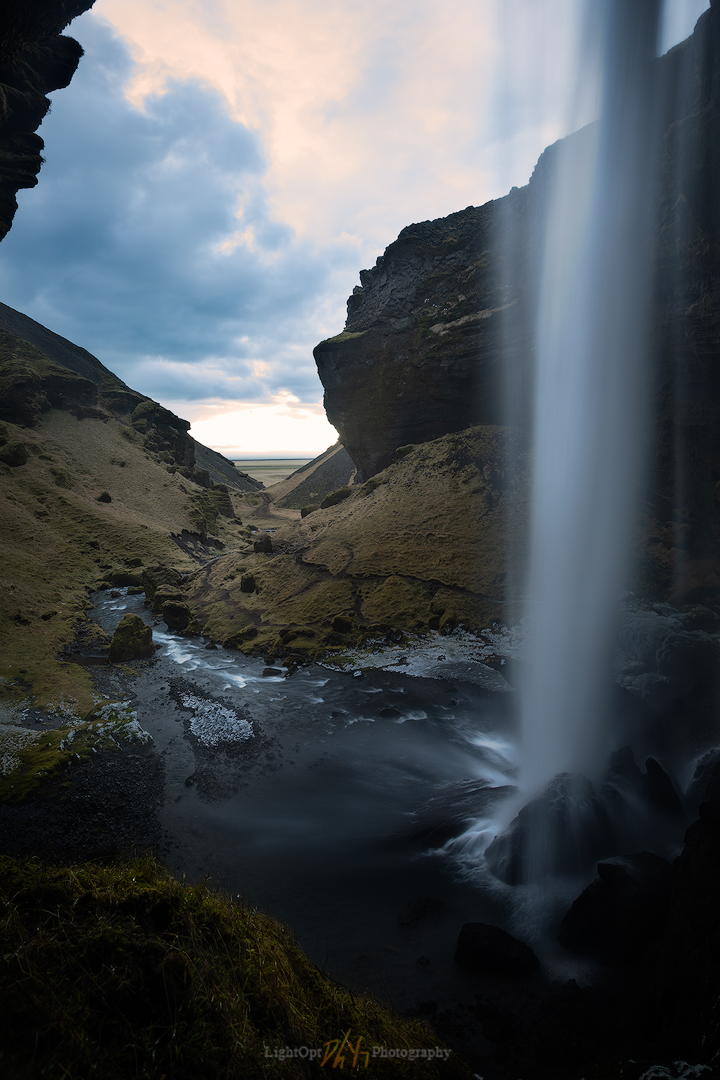
Thor had a better idea. We’d drive a short distance south and hike the similarly short distance to Kvernufoss. It is wonderful how the necessity of a hike allows an escape from crowds—and this was not a long or difficult hike. I got a little mojo back as the walk invigorated our small group, and the sharp falls pouring through a small grotto appealed to me more than the massive curtain-like falls. I waded into the stream to capture the energy flowing at me. It was amazingly fun. Leaving the stream, I climbed along an icy trail behind the falls to gain a perspective I’d never experienced before at any waterfall. Back streamside, I watched from a distance as Ken lost his grip on his Nikon D850. It tumbled toward the rapids, but he and Quinn dove toward the water, Ken grasping the fumbled camera on its last bounce before the water. The two men sprawled on the grassy terrace, water flowing at arm’s reach. That was close!

Portraits at Kvernufoss. Photos by Nick Page.

Capturing Kvernufoss, see below. Photo by Nick Page.
Kvernufoss. Exposure blend to show the power of the falls and its outflow stream; 1/80 sec (falls), 1/6 sec (stream), f/8, ISO 320.
Behind the falls. A difficult perch in cold mist, a fun shot, 0.3 sec, f/8, ISO 100.

On our short hike back, Quinn and Jeremy scattered along a field to get a composition of a languid Icelandic pony. The horse was pretty far off, but their effort established the idea of looking for some close-up horses to photograph. I think plenty of folks were hoping to capture a few pony images so we were soon traversing some side-roads and approaching small herds grazing in winter pastures. The afternoon light was kind to our group and several folks took to it happily. However, we soon realized our light was fading on our last day and we had at least another iconic waterfall to visit. So, with a little more scurrying we were soon at Seljalandsfoss. This typically popular spot wasn’t too busy in the fading evening and I was able to wander the paths and enjoy the light. Ice coated the viewing platforms and, in one exhilarating moment, Randy, Robert, and I found ourselves skating and scrambling for foot-holds, crashing together on the wood planks, tripods skittering. We carefully retreated.

Island pony. Just had to take one, 1/50 sec, f/5.6, ISO 400.
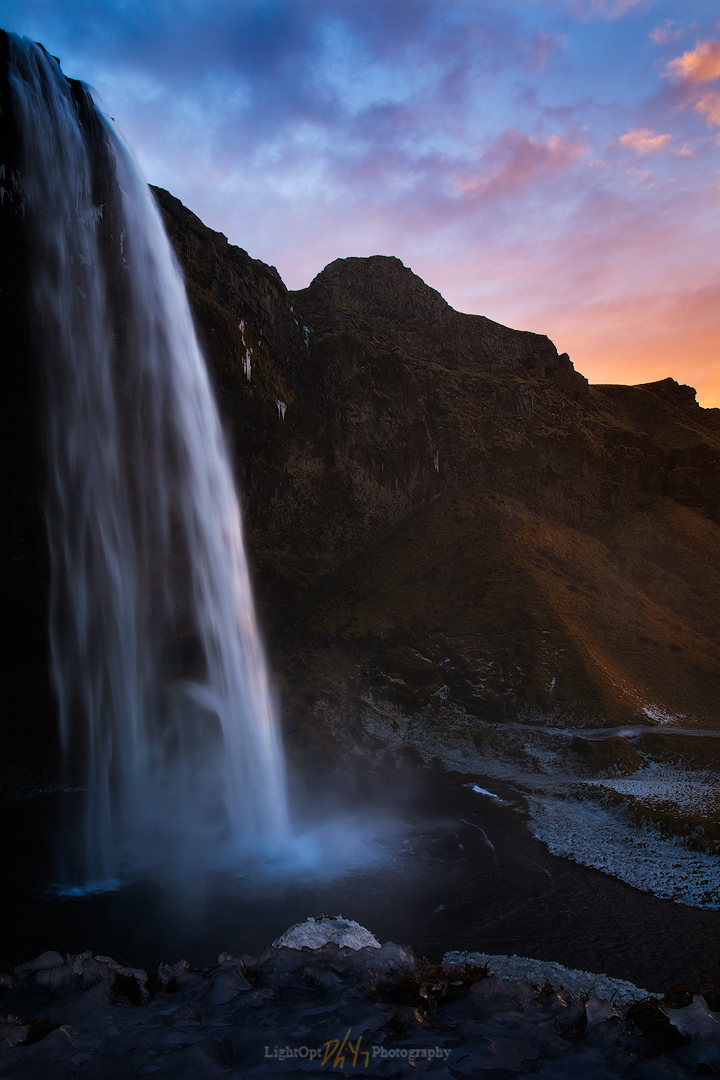
Seljalandsfoss. A frozen deck at sunset, 1/8 sec, f/14, ISO 100.

Iceland 2018 Collection

And then the quiet drive to Keflavik. We’d done a lot on this last workshop day. Maybe too much, trying to fit in several stops and a variety of scenes as we traveled to the end. It was nice to see the sights, and I love my intimate beach gravel image, but it really wasn’t a day for mindful photography. We had experienced many gifts from Snaefellsnes to Vestrahorn; you can’t win ‘em all. That’s a given with photographic journeys. Our group gathered late into the evening at the Keflavik guesthouse, reminiscing and trading stories about future plans. An endless, own-rules snooker game kept Ian and I occupied. Most were soon packed for their stateside returns, but a few of us prepared for one additional excursion to visit an icon. Tomorrow, we were on our way to Kirkjafell.

Keep going.

Iceland Day 8: Jökulsárlón and Diamond Beach

D. Craig Young · December 4, 2018 · 10 Comments

It looked like we had a couple days of good weather ahead and we planned to take full advantage. Although I had no real reason to, given the late sunrise, I was still getting up early, brewing some coffee in the lobby, backing up my remaining SD card, and loading images into my traveling Lightroom catalog. I have a small, portable harddrive tied to my Surface tablet, and I am also keeping all the images on the SD card, at least until it’s full. If I keep this up, I’m not terribly concerned about losing the extra cards—they were empty.

Hali is one of a cluster of simple, nice guesthouses that sit as satellite buildings surrounding a a common dining hall, check-in, and museum; all within a working ranch above the coastline. Our building has a common area with a few amenities, coffee, tea, and plenty of nightly beer. It is here that we gather morning and evening to share processing tips, strategize for the coming days, and basically get to know each other. The group has bonded nicely, and it’s good to have a few nights in one place.

We drive up to breakfast and as we exit the van, Thor tells me a stranger left him a voicemail last night. He says that an American couple he talked with during our shoot at the Solheimasandur plane wreck had stumbled on my battery bag, remembered Thor Photography, and deduced that some silly person in Thor’s group must have left it behind. And, it turns out, they are basically paralleling our travel route and figure we can easily cross paths in the coming days. You might think this would call for the cliché of “only in Iceland”, but I’ve experienced random, yet purposeful, acts of kindness—often revolving around my losing bits of gear—from the islands of Fiji to the jungles of central Africa. People are good.

Diamond Morning. Cool light of early morning and first shots at Diamond Beach.
Diamond delivered. I am reminded of Racetrack Playa, Death Valley, USA.

Iceland 2018 Collection

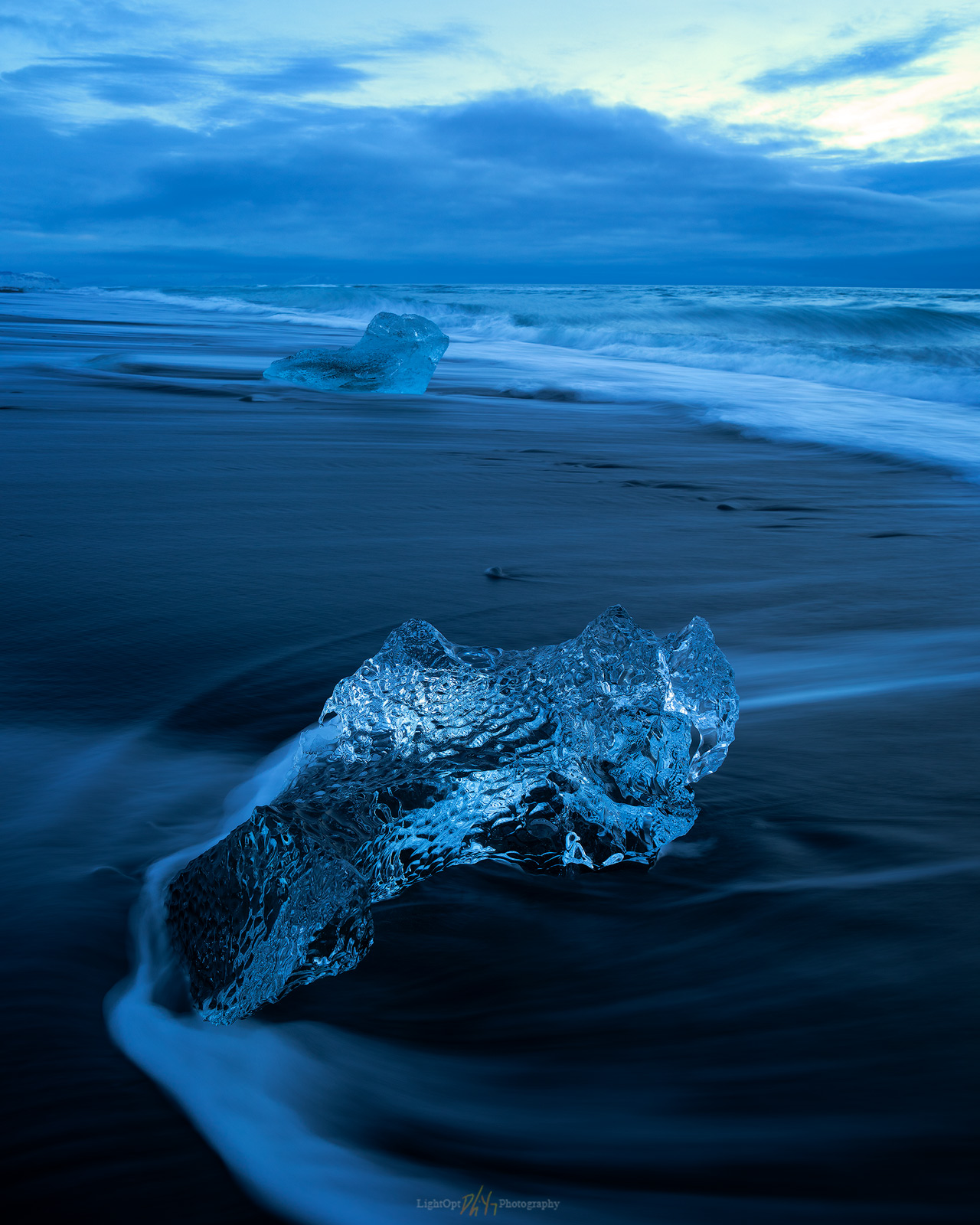
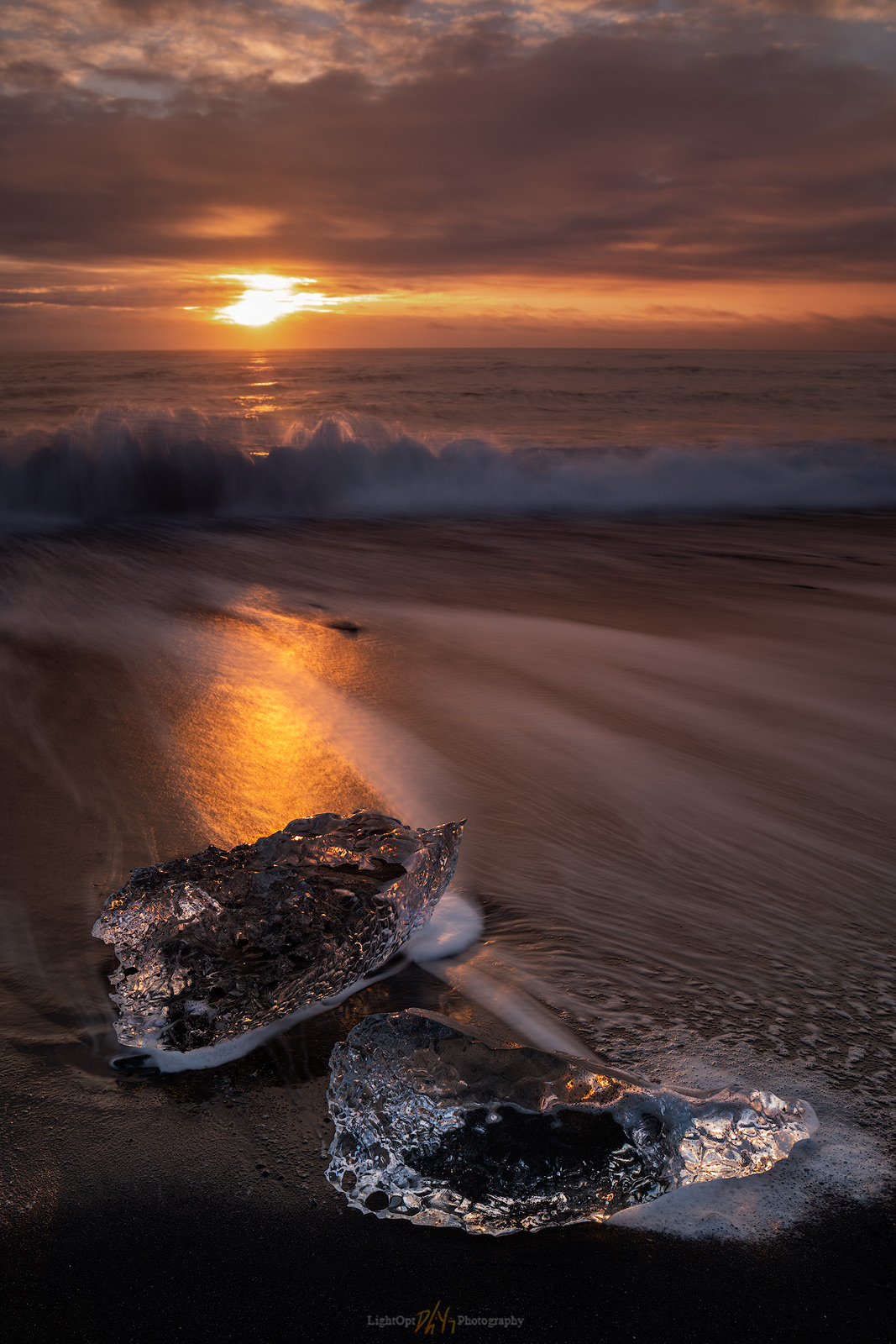
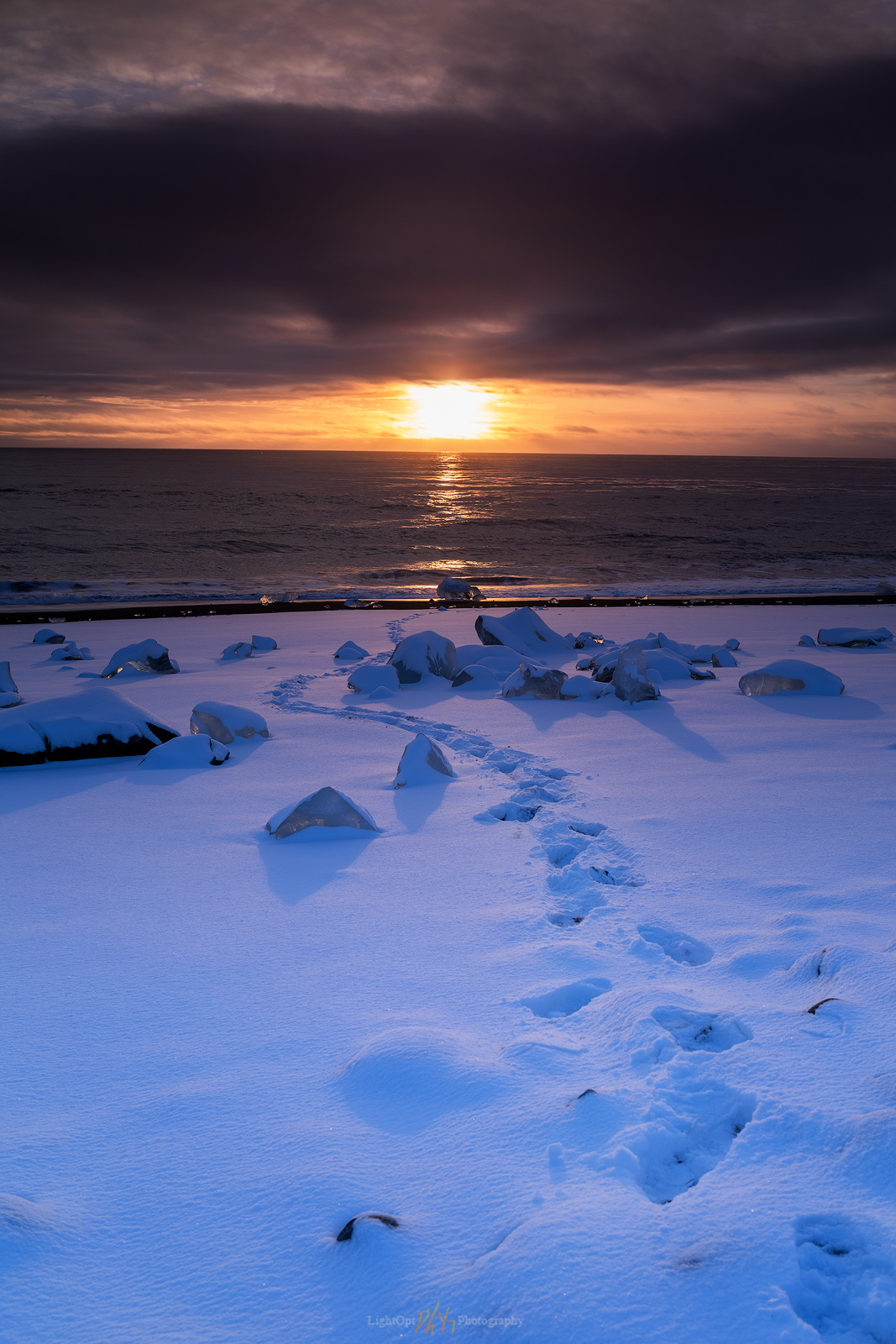
Today we focused on Diamond Beach at the outlet of Jökulsárlón. The dawn was cloudy, cool blue and grey, but breaks in the clouds teased of goodness to come. We huddled at the van with Nick and Thor for some general tips for shooting on the beach; I think these guys knew the group would soon be scattered along the beach like children at an egg-hunt. The black beach with its lag of glacial chunks and shards is one of the icons of the South Coast. I had of course seen several videos and many images documenting the multi-faceted, crystalline remnants of wave-polished ice, in sizes from bergs to tumbler cubes. Yet, it is difficult to grasp the scale and simple beauty of the setting until you begin to wander among the diamonds. A fresh coat of snow added contrast and drama to the black shoreline and its scattered crystals. We readily and greedily dispersed.

The ebbing tide and a debouching stream pull glacial bergs from Jökulsárlón, and the slowly melting ice rolls into long-shore currents to be distributed by curling waves along the black beach. Gathering and focusing the ambient light, the little bergs of ice glow against the darkness of volcanic sand. As usual, arriving before dawn, we had the beach to ourselves; remember, in the Instagram era iconic is synonymous with crowded—we were ahead of (or behind) most of the crowd, yet again. We also had the good fortune of fantastic conditions. The fickleness of storms and currents can either pack the shore with ice, creating a mish-mash of shapes and clutter, or strip it bare, leaving a simple, curving and empty beachline. It was practically Goldilocks day, just right—actually, just perfect.

Forward ebb. Apparent motion in the waves of sunrise.

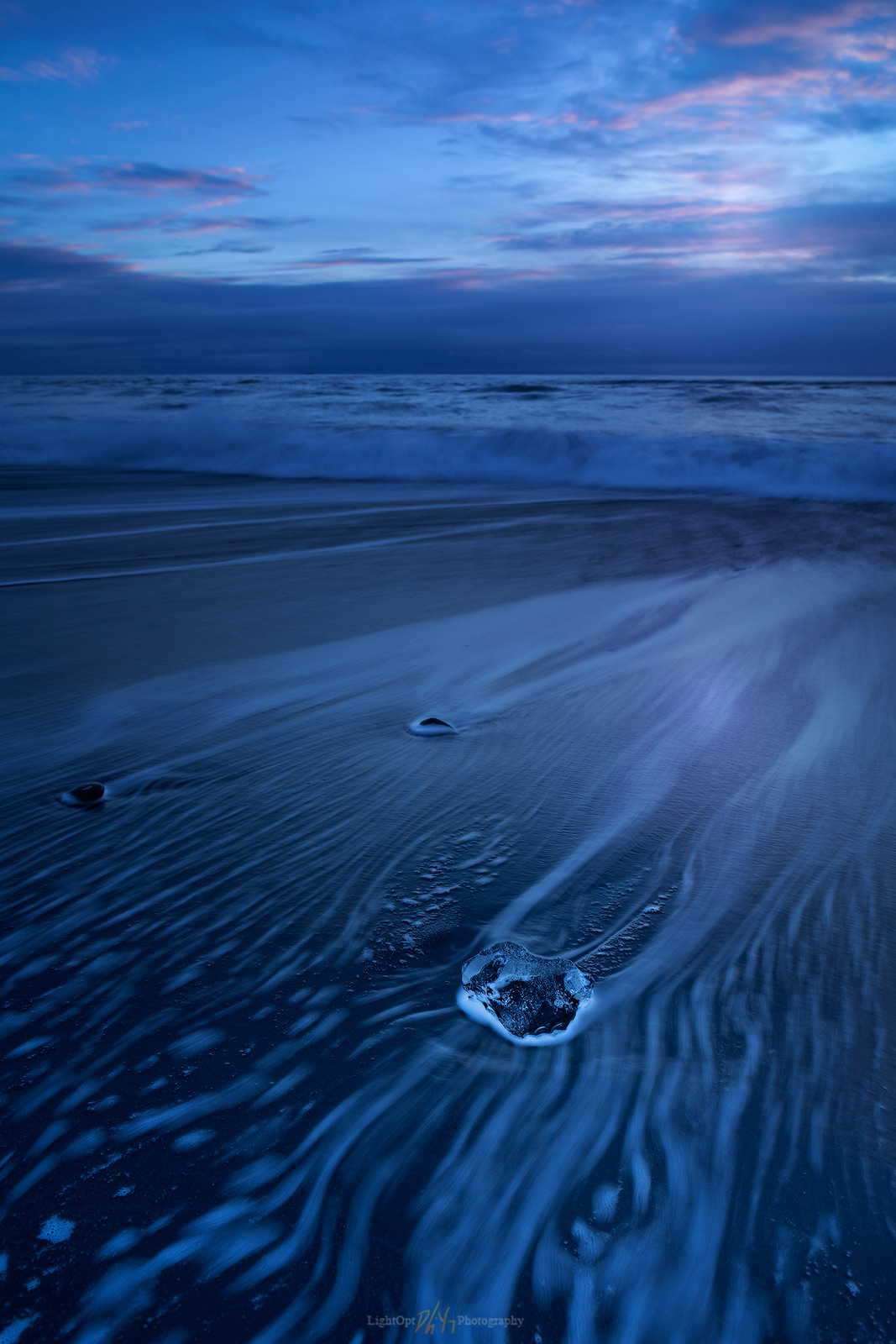
Although it is an iconic shooting location, it’s first and foremost a seascape with ice. This means, unlike many icons, it is dynamic and every shot is different. However, there are basically three common compositions: 1) splashy waves surrounding and retreating around emerging bergs; 2) dramatic otherworldly crystals lit by the winter sun; and 3) intimate images of a lonely diamond on black sand. Or some slight variation on these. Several us dispersed far up the beach as the crowd grew near the easy walk-in spots. I shot in burst mode, capturing the interaction between various shapes of ice and incoming and outgoing waves. Even with intimate scenes of a single crystal, its interaction with a framing, foamy surf can make or break a potential keeper image. Getting up close, down low, and purposefully identifying the subject improve any of the three basic compositions significantly. Of course, these means getting familiar with the surf, occasionally getting into it, or even getting surprisingly soaked by it. We came prepared to get wet, and it was great fun.

Wave escape. In close with a small berg.
Diamond classic. Watching this unfold in-camera and in processing simply stunned me.

We took a break for lunch. Or we didn’t. Maybe. The conditions were so good we may have simply kept going. The day was so good I honestly can’t recall what we did, if it was something other than finding new compositions and taking advantage. I do know we eventually moved inland to the lagoon—basically across the highway, where we watched a practically endless, golden-hour sunset emerge from a cloudless sliver on the horizon. Um, Goldilocks had grown up and was now lording over us—it’s not just-right, it’s wonderland (or is that Alice?). Being daytime, it was the opposite of our aurora show, but I was as gobsmacked today as I was on any previous night.

Standing above. The light continued into the afternoon, rising over Jökulsárlón.
Mist and massif, Iceland

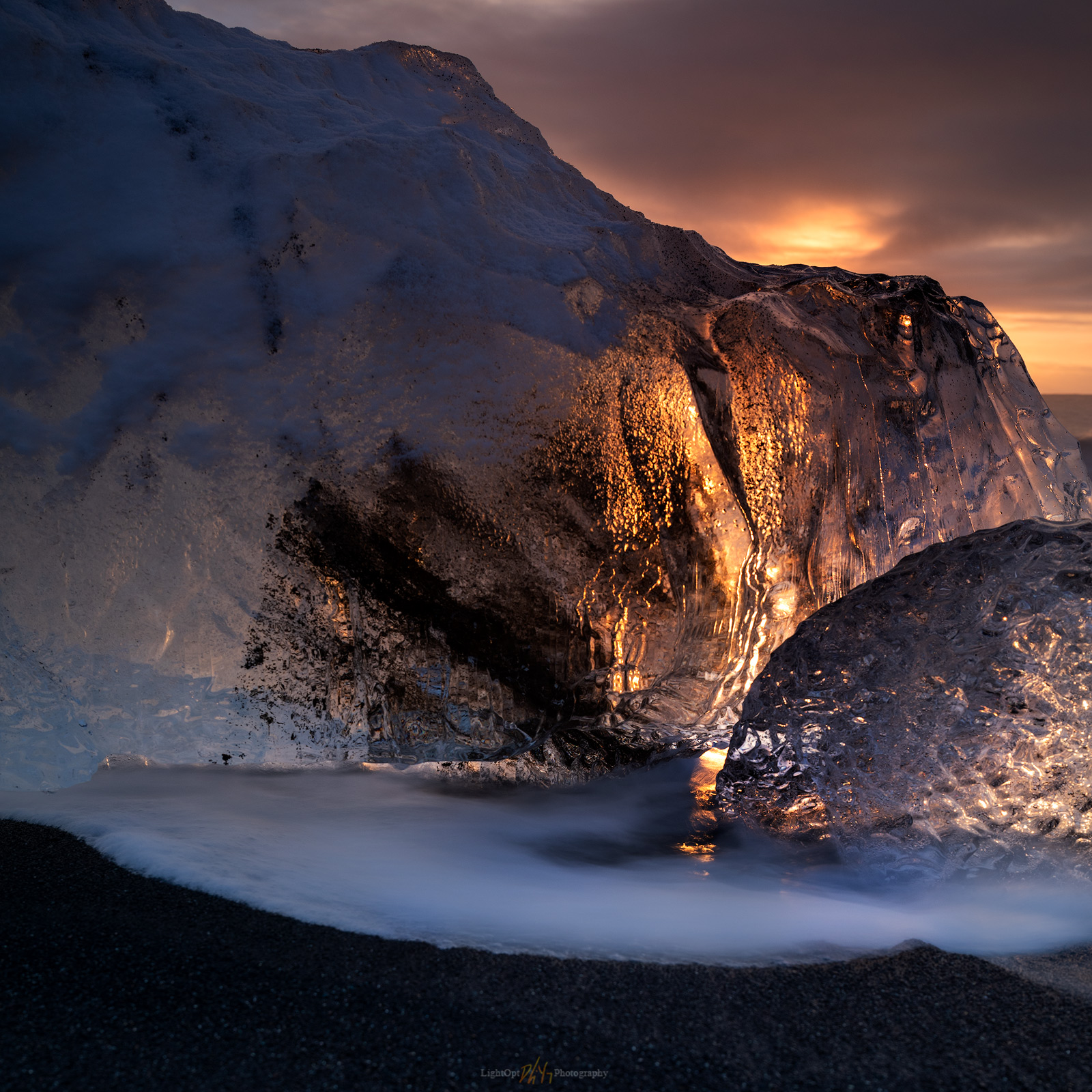
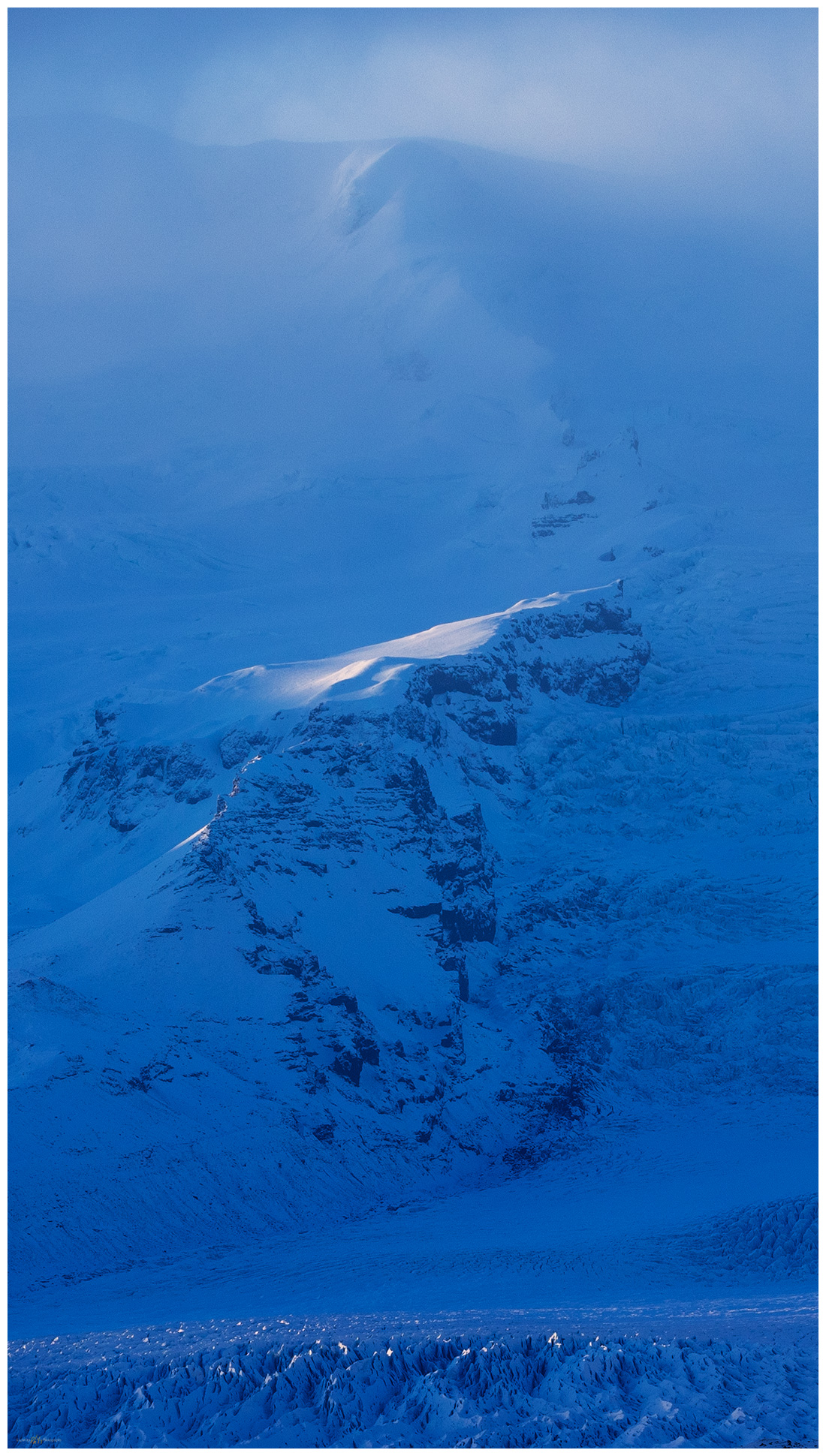
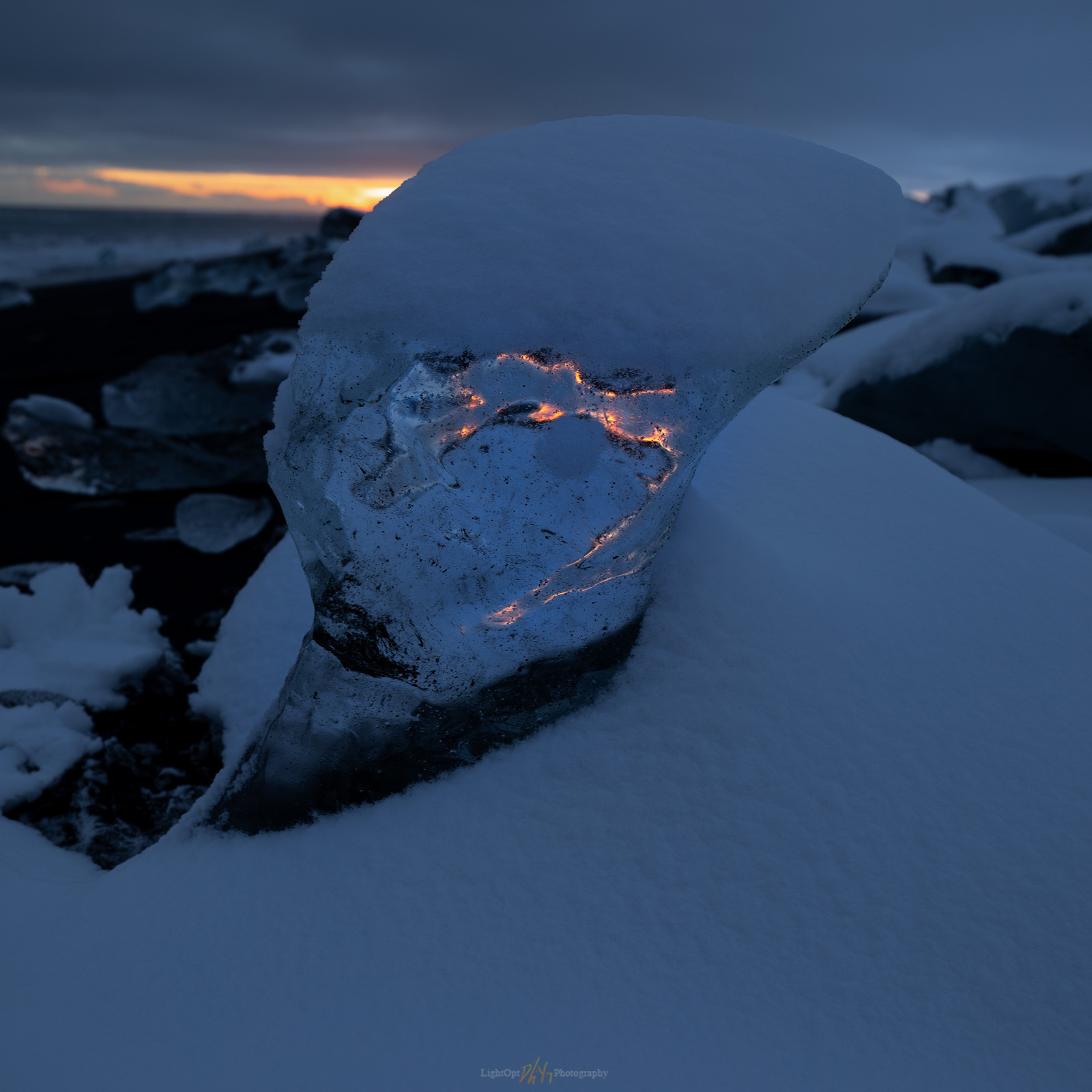
All afternoon I am overwhelmed with mountain scenes rising from Jökulsárlón—I could photograph mountains forever. But soon, I catch Nick motioning to those of us near him, he’s heading back to the beach as the sun settles into the ocean. We had spent the morning capturing the iconic compositions, getting practiced and occasionally successful at the three basics, but his instinct drove him to look for something different, something other than the popular shot. Generously, he shared a glimpse of that instinct and encouraged several of us, those of us within earshot and anyone he came across, to think about how the last light would interact with some of the snow-covered bergs higher on the beach. Maybe, by considering this, we’d get something unique to add to our successful morning. It is a common instructional tool, “look for something different”, but this was in real-time, with perfect conditions that where somehow improving, if only in the last breath of light.

Leaving light. Finding fresh snow at day’s end amazed me.
Fire within. Seeing and feeling the difference.

Nick Page’s Photographing Iceland video

Did I translate his wisdom successfully?  I think so. Is it truly unique? That’s unlikely. However, it’s definitely not the million-in-a-million images of the ice at Diamond Beach (as enjoyable and compelling as those are individually). Maybe it’s unique in a hundred-in-a-million sense. Regardless, it was about  knowing (or learning) to see something new, even if you’ve only been in the perfection of the icons and diamonds for a day. Thanks Nick.

Iceland 2018 Collection

Keep going.

Iceland Day 7: Vik to Vestrahorn

D. Craig Young · December 3, 2018 · 2 Comments

It’s a drive day. Forecasts called for a good twenty-four hours or so before the next storm, so the plan was to position ourselves further east along the South Coast, setting a base to explore the region as conditions change. I was up early to pack.

I have a pretty simple system in two bags. One large duffle for personal gear —an ancient watertight Patagonia bag that’s been from Lake Baikal to Fiji to Central Africa—and my camera pack. I have a smaller pack that fits in the duffle for foul-weather outerwear and waders; I usually just stow it in the van so it’s at arms-reach when necessary. My camera bag is bit on the large side, but I’ve yet to wean myself from carrying two too many lenses, and here in Iceland I’m carrying an extra camera body, just in case. The pack is almost heavy, but it’s not too bad. I also have some filters and a bag of extra batteries for the cold…  Hold it… No, you’ve got to be kidding me…  Where is the battery bag?  The top pouch on my pack, where it typically rides, is wide-open—no bag, no batteries. That also means no back-up SD cards.

Iceland 2018 Collection

The bag and batteries are on the beach next to the plane at Soldheimasander. I can see it happening. I swapped batteries in the dark, proud of my no-headlamp maneuver, and dropped everything back in the appropriate pouch. Without the final zip—as always, so embarrassing. When, later, I grabbed the pack and flopped the top pouch in place, out dropped the battery bag. A black battery bag, in black of night, on a black beach.

I sit back on the hotel bed and consider my options. Go now, wake-up Thor to drive out in the dark before or during breakfast? He’d do it; he’s a nice guy. Maybe I will see if the group wants to go back to the plane for sunrise photos? Neither dramatic nor surreal, no way it lives up to anything like last night, just a broken plane on a barren beach some distance from actual light-catching surf. They’d do it, they’re nice people. Either option, however, puts undo burden on all of us, and we’ve a long drive planned for the day. I’ll just forget about it. I’ve still got two batteries and two SD cards plus a back-up drive. It’s my offering to the aurora, trolls, elves, and some lucky tourist who can use four Canon batteries and a few hundred gigs of storage. Spit. At breakfast, I quietly mentioned my idiocy to Thor and a few teammates, mostly because it had now grown funny to me. But we also had a few other nights of aurora photography coming up (hopefully), therefore, lesson learned: everyone double-check your gear as we leave location. I could see Thor pondering the same recovery options I’d already dismissed, so I insisted we stick to the current plan and we loaded into the van. Actually, what was Thor pondering? He’s a Canon shooter. He’s got friends around here. He could always use more batteries. Too easy.

Sunrise at Vik. Sunrise panorama at Vik í Mýdar and the sea-stacks of Renisdrangar.

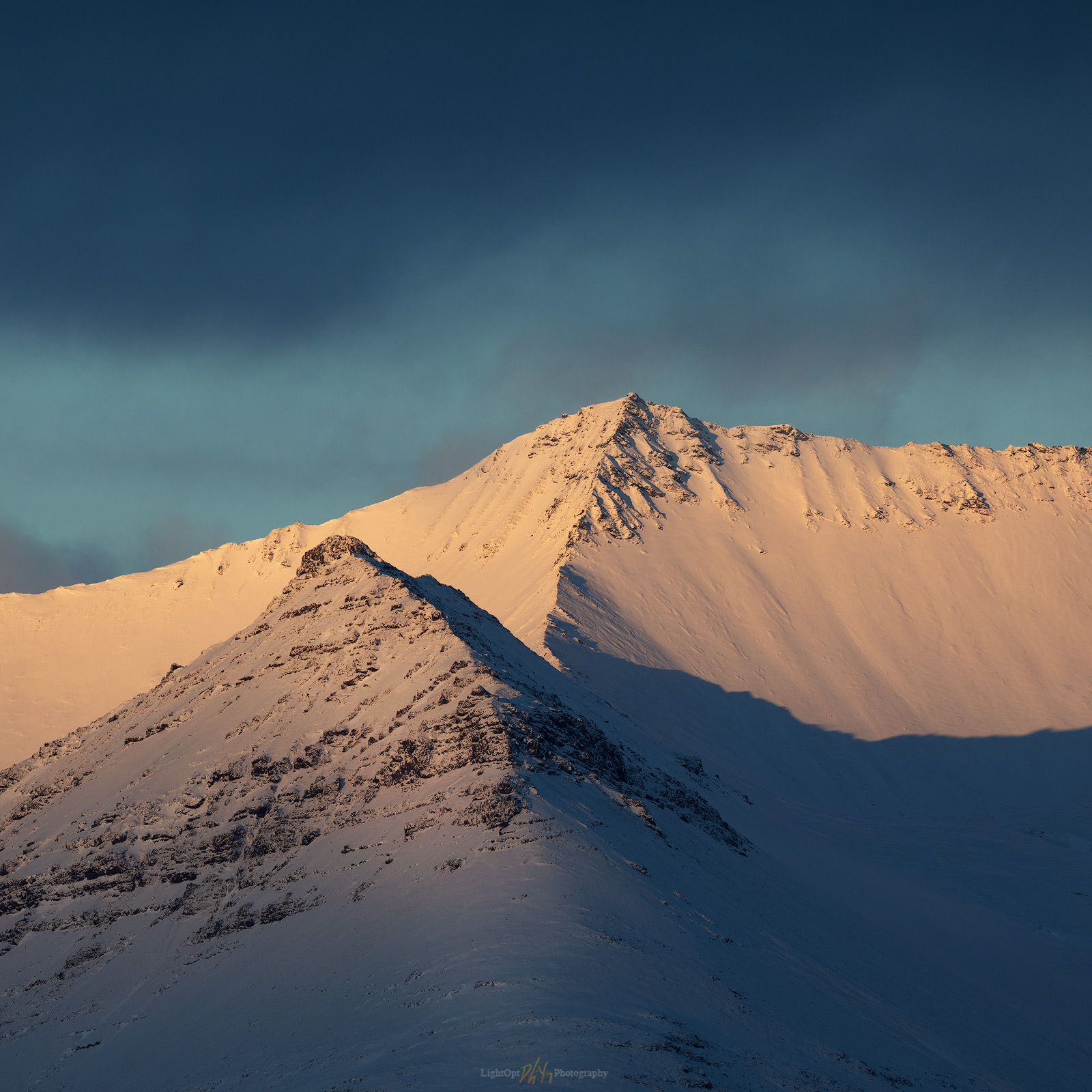
After the stormy drama of our first sunrise shoot, catching the calm sunrise at Vik í Mýdar was somewhat anticlimactic. The skies were crystal clear and the scene was beautiful, but I could not decide what to shoot. Overlook shots need some clouds to get some depth and interest. The volcanic outcrop above the village is striking and leads to the abrupt coastline and rocks stacks at Reynisdrangar. There’s a pretty church in the foreground, but after black church, this one isn’t compelling to me. I’m drawn to the rugged mountains rising to the east with long colluvial aprons, landslide scars, and summit crags. But now I miss the intensity of the scudding clouds and dramatic wind. Silly me. In the cold, we watched a vanload of tourists (like us) set up their tripods on the grass (like us), frame identical compositions (like us), and capture images (like us). But they were still in their van (so not like us). Seems each one, before returning to their seats, set an interval timer, leaving their lonely cameras to continuously snap photos of the slightly changing light. It went on, I’d guess, after we’d packed up and hit the road. They may still be there.

Aprons of Vik. Colluvial apron below the crags of Vik.
Remnants. Volcanic flows and tuffs at Vik.

For the second day in a row, we drove the ring-road through the extended golden hour. Glaciers crumbled from mountain ridges. Waterfalls debouched from every cliff. It almost didn’t matter, we were now aurora addicts, the Kp index was good, and we wanted the Vestrahorn tonight.

The light faded as we arrived at the iconic Glacial Lagoon. This wasn’t our planned destination, but we made time for a recon, as we’d planned a full day in this area tomorrow. I’d seen many scenes—English is hard—from the lagoon but the scale was hard to take in. The glacier was far away and the jumble of icebergs and crystalline ice-shards in the tidal outlet of Jökulsárlón was chaotic. I’m glad we had this opportunity to scout the location even in the fading blue light of evening.

Jökulsárlón blue. Ice of Jökulsárlón against the backdrop of Breiðamerkujökull.
Ripples

We checked in at Hali Country guesthouse, near Glacial Lagoon, and fueled up for another night out. Beer, fish and lamb, coffee. We had developed a definitive pattern. The caffeine soon faded, however, and the next couple hours, once again in the van, passed quietly. Thor eventually left Highway 1 and steered us onto a dirt road where a small group of buildings, the Viking Café, soon appeared in the headlights. Providing the necessary fee, we passed through a simple gate, Nick following close behind. We were at the frozen tidal pool of Stokksnes, the prominence of Vestrahorn rising to the north.

Spires at Vestrahorn
Coming change

Iceland 2018 Collection

We gathered on an expanse of ice just as the glow greeted us yet again—this was three nights in a row. Not a record by any standard, but we were fretting and responding to storm warnings as our journey began a few short days ago. We could only dream of this good fortune on our first wind-driven night. The ice at our feet mirrored the distant sky, spreading the luminescence of the aurora rising above Vestrahorn. We critiqued the performance, better and worse, like the light-show connoisseurs we now were. The curtains and spires of light were subtler than the displays of previous nights, but, for me, the natural setting provided so much more. I stood heartily awed and peaceful, once again laughing aloud at the spectacle. This wasn’t a church, or a plane, it was the stage where aurora has danced forever, in the mountains where longitudes collide.

Keep going.

  • « Go to Previous Page
  • Page 1
  • Interim pages omitted …
  • Page 12
  • Page 13
  • Page 14
  • Page 15
  • Page 16
  • Interim pages omitted …
  • Page 19
  • Go to Next Page »

Trail Option

Copyright © 2026 · Monochrome Pro on Genesis Framework · WordPress · Log in

  • Contact TrailOption
  • Substack
  • Waypoints Bibliography
  • Young Archives